
Albert Einstein — The Physicist Who Reimagined Space, Time, and the Universe
Einstein's special and general theories of relativity, the photoelectric effect, and E = mc² transformed humanity's understanding of space, time, gravity, and energy. In 1999, Time magazine named him Person of the Century.
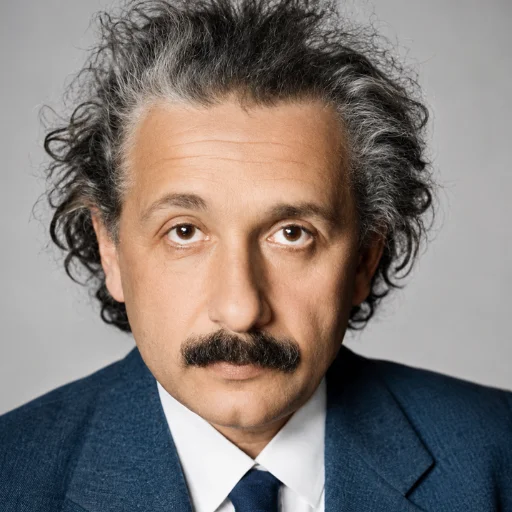
Quick Facts
- Full Name
- Albert Einstein
- Born
- 14 March 1879, Ulm, Kingdom of Württemberg, German Empire
- Died
- 18 April 1955, Princeton, New Jersey, USA (aged 76)
- Citizenship
- German (1879–1896), Swiss (1901–1955), Austrian (1911–1912), German (1914–1933), American (1940–1955)
- Fields
- Theoretical Physics
- Institutions
- Swiss Patent Office Bern, University of Zurich, Charles University Prague, ETH Zurich, Prussian Academy of Sciences Berlin, Institute for Advanced Study Princeton
- Known For
- General Relativity, Special Relativity, E = mc², Photoelectric Effect, Brownian Motion, Bose–Einstein Statistics, Gravitational Waves, Cosmological Constant, EPR Paradox
- Key Publications
- Annus Mirabilis papers (1905), General Theory of Relativity (1915), Relativity: The Special and the General Theory (1916)
- Honours
- Nobel Prize in Physics (1921), Copley Medal (1925), Max Planck Medal (1929), Time Person of the Century (1999), Element 99 (Einsteinium)
- Spouse(s)
- Mileva Marić (m. 1903, div. 1919), Elsa Löwenthal (m. 1919, d. 1936)
- Children
- Lieserl (b. 1902, fate unknown), Hans Albert (b. 1904), Eduard (b. 1910)
- Buried
- Cremated; ashes scattered at undisclosed location
Albert Einstein was a German-born theoretical physicist who fundamentally transformed humanity's understanding of space, time, gravity, and energy. In 1905, while working as a clerk at the Swiss Patent Office in Bern, he published four papers that reshaped modern physics: explaining the photoelectric effect (for which he won the 1921 Nobel Prize), proving the existence of atoms through Brownian motion, introducing the special theory of relativity, and deriving the world's most famous equation, E = mc². In 1915, he completed his general theory of relativity, replacing Newton's concept of gravitational force with the curvature of spacetime — a prediction confirmed by the 1919 solar eclipse observations that made him an overnight global celebrity. He fled Nazi Germany in 1933, settled at Princeton's Institute for Advanced Study, became an American citizen in 1940, and spent his final decades pursuing an unsuccessful unified field theory while advocating for civil rights, pacifism, and nuclear disarmament. His prediction of gravitational waves was confirmed by LIGO in 2015, a century after he made it. In 1999, Time magazine named him Person of the Century.
Childhood and Early Curiosity
The Compass and the Geometry Book
Albert Einstein was born on 14 March 1879 in Ulm, in the Kingdom of Württemberg, part of the German Empire. His parents were Hermann Einstein, a salesman and engineer, and Pauline Koch. Both were secular Ashkenazi Jews. Six weeks after Albert's birth, the family moved to Munich, where Hermann and his brother Jakob founded Elektrotechnische Fabrik J. Einstein & Cie, a company manufacturing electrical equipment based on direct current.
Einstein's parents worried he had a learning disability because he was very slow to learn to talk. But at the age of five, sick in bed, his father brought him a compass. The experience was transformative. Einstein later recalled that "something deeply hidden had to be behind things" — the invisible force that moved the needle sparked a lifelong fascination with electromagnetism.
The second formative experience came at age 12 when he discovered a geometry textbook. A family tutor, Max Talmud, reported that only a short time after giving the boy the book, "he had worked through the whole book. He thereupon devoted himself to higher mathematics. Soon the flight of his mathematical genius was so high I could not follow." Einstein recorded that he had "mastered integral and differential calculus" while still just fourteen. By twelve, he was already confident that nature could be understood as a "mathematical structure."
"At the time he was still a child, only thirteen years old, yet Kant's works, incomprehensible to ordinary mortals, seemed to be clear to him."
— Max Talmud, Einstein's childhood tutor
School Years in Munich
Einstein attended St. Peter's Catholic elementary school in Munich from age five and transferred to the Luitpold Gymnasium at age eight. He excelled at physics and mathematics but was a fractious pupil who found the school's strict rote learning harmful to creativity. He later wrote that such methods were detrimental to genuine understanding.
In 1894, his father's electrical business failed — the company had lacked the capital to update from direct current to the more efficient alternating current system. The family moved to Italy, first to Milan and then to Pavia. Einstein, then fifteen, was supposed to stay in Munich to finish school. Instead, miserable and facing the prospect of military conscription at sixteen, he obtained a doctor's letter releasing him from the Gymnasium and joined his family in Italy. During his time in Italy, he wrote an essay titled "On the Investigation of the State of the Ether in a Magnetic Field" — his first work on the subject that would consume his life.
Switzerland — Education and the Patent Office
The Polytechnic and Mileva Marić
In 1895, at sixteen, Einstein sat the entrance examination for the Swiss Federal Polytechnic School (later the ETH) in Zurich. He failed the general part but performed with distinction in physics and mathematics. On the polytechnic's advice, he completed his secondary education at the cantonal school in Aarau, graduating in 1896. His final certificate awarded him a top grade of 6 (the highest mark) in physics, algebra, geometry, and descriptive geometry.
In January 1896, with his father's approval, Einstein renounced his German citizenship to avoid military conscription. He enrolled in the polytechnic's four-year mathematics and physics teaching diploma programme, acquiring Swiss citizenship in 1901.
Among his fellow students was Mileva Marić, a Serbian mathematician and the only woman in the programme. Over the following years, the pair became study partners, friends, and eventually lovers. In letters to Marić, Einstein wrote that exploring science with her by his side was far more enjoyable than reading alone. They had a daughter, Lieserl, born in early 1902 before they married; her fate remains uncertain — she was likely either given up for adoption or died of scarlet fever in infancy.
Einstein graduated in 1900 but spent nearly two years failing to find a teaching position. He called it a "grim" period.
The Patent Clerk Who Changed Physics
With the help of his friend Marcel Grossmann's father, Einstein secured a position as an assistant examiner (level III) at the Swiss Patent Office in Bern in 1902. His job was to evaluate patent applications for inventions including gravel sorters and electric typewriters. His employers were pleased with his work but did not promote him until he had "fully mastered machine technology."
Einstein and Marić married on 6 January 1903. Their son Hans Albert was born in May 1904.
"That worldly cloister where I hatched my most beautiful ideas."
— Albert Einstein, on the Swiss Patent Office
At the patent office, Einstein spent his free time studying physics and developing theories. With friends Conrad Habicht and Maurice Solovine, he formed the "Olympia Academy" — an informal group that met regularly to discuss science and philosophy, reading works by Poincaré, Mach, and Hume that would significantly influence his thinking.
The Annus Mirabilis — Four Papers That Shook the World
In 1905, a 26-year-old patent clerk with no university position submitted four papers to the journal Annalen der Physik that fundamentally changed physics. He also completed his PhD dissertation at the University of Zurich. The year is known as his annus mirabilis — miracle year — comparable to Newton's plague years of 1665–1666.
The Photoelectric Effect — Light as Particles
Received 18 March 1905, published 9 June. "On a Heuristic Viewpoint Concerning the Production and Transformation of Light" proposed that light consists of discrete packets of energy — "quanta" — rather than continuous waves. Each quantum carries energy E = hf, where h is Planck's constant and f is frequency. This explained why electrons are ejected from a metal surface only when light above a certain frequency strikes it, regardless of intensity. It was for this work — not for relativity — that Einstein received the 1921 Nobel Prize in Physics. The concept was so radical that nearly every physicist, including Max Planck and Niels Bohr, initially rejected it.
Brownian Motion — Proving Atoms Are Real
Received 11 May 1905, published 18 July. This paper explained the random jiggling of microscopic particles suspended in liquid — a phenomenon observed by botanist Robert Brown in 1827 but never adequately explained. Einstein showed that Brownian motion is caused by individual water molecules colliding with the larger particles, and provided a mathematical formula to predict the particles' movements. The paper resolved a decades-long debate: atoms and molecules are physically real entities, not merely mathematical conveniences. Experimental verification by Jean Perrin in 1908 convinced the remaining sceptics and earned Perrin the 1926 Nobel Prize.
Special Relativity — Space and Time Are One
Received 30 June 1905, published 26 September. "On the Electrodynamics of Moving Bodies" reconciled a fundamental conflict between Maxwell's equations and Newtonian mechanics. Einstein built his theory on two postulates: the laws of physics are the same for all observers in uniform motion, and the speed of light in a vacuum is constant regardless of the motion of the source or observer. The consequences were revolutionary: space and time are interwoven into a single four-dimensional fabric called spacetime. A moving clock ticks more slowly (time dilation). A moving object contracts in its direction of motion (length contraction). There is no absolute simultaneity. The concept of a luminiferous aether was declared superfluous.
E = mc² — Mass Is Energy
Received 27 September 1905, published 21 November. "Does the Inertia of a Body Depend Upon Its Energy Content?" contained the most famous equation in physics. Energy (E) equals mass (m) multiplied by the speed of light (c) squared. Since c = 299,792,458 m/s, even a tiny amount of mass corresponds to an enormous quantity of energy. A single kilogram of matter, if fully converted, contains approximately 9 × 10¹⁶ joules — equivalent to the energy released by 21 megatons of TNT. This insight would ultimately underpin nuclear energy and nuclear weapons, though Einstein himself did not foresee these applications at the time.
From Patent Clerk to Professor
Academic Career Across Europe
Einstein's 1905 papers brought him increasing recognition. In 1908, he became a Privatdozent at the University of Bern. In 1909, an admired lecture at the University of Zurich led to an associate professorship there. He was promoted to full professor in April 1911, taking a chair at the German Charles-Ferdinand University in Prague, where he produced eleven research papers.
In July 1912, he returned to ETH Zurich as professor of theoretical physics. In the spring of 1913, Max Planck and Walther Nernst visited him in Zurich to lure him to Berlin with an irresistible offer: membership in the Prussian Academy of Sciences, the directorship of the planned Kaiser Wilhelm Institute for Physics, and a professorial salary with no teaching duties. Einstein joined the Academy on 24 July 1913 and moved to Berlin on 1 April 1914.
His second son Eduard had been born in July 1910. By 1912, Einstein had begun a relationship with his cousin Elsa Löwenthal. When Mileva Marić discovered the affair shortly after moving to Berlin with him in April 1914, she returned to Zurich with both sons. They were divorced on 14 February 1919. As part of the settlement, Einstein agreed to give Marić the Nobel Prize money if he won — which he did two years later.
The Road to General Relativity Begins
In 1907, Einstein formulated the equivalence principle — the insight that an observer in free fall cannot detect a gravitational field. This was the starting point for a ten-year effort to extend special relativity to include gravity. In 1911, he published a preliminary calculation of how gravity would bend light passing near a massive body. His friend Marcel Grossmann helped him master the Riemannian geometry needed to describe curved spacetime.
General Relativity — Gravity Is Curved Spacetime
Ten Years of Struggle
"Years of anxious searching in the dark, with their intense longing, their alternations of confidence and exhaustion and the final emergence into the light."
— Albert Einstein, on the decade leading to general relativity
Einstein spent entire years pursuing blind alleys before finding the correct mathematical framework. On 25 November 1915, Einstein presented the completed field equations of general relativity to the Prussian Academy of Sciences. One week earlier, on 18 November, he had shown that the theory correctly predicted the anomalous precession of Mercury's orbit — an unexplained deviation of 43 arcseconds per century that had baffled astronomers since 1859.
What General Relativity Says
General relativity replaced Newton's concept of gravity as a force acting at a distance with a geometric description: massive objects curve the fabric of spacetime, and other objects follow curved paths through that warped geometry.
"Spacetime tells matter how to move; matter tells spacetime how to curve."
— John Archibald Wheeler
The theory predicted phenomena that Newton's gravity could not: the bending of light by massive objects (gravitational lensing), the slowing of time in strong gravitational fields (gravitational time dilation), the existence of black holes, the expansion or contraction of the universe, and gravitational waves — ripples in spacetime caused by accelerating masses.
The Cosmological Constant
In 1917, Einstein applied general relativity to the universe as a whole. His equations predicted a dynamic universe — either expanding or contracting. Since observational evidence for expansion was not yet available, Einstein introduced a "cosmological constant" (Λ) to force the equations to yield a static universe.
When Edwin Hubble discovered the expansion of the universe in 1929, Einstein abandoned the cosmological constant, reportedly calling it his "biggest blunder" — though astrophysicist Mario Livio has cast doubt on whether Einstein actually used those words. In a twist of irony, the cosmological constant was revived in 1998 when observations of distant supernovae revealed that the expansion of the universe is accelerating, driven by a mysterious force now called dark energy. The cosmological constant remains part of modern cosmology.
Instant Celebrity — The 1919 Eclipse
Eddington's Confirmation
General relativity predicted that starlight passing close to the Sun would be deflected by 1.75 arcseconds — twice the value predicted by Newton's gravity. A total solar eclipse on 29 May 1919 provided the opportunity to test this. The British astronomer Sir Arthur Eddington led expeditions to Príncipe (off the coast of Africa) and Sobral (Brazil) to photograph stars near the Sun during the eclipse.
On 6 November 1919, the results were presented to a joint meeting of the Royal Society and the Royal Astronomical Society in London. They were consistent with Einstein's prediction. The next day, The Times of London ran the headline: "Revolution in Science — New Theory of the Universe — Newtonian Ideas Overthrown." Einstein became an overnight global celebrity — "perhaps the world's first celebrity scientist."
The Nobel Prize (1921)
In 1922, Einstein was awarded the 1921 Nobel Prize in Physics "for his services to theoretical physics, and especially for his discovery of the law of the photoelectric effect." The Nobel committee avoided endorsing relativity, which some physicists still regarded sceptically. The citation did not even assent to Einstein's notion of the particulate nature of light.
As part of his 1919 divorce settlement, the Nobel Prize money went to his first wife, Mileva Marić.
Einstein married Elsa Löwenthal in 1919. He was elected a Foreign Member of the Royal Society in 1921 and received the Copley Medal in 1925.
World Tours and Fame
Einstein's celebrity brought invitations from around the globe. In 1921, he toured the United States, meeting President Warren Harding at the White House and lecturing at Columbia University and Princeton. In 1922, he spent six months touring Asia — Japan, Singapore, and Sri Lanka — meeting Emperor Yoshihito at the Imperial Palace while thousands thronged the streets. He spent twelve days in Mandatory Palestine, where the British High Commissioner welcomed him with a cannon salute. In 1925, he toured South America, spending time in Brazil, Uruguay, and Argentina.
"They cheer me because they understand me, and they cheer you because no one understands you."
— Charlie Chaplin to Einstein, at the premiere of City Lights, January 1931
Quantum Mechanics — "God Does Not Play Dice"
Bose–Einstein Statistics and the Condensate
In 1924, Einstein received a paper from the Indian physicist Satyendra Nath Bose describing a statistical model in which light is treated as a gas of indistinguishable particles. Einstein recognised its significance, translated it into German, and submitted it for publication. He then extended Bose's work to matter, predicting that at extremely low temperatures, a group of atoms would collapse into a single quantum state — a phenomenon now called a Bose–Einstein condensate. This prediction was confirmed experimentally in 1995 by Eric Cornell and Carl Wieman at the University of Colorado, earning them the 2001 Nobel Prize.
The Bohr–Einstein Debates
Einstein played a major role in developing quantum theory through his 1905 photoelectric paper and his 1917 work on stimulated emission (the principle behind lasers and masers). However, he became deeply uncomfortable with the theory as it developed after 1925 under Niels Bohr and Werner Heisenberg. He objected to the fundamental randomness at the heart of quantum mechanics, famously declaring that "God does not play dice."
The Bohr–Einstein debates — a series of public disputes spanning the late 1920s and 1930s — became among the most important philosophical discussions in the history of physics. Einstein repeatedly devised thought experiments to expose contradictions in quantum mechanics; Bohr repeatedly found subtle flaws in Einstein's arguments.
The EPR Paradox
In 1935, Einstein, Boris Podolsky, and Nathan Rosen published a paper arguing that quantum mechanics was incomplete. Their thought experiment — now known as the EPR paradox — showed that measuring one particle of an entangled pair would instantaneously determine the state of the other, no matter how far apart they were. Einstein called this "spooky action at a distance" and argued it proved that hidden variables must underlie quantum mechanics.
In 1964, physicist John Stewart Bell showed that no local hidden variable theory could reproduce all the predictions of quantum mechanics. Experiments since the 1970s have confirmed that quantum entanglement is real, and Bell's theorem is now considered one of the most important results in physics. The EPR paper became a cornerstone of quantum information theory.
Fleeing Nazi Germany
Refugee and American Citizen
In January 1933, Adolf Hitler became Chancellor of Germany. Einstein was visiting the United States at the time and realised he could not return. While he and Elsa were at sea returning to Europe, they learned the Reichstag had passed the Enabling Act, transforming Hitler's government into a dictatorship. The Gestapo raided their Berlin apartment multiple times. The Nazis confiscated Einstein's savings, seized his personal sailboat, and converted his cottage into a Hitler Youth camp. His works were among those burned in the Nazi book burnings of May 1933. A German magazine placed him on a list of enemies of the regime with the caption "not yet hanged" and a $5,000 bounty on his head.
Einstein surrendered his German passport at the consulate in Antwerp on 28 March 1933, formally renouncing his citizenship. He spent several months in Belgium and then England — at one point hiding in a secluded cabin on Roughton Heath in Norfolk, guarded by two armed men — before accepting a position at the Institute for Advanced Study in Princeton, New Jersey, in October 1933.
Einstein became an American citizen in 1940. He also helped found the International Relief Association (a precursor to the International Rescue Committee) in 1933 and personally wrote visa affidavits for countless refugees fleeing Nazi persecution.
The Einstein–Szilard Letter and the Manhattan Project
In August 1939, the Hungarian physicists Leo Szilard and Eugene Wigner visited Einstein to explain the possibility of atomic bombs based on nuclear fission. Einstein, a lifelong pacifist, said he had never considered such a weapon. On 2 August 1939, Einstein signed a letter — drafted primarily by Szilard — to President Franklin D. Roosevelt warning that Germany might be developing nuclear weapons and urging the US to begin its own research.
The letter, delivered to Roosevelt on 11 October 1939, is considered "arguably the key stimulus" for the US adoption of serious nuclear weapons research. It ultimately led to the Manhattan Project. However, Einstein himself played no role in the project — he was denied a security clearance in July 1940 due to his pacifist associations.
"I made one great mistake in my life — when I signed the letter to President Roosevelt recommending that atom bombs be made; but there was some justification — the danger that the Germans would make them."
— Albert Einstein, to Linus Pauling, 1954
In April 1955, just days before his death, Einstein signed the Russell–Einstein Manifesto alongside Bertrand Russell and nine other intellectuals, warning of the existential danger of nuclear weapons.
Princeton — The Final Two Decades
The Institute for Advanced Study
Einstein's affiliation with the Institute for Advanced Study lasted from 1933 until his death. He was one of the first four scholars selected, alongside John von Neumann, Kurt Gödel, and Hermann Weyl. He developed a close friendship with Gödel; the two took long daily walks together discussing their work.
Princeton became his permanent home. He lived at 112 Mercer Street from 1935 onward — a white two-story house that became famous worldwide. The house was declared a National Historic Landmark in 1976. At Einstein's request, it has never been turned into a museum.
His wife Elsa was diagnosed with heart and kidney problems in 1935 and died in December 1936. His close friend Paul Ehrenfest committed suicide in 1933. His son Eduard, diagnosed with schizophrenia after a mental breakdown around age twenty, was eventually committed permanently to the Burghölzli psychiatric hospital in Zurich.
Civil Rights and Humanitarian Work
In Princeton, Einstein joined the NAACP and became an outspoken advocate for the civil rights of African Americans. He called racism America's "worst disease" and said it was "handed down from one generation to the next." He corresponded with W. E. B. Du Bois and offered to testify as a character witness at Du Bois's trial — after which the judge dropped the case.
"I do not intend to be quiet about it."
— Albert Einstein, at Lincoln University, 1946
In 1946, Einstein visited Lincoln University in Pennsylvania, the first American university to grant degrees to African Americans, where he received an honorary degree. When the contralto Marian Anderson was refused a hotel room in Princeton in 1937, Einstein invited her to stay at his home — and she returned to stay with him whenever she visited Princeton.
The Offer of Israel's Presidency
Einstein was a figurehead leader in the establishment of the Hebrew University of Jerusalem, which opened in 1925. Upon the death of Israeli President Chaim Weizmann in November 1952, Prime Minister David Ben-Gurion offered Einstein the largely ceremonial presidency.
Einstein declined, writing that he was "deeply moved" but "at once saddened and ashamed" that he could not accept.
"Tell me what to do if he says yes! I've had to offer the post to him because it's impossible not to. But if he accepts, we are in for trouble."
— David Ben-Gurion, privately to his secretary
The Unified Field Theory — An Unfinished Dream
For the last three decades of his life, Einstein pursued a unified field theory that would combine gravity and electromagnetism into a single mathematical framework. In 1950, he described his approach in Scientific American. His attempt won admiration for its ambition but not success: the theory could not accommodate the strong and weak nuclear forces, which were not well understood until decades after his death. As the majority of physicists turned to quantum mechanics, Einstein became increasingly isolated. His goal of a "theory of everything" remains one to which his successors still aspire.
Death and Legacy
"I Want to Go When I Want"
On 17 April 1955, Einstein experienced internal bleeding caused by the rupture of an abdominal aortic aneurysm — a condition that had been surgically reinforced by Dr. Rudolph Nissen in 1948. He was taken to Princeton Hospital with the draft of a speech he was preparing for Israel's seventh anniversary, but he did not live to complete it.
"I want to go when I want. It is tasteless to prolong life artificially. I have done my share; it is time to go. I will do it elegantly."
— Albert Einstein
He died early the next morning, 18 April 1955, at the age of 76. He had continued working until near the end. His remains were cremated in Trenton, New Jersey, and his ashes scattered at an undisclosed location.
The Brain That Was Stolen
During the autopsy, pathologist Thomas Stoltz Harvey removed Einstein's brain without the permission of his family, hoping that future neuroscience could discover what made Einstein so intelligent. The brain was preserved in a jar and studied intermittently over the following decades. The studies produced no definitive conclusions about the source of Einstein's genius.
Rankings and Recognition
In a 1999 Physics World survey, Einstein was voted the "greatest physicist ever" by 100 leading physicists. A parallel survey of rank-and-file physicists gave the top spot to Newton, with Einstein second. The physicist Lev Landau ranked physicists on a logarithmic scale from 0 to 5: Newton received 0 (the highest), Einstein 0.5, and the founders of quantum mechanics — Bohr, Heisenberg, Dirac — received 1.
In 1999, Time magazine named Einstein Person of the Century. In 2005, the International Union of Pure and Applied Physics declared the "World Year of Physics" in recognition of the centenary of his miracle year. The United Nations also designated 2005 the "International Year of Physics."
"He was almost wholly without sophistication and wholly without worldliness. There was always with him a wonderful purity at once childlike and profoundly stubborn."
— J. Robert Oppenheimer, 1965 UNESCO memorial lecture
Technologies Einstein Made Possible
Photoelectric Effect → Solar Cells & Digital Cameras
The photoelectric effect is the basis of solar cells and digital camera sensors. Every photovoltaic panel converting sunlight to electricity relies on the quantum principle Einstein described in 1905.
Stimulated Emission → Lasers
Einstein's 1917 paper on stimulated emission is the principle behind every laser and maser — from barcode scanners to fibre-optic communications to surgical instruments.
Relativity → GPS Satellites
Special and general relativity are essential to GPS satellites, which must correct for both velocity-based time dilation and gravitational time dilation to maintain accuracy within a few metres.
Gravitational Waves → New Astronomy
Einstein's prediction of gravitational waves, confirmed by LIGO in 2015, has opened an entirely new field of gravitational-wave astronomy — observing the universe through ripples in spacetime rather than light.
Commemorations
The synthetic element Einsteinium (Es, atomic number 99) was named in Einstein's honour in 1955, a few months after his death. The Albert Einstein Memorial, a bronze statue by sculptor Robert Berks, was unveiled in 1979 outside the National Academy of Sciences in Washington, D.C. Mount Einstein in Alaska's Chugach Mountains was named in 1955. His image appeared on Israeli 5-pound banknotes and US postage stamps. The Albert Einstein College of Medicine in New York City was established with his involvement in the early 1950s. His personal archives, library, and intellectual assets are held by the Hebrew University of Jerusalem.
Personal Life
Marriages and Children
Einstein married Mileva Marić on 6 January 1903. They had a daughter, Lieserl (born 1902, fate unknown), and two sons: Hans Albert (born 1904) and Eduard (born 1910). The marriage deteriorated as Einstein became involved with his cousin Elsa Löwenthal from 1912. Einstein and Marić divorced on 14 February 1919; he married Elsa the same year. Elsa died in 1936.
Eduard was diagnosed with schizophrenia and spent most of his adult life in psychiatric institutions. Hans Albert became a professor of hydraulic engineering at the University of California, Berkeley.
Music — The Violinist
Einstein developed a deep love of music from early childhood. He began learning violin at age five, initially without enthusiasm, but at thirteen he discovered Mozart's violin sonatas and his passion ignited. He taught himself to play without systematic practice, saying "love is a better teacher than a sense of duty." A school examiner who heard the seventeen-year-old play Beethoven noted his performance was "remarkable and revealing of great insight."
Einstein played chamber music throughout his life — with Max Planck and his son in Berlin, and with various professionals and amateurs in Princeton.
"If I were not a physicist, I would probably be a musician. I often think in music. I live my daydreams in music."
— Albert Einstein
Faith and Philosophy
Einstein described himself as an agnostic and a "deeply religious nonbeliever." He had sympathy for the impersonal pantheistic God of Baruch Spinoza's philosophy but rejected the idea of a personal god who intervenes in human affairs.
"A spirit is manifest in the laws of the universe — a spirit vastly superior to that of man, and one in the face of which we with our modest powers must feel humble."
— Albert Einstein
Einstein was a lifelong pacifist who became increasingly involved in political causes. He supported socialism, global government, nuclear disarmament, and civil rights. He was deeply impressed by Mahatma Gandhi, describing him as "a role model for the generations to come." The FBI maintained a 1,427-page dossier on Einstein due to his associations with pacifist and socialist organisations.
Published Works
Major Scientific Papers
- On a Heuristic Viewpoint Concerning the Production and Transformation of Light (1905) — Photoelectric effect
- On the Motion of Small Particles Suspended in a Stationary Liquid (1905) — Brownian motion
- On the Electrodynamics of Moving Bodies (1905) — Special relativity
- Does the Inertia of a Body Depend Upon Its Energy Content? (1905) — E = mc²
- The Field Equations of Gravitation (1915) — General relativity
- Cosmological Considerations in the General Theory of Relativity (1917) — Cosmological constant
- On the Quantum Theory of Radiation (1917) — Stimulated emission
- Quantentheorie des einatomigen idealen Gases (1924) — Bose–Einstein statistics
- Can Quantum-Mechanical Description of Physical Reality Be Considered Complete? (1935, with Podolsky and Rosen) — EPR paradox
Books
- Relativity: The Special and the General Theory (1916)
- Investigations on the Theory of Brownian Movement (1926)
- The Evolution of Physics (1938, with Leopold Infeld)
- Ideas and Opinions (1954)
- Autobiographical Notes (1949)
Life Timeline
Frequently Asked Questions About Albert Einstein
What is E = mc²?
E = mc² states that energy (E) equals mass (m) multiplied by the speed of light (c) squared. Since c = 299,792,458 m/s, even a tiny mass corresponds to an enormous energy. One kilogram of matter, fully converted, contains approximately 9 × 10¹⁶ joules — equivalent to 21 megatons of TNT. The equation, published in September 1905, revealed that mass and energy are interchangeable forms of the same thing. It is the theoretical foundation of nuclear energy and nuclear weapons.
What is the theory of relativity?
Einstein developed two theories of relativity. Special relativity (1905) deals with objects moving at constant speeds, showing that space and time are interwoven, that the speed of light is constant for all observers, and that E = mc². General relativity (1915) extends these ideas to include gravity, describing it not as a force but as the curvature of spacetime caused by mass and energy. General relativity predicts black holes, gravitational waves, gravitational lensing, and the expansion of the universe.
What did Einstein win the Nobel Prize for?
Einstein received the 1921 Nobel Prize in Physics (awarded in 1922) "for his services to theoretical physics, and especially for his discovery of the law of the photoelectric effect." The Nobel committee chose the photoelectric effect rather than relativity because some physicists still regarded general relativity sceptically in the early 1920s.
Was Einstein really a patent clerk?
Yes. From 1902 to 1909, Einstein worked as an assistant examiner at the Swiss Patent Office in Bern, evaluating patent applications for inventions. It was during this period, working in his free time, that he published his four groundbreaking 1905 papers. He called the patent office "that worldly cloister where I hatched my most beautiful ideas." He did not secure a full professorship until 1909.
Did Einstein help build the atomic bomb?
Einstein did not work on the Manhattan Project. His only direct involvement was signing a letter to President Roosevelt on 2 August 1939, warning that Germany might develop nuclear weapons. The letter helped initiate US nuclear research. Einstein was denied a security clearance in 1940 due to his pacifist associations. He later deeply regretted signing the letter, telling Linus Pauling in 1954: "I made one great mistake in my life."
Why did Einstein leave Germany?
Einstein fled Nazi Germany in 1933 after Adolf Hitler came to power. As a prominent Jewish intellectual, his property was confiscated, his works were burned, and a $5,000 bounty was placed on his head. He renounced his German citizenship, spent several months in Belgium and England, and settled permanently in Princeton, New Jersey, becoming an American citizen in 1940.
What is the EPR paradox?
The Einstein–Podolsky–Rosen (EPR) paradox, published in 1935, is a thought experiment arguing that quantum mechanics is incomplete. It showed that measuring one particle of an entangled pair instantaneously determines the state of the other, no matter how far apart they are — what Einstein called "spooky action at a distance." In 1964, John Bell proved that no local hidden variable theory can reproduce quantum mechanics' predictions. Experiments have since confirmed quantum entanglement is real, making the EPR paper a cornerstone of quantum information theory.
Was Einstein offered the presidency of Israel?
Yes. After the death of President Chaim Weizmann in November 1952, Prime Minister David Ben-Gurion offered Einstein the largely ceremonial presidency. Einstein declined, saying he was "deeply moved" but lacked "the natural aptitude and the experience to deal properly with people." Ben-Gurion privately admitted relief at the refusal.
What happened to Einstein's brain?
During the autopsy on 18 April 1955, pathologist Thomas Stoltz Harvey removed Einstein's brain without family permission, preserving it for future study. The brain was sectioned and studied over the following decades, but no definitive conclusions about the source of Einstein's intelligence were established. Einstein's body was cremated and his ashes scattered at an undisclosed location.
How is Einstein ranked among physicists?
Einstein is ranked first or second among all physicists in virtually every survey. In a 1999 Physics World poll of 100 leading physicists, Einstein was voted the greatest physicist ever, with Newton second. A parallel survey of rank-and-file physicists reversed the order. Time named him Person of the Century in 1999. Lev Landau's logarithmic genius scale placed Newton at 0, Einstein at 0.5, and the founders of quantum mechanics at 1.