Master Physics Fundamentals
through Clear Guides,
Interactive Games and Calculators
The complete guide to the concepts, laws, and principles that describe how the universe works — from Newton's laws to quantum mechanics. Every idea explained clearly, illustrated visually, and connected to interactive simulations you can experiment with.
Free forever — no account, no paywall, no signup required
INTRODUCTION
What Is Physics?
Physics is the science of how the universe works at its most basic level. It studies matter, energy, motion, force, and the fundamental interactions that govern everything from the fall of an apple to the collision of galaxies. If a phenomenon can be observed, measured, and described mathematically, physics is the discipline that tries to explain why it happens.
The word "physics" comes from the Greek physis (φύσις), meaning "nature." Its intellectual roots stretch back more than 2,500 years — to Thales, Democritus, and Aristotle in the 6th–4th centuries BCE. But physics as we recognize it today began in the 17th century, when Galileo Galilei (1564–1642) established experimentation as the foundation of scientific knowledge and Isaac Newton (1643–1727) published Principia Mathematica in 1687, laying out the three laws of motion and universal gravitation that would describe the physical world for the next two centuries.
The 20th century transformed physics again. Albert Einstein's theories of special relativity (1905) and general relativity (1915) redefined space, time, and gravity. Between 1900 and 1930, Max Planck, Niels Bohr, Werner Heisenberg, Erwin Schrödinger, and others built quantum mechanics — the framework describing matter at atomic and subatomic scales. These two theories, alongside Newton's classical mechanics, form the three pillars of modern physics.
At its core, physics rests on a small number of fundamental principles: the conservation of energy, momentum, and charge; the constancy of the speed of light at 299,792,458 metres per second; the four fundamental forces (gravity, electromagnetism, and the strong and weak nuclear forces); and the mathematical language — calculus, differential equations, linear algebra — used to express them.
Physics matters because everything else in science and engineering is built on it. Chemistry is applied atomic physics. Electronics is applied electromagnetism. Astronomy, materials science, medical imaging, GPS satellites, and semiconductors all rely on physical principles first worked out in a laboratory or on a chalkboard. Understanding physics fundamentals is the closest thing there is to reading the operating instructions of reality.
CORE TOPICS
Explore Physics by Topic
Physics is traditionally divided into six major branches, each dealing with a different aspect of the physical world. Start with any category — they're deeply connected, and every concept links back to the fundamentals.
Classical Mechanics
Newton's laws, forces, energy, momentum, and rotation — the physics of moving objects at everyday scales.
Kinematics
How objects move through space and time — displacement, velocity, acceleration, and the SUVAT equations that describe them.
Thermodynamics
Heat, temperature, energy transfer, entropy, and the laws that govern why engines work and why time only runs forward.
Waves & Optics
The physics of oscillation and light — sound, wave interference, reflection, refraction, and the electromagnetic spectrum.
Electromagnetism
Electric charge, current, magnetic fields, and how they combine — the physics behind every circuit, motor, and radio wave.
Modern Physics
Special relativity, quantum mechanics, and nuclear physics — the strange, precise physics of the very fast and the very small.
LATEST ARTICLES
Latest from the Blog
New guides published regularly, covering the concepts, formulas, and worked examples every physics student needs.
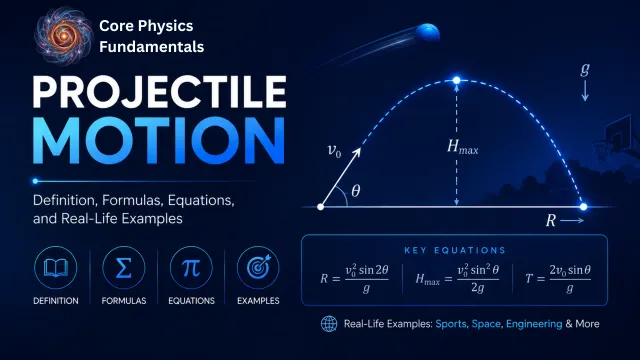
Projectile Motion: Definition, Formulas, Equations, and Real-Life Examples
Learn what projectile motion is, its key formulas and equations, how to calculate time of flight, maximum height, and range, with solved examples and real-life applications.
Aug 30, 2026 · 5 min read
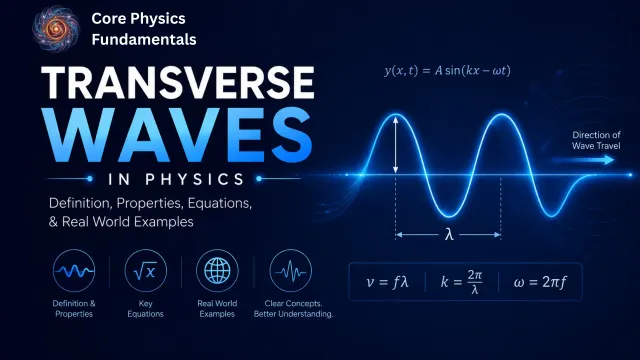
Transverse Waves: Definition, Properties, Equations & Examples
Learn what transverse waves are, their 5 key properties, the wave equation (v = fλ), polarization, real-life examples, and solved problems – all explained simply.
Aug 30, 2026 · 5 min read
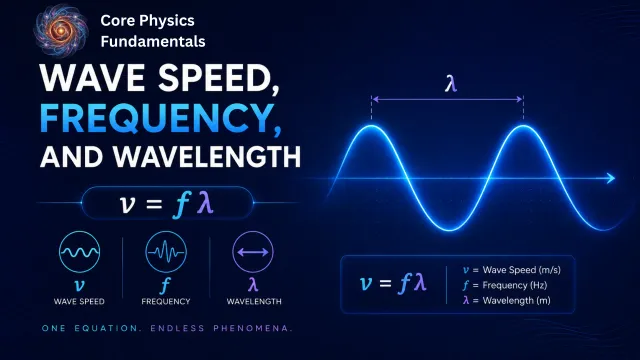
Wave Speed, Frequency & Wavelength – The Wave Equation (v = fλ)
Learn the wave equation v = fλ. Understand wave speed, frequency, and wavelength with simple definitions, solved examples, the electromagnetic spectrum, and real-life applications.
Aug 30, 2026 · 5 min read
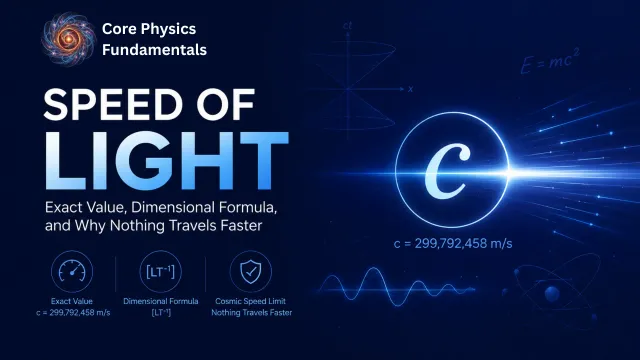
Speed of Light Exact Value in m/s, km/h, mph & How It Was First Measured
The speed of light is exactly 299,792,458 m/s — about 1.08 billion km/h. Learn unit conversions, dimensional formula, speed in water and glass, historical measurements from Rømer to lasers, and why c is the universe's speed limit.
Aug 25, 2026 · 5 min read
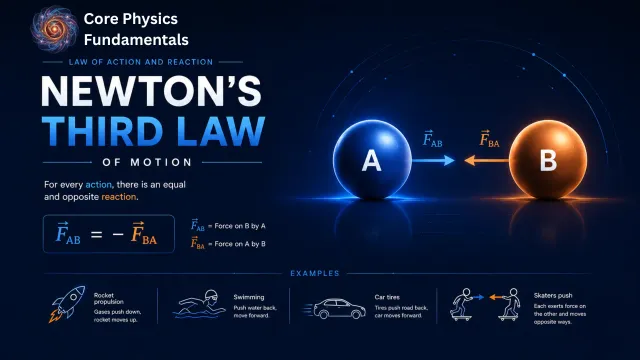
Newton's Third Law of Motion | Definition, Formula, Examples & Applications
Newton's third law of motion: for every action force, there is an equal and opposite reaction force on a different object. Formula, worked numerical problems, real-world applications, misconceptions, and FAQs.
Aug 22, 2026 · 5 min read
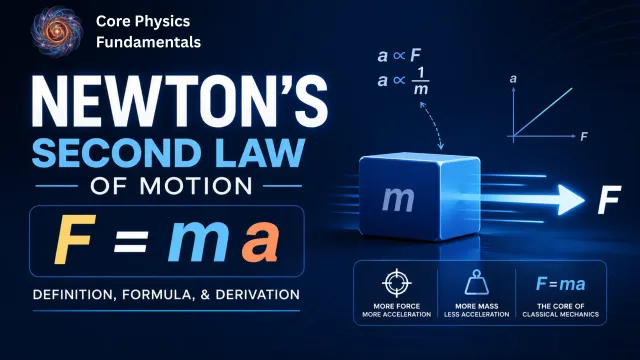
Newton's Second Law of Motion (F = ma): Definition, Formula & Derivation
Newton's second law states F = ma — net force equals mass × acceleration. Learn the definition, formula derivation from momentum, worked examples, free-body diagrams, and real-world applications.
Aug 18, 2026 · 5 min read
HISTORICAL FIGURES
The Scientists Who Shaped Physics
Physics is the accumulated work of thousands of people across centuries. Behind every equation on this site is a person who first worked it out — often against considerable resistance.

Isaac Newton
1643–1727
Laws of motion, universal gravitation, calculus

Albert Einstein
1879–1955
Special and general relativity, photoelectric effect

Nikola Tesla
1856–1943
Alternating current, Tesla coil, rotating magnetic field
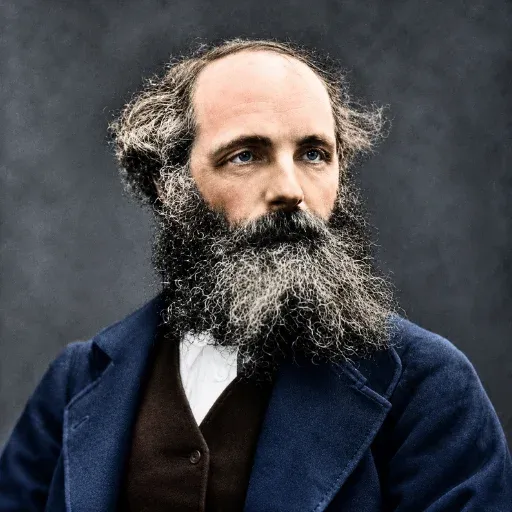
James Clerk Maxwell
1831–1879
Four equations unifying electricity, magnetism, and light

Michael Faraday
1791–1867
Electromagnetic induction, laws of electrolysis
INTERACTIVE LEARNING
Learn Physics by Interacting With It
Reading about projectile motion is one thing. Watching a ball follow the exact parabolic arc that Newton's equations predict — and being able to change the launch angle, gravity, or air resistance yourself — is another. Every simulation on this site runs real physics in your browser, no downloads, no signup.
Projectile Motion
Launch a projectile at any angle and velocity. See the parabolic trajectory, range, and time of flight update in real time.
Try it →Collision Lab
Explore elastic and inelastic collisions in 1D and 2D. Verify conservation of momentum and energy for yourself.
Try it →Pendulum
Adjust length, mass, and starting angle. Watch how period, amplitude, and damping change the motion.
Try it →Wave Interference
Two coherent wave sources create constructive and destructive interference patterns. Change frequency and spacing to see the effect.
Try it →PHYSICS TOOLS
Physics Calculators
Fast, accurate calculators for every core physics formula. Each one shows the equation, explains every variable, and works through the numbers step by step.
Speed, Distance & Time Calculator
Solve for speed, distance, or time from v = d/t — the most fundamental kinematics relationship.
Acceleration Calculator
Calculate acceleration from velocity change and time, or from force and mass using a = F/m.
SUVAT Equations Calculator
Solve any kinematics problem — displacement, velocity, acceleration, and time.
Projectile Motion Calculator
Range, maximum height, and time of flight from launch angle and velocity.
Free Fall Calculator
Vertical motion under gravity alone — the θ = 90° special case of projectile motion.
Relative Velocity Calculator
Find the velocity of one object relative to another in one or two dimensions.
OUR APPROACH
How We Teach Physics Fundamentals
Physics is not about memorising formulas. It's about developing the intuition to understand why the formulas are what they are — and being able to apply them to problems you've never seen before.
Concepts before equations
Every article starts with the physical picture — what's actually happening and why — before introducing any mathematics. The equations then feel obvious rather than arbitrary.
Verified against standard references
Every formula, derivation, and worked example is checked against standard university physics textbooks including Halliday/Resnick/Walker and Young/Freedman.
Interactive by default
Where a diagram would help, we build one. Where a simulation would help more, we build that instead. Static learning has its limits.
Free and always will be
No paywalls, no premium tier, no locked chapters. Physics education should be accessible to anyone with curiosity and an internet connection.
FAQ
Frequently Asked Questions
What are the fundamentals of physics?
What are the main branches of physics?
What are the basic principles of physics every student should know?
Is physics hard to learn?
What math do I need to know to learn physics?
What curriculum does this site cover?
Is Core Physics Fundamentals free?
How is the content created and fact-checked?
Ready to Dive In?
Start with any topic that interests you. Every article, calculator, and simulation is designed to build on the last — the more you explore, the deeper the connections become.