Michael Faraday — The Self-Taught Genius Who Gave the World Electricity
Faraday's discovery of electromagnetic induction powers every generator on Earth. His concept of "lines of force" became the foundation of Maxwell's equations and all modern electromagnetic theory. Einstein kept his photograph on his study wall alongside Newton and Maxwell.
Quick Facts
- Full Name
- Michael Faraday
- Born
- 22 September 1791, Newington Butts, Surrey, England
- Died
- 25 August 1867, Hampton Court, Middlesex, England (aged 75)
- Nationality
- English
- Fields
- Physics, Chemistry, Electromagnetism, Electrochemistry
- Institutions
- Royal Institution of Great Britain (1813–1867)
- Known For
- Electromagnetic Induction, First Electric Motor, First Dynamo, Laws of Electrolysis, Discovery of Benzene, Faraday Effect, Faraday Cage, Lines of Force, Christmas Lectures
- Key Publications
- Experimental Researches in Electricity (3 vols., 1839–1855), Chemical Manipulation (1827)
- Honours
- FRS (1824), Copley Medal (1832, 1838), Royal Medal (1835, 1846), Rumford Medal (1846), Albert Medal (1866), Fullerian Professor of Chemistry (1833–1867)
- Spouse
- Sarah Barnard (m. 1821)
- Children
- None
- Buried
- Highgate Cemetery, London (memorial plaque at Westminster Abbey near Newton's tomb)
Michael Faraday was an English physicist and chemist who, despite receiving almost no formal education, became one of the most influential scientists in history. Apprenticed to a London bookbinder at fourteen, he educated himself by reading the books he was binding and attended lectures by the chemist Humphry Davy, who eventually hired him as a laboratory assistant at the Royal Institution. Faraday went on to discover electromagnetic induction (1831) — the principle behind every electrical generator and transformer on Earth — invented the first electric motor (1821) and the first dynamo, formulated the laws of electrolysis (1833), discovered benzene (1825), and demonstrated the Faraday effect (1845), the first evidence that light and magnetism are related. His concept of "lines of force" provided the physical intuition that James Clerk Maxwell later translated into his mathematical equations of electromagnetism. He founded the Royal Institution's Christmas Lectures, declined a knighthood, and twice refused the presidency of the Royal Society. Einstein kept a photograph of Faraday on his study wall alongside pictures of Newton and Maxwell.
From Poverty to the Royal Institution
A Blacksmith's Son
Michael Faraday was born on 22 September 1791 in Newington Butts, Surrey (now part of South London), to James Faraday, a blacksmith, and Margaret Hastwell. The family was poor — James Faraday was frequently ill and unable to work steadily. Michael was one of four children who were often hungry. The family belonged to the Sandemanian sect of the Christian church, a small, strict denomination that demanded literal interpretation of the Bible and rejected the accumulation of worldly wealth. This faith would shape Faraday's character and decisions throughout his life.
Faraday later recalled being given one loaf of bread that had to last him a week. His mother, Margaret, was described by contemporaries as a woman of "great calm and wisdom" who supported her son emotionally through a difficult childhood. The Sandemanian faith — described by biographers as "the single most important influence upon him" — shaped how he approached and interpreted nature throughout his life.
Faraday received only the most basic education — reading, writing, and arithmetic — at a local Sunday school. At age thirteen, he began work as an errand boy and newspaper delivery boy for George Riebau, a bookbinder and bookseller. In 1805, at fourteen, he was formally apprenticed to Riebau for seven years.
The Bookbinder Who Read the Books
Unlike other apprentices, Faraday read the books that came in for binding. The article on electricity in the third edition of the Encyclopædia Britannica particularly fascinated him. He also devoured Jane Marcet's Conversations on Chemistry, a popular science book written specifically for young readers. Using old bottles, lumber, and wire, he built a crude electrostatic generator and a weak voltaic pile, conducting simple experiments in electrochemistry on his own.
A French émigré artist who lodged above the bookshop befriended the boy and gave him lessons in perspective drawing — a skill that would later prove invaluable for his meticulous scientific illustrations and lecture diagrams.
Among the books that shaped him was Isaac Watts's The Improvement of the Mind, whose principles for self-education Faraday enthusiastically implemented. He also attended lectures and discussions at the City Philosophical Society, where young Londoners gathered to hear talks on scientific topics. Between 1816 and 1818, Faraday himself delivered chemistry lectures at the Society to refine his lecturing skills — the only lectures he ever gave outside the Royal Institution.
Attending Davy's Lectures
In 1812, one of Riebau's customers gave Faraday free tickets to attend four chemistry lectures by Sir Humphry Davy at the Royal Institution. Faraday took beautiful, detailed notes — 300 pages — illustrated with the kind of precision he had learned from the French artist, and bound them into a book.
At twenty-one, with his apprenticeship ending, Faraday wrote to Davy enclosing his bound lecture notes and asking whether any position, "however lowly," might be available at the Royal Institution. Davy was impressed but had no vacancy. Shortly after, when Davy was temporarily blinded by an explosion in the laboratory, he hired Faraday to assist him. In March 1813, a permanent position opened as chemical assistant, and Faraday was appointed. He was twenty-one years old.
From Assistant to Scientist
The Continental Tour with Davy
In October 1813, Davy invited Faraday to accompany him on an eighteen-month tour of European scientific centres, serving as both scientific assistant and valet. Davy treated Faraday as an intellectual equal, but Lady Davy regarded him as nothing more than a servant — an experience Faraday found humiliating.
Despite this, the tour was transformative. Faraday met leading scientists including André-Marie Ampère in Paris and Alessandro Volta in Milan. In Florence, he and Davy conducted experiments burning diamonds in oxygen. By the time they returned to London in April 1815, the twenty-three-year-old Faraday had been exposed to the cutting edge of European science.
Early Chemical Work
Back at the Royal Institution, Faraday continued assisting Davy and other scientists while developing his own research programme. He studied chlorine, discovering two new compounds of chlorine and carbon. He conducted early experiments on the diffusion of gases. He succeeded in liquefying several gases previously believed to be "permanent" — including chlorine, ammonia, and carbon dioxide — proving that with sufficient pressure and cooling, all gases could be condensed into liquids.
On 12 June 1821, Faraday married Sarah Barnard, daughter of a Sandemanian elder. The couple had no children. They lived at the Royal Institution for most of their married life, in quarters provided above the laboratory.
The Electric Motor and Electromagnetic Rotation
In September 1821, shortly after Hans Christian Ørsted's 1820 discovery that electric current creates a magnetic field, Faraday conducted an experiment that would change the world. He placed a magnet upright in a pool of mercury and suspended a wire above it, connected to a battery. When current flowed through the wire, it rotated continuously around the magnet.
This was electromagnetic rotation — the conversion of electrical energy into continuous mechanical motion. Faraday had invented the first electric motor. The principle he demonstrated — that a current-carrying conductor in a magnetic field experiences a force — remains the operating principle of every electric motor in existence today, from industrial turbines to the tiny vibration motors in smartphones.
The publication of this discovery brought Faraday both fame and trouble. Humphry Davy and William Hyde Wollaston had been working on similar ideas, and Davy accused Faraday of stealing their work — a charge Faraday denied and which historians have largely dismissed. The episode strained their relationship, and some historians believe Davy later blocked Faraday's election to the Royal Society. Faraday was nonetheless elected a Fellow of the Royal Society in 1824.
The Discovery of Benzene and Other Chemical Achievements
Faraday's chemical work in the 1820s was substantial in its own right. In 1820, he produced the first known compounds of carbon and chlorine, including hexachloroethane and tetrachloroethylene.
In 1825, he isolated and identified benzene — the simplest aromatic hydrocarbon — from the oily residue left by the production of illuminating gas. Benzene would become one of the most important compounds in industrial chemistry, fundamental to the production of plastics, synthetic fibres, dyes, detergents, drugs, and explosives.
Faraday was appointed Director of the Laboratory at the Royal Institution in 1825. In the mid-1820s, he founded two institutions that continue to this day: the Friday Evening Discourses — public lectures on scientific topics — and the Christmas Lectures, a series of science lectures for young people. Faraday himself delivered nineteen series of Christmas Lectures between 1827 and 1860, establishing his reputation as the outstanding scientific communicator of his era.
Nanoparticles — A Discovery Ahead of Its Time (1857)
In 1857, Faraday reported that gold colloids — tiny particles of gold suspended in liquid — have different optical properties from bulk gold metal. This was likely the first observation of what are now known as quantum size effects, and is considered by many historians of science to mark the birth of nanoscience. The discovery was so far ahead of its time that its significance was not fully appreciated until the late 20th century.
Electromagnetic Induction — The Discovery That Powers the Modern World
The Induction Ring
On 29 August 1831, Faraday made what is arguably the most consequential experimental discovery in the history of technology. Using an iron ring wrapped with two separate coils of insulated wire, he connected one coil to a battery and the other to a galvanometer. When he closed the battery circuit, the galvanometer needle momentarily deflected — then returned to zero. When he opened the circuit, the needle deflected again, in the opposite direction.
He had induced an electric current in the second coil through the electromagnetic effect of the current in the first — without any direct electrical connection between them. This was electromagnetic induction. The iron ring was the first electric transformer.
The First Dynamo
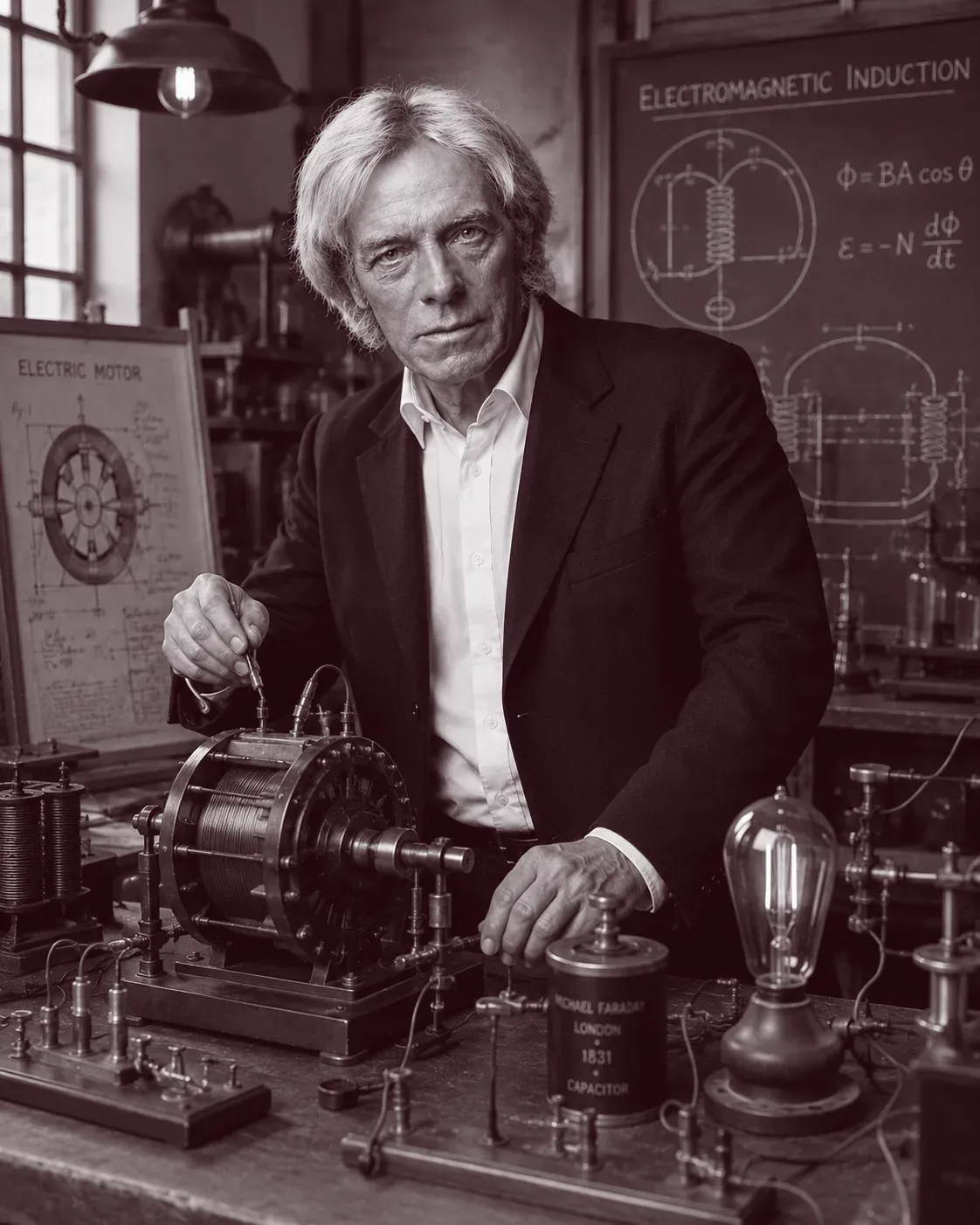
Over the following weeks, Faraday devised variations and extensions. In his most famous experiment, he attached two wires through a sliding contact to a copper disc and rotated the disc between the poles of a horseshoe magnet. The result was a continuous flowing electric current — the first dynamo (the "Faraday disc").
Previously, the only way to produce electric current was with a chemical battery. Now Faraday had shown that mechanical motion could be converted into electricity. This single discovery is the basis of the entire electrical power industry. Every coal, gas, nuclear, hydroelectric, and wind power station on Earth generates electricity using the principle Faraday demonstrated in 1831.
Faraday's Law of Induction
Faraday formalised his discovery as Faraday's law of electromagnetic induction: the electromotive force induced in a circuit is proportional to the rate of change of the magnetic flux through the circuit. This became the third of Maxwell's four equations of electromagnetism. It is the fundamental operating principle of all transformers, inductors, and most types of electrical motors and generators.
The Laws of Electrolysis and the Language of Electricity
In 1833, Faraday turned to electrochemistry and formulated his two laws of electrolysis:
First Law
The mass of a substance deposited or liberated at an electrode during electrolysis is directly proportional to the total electric charge passed through the electrolyte.
Second Law
For a given quantity of electric charge, the mass of a substance deposited is proportional to its equivalent weight (atomic weight divided by valence).
These laws were the first quantitative relationships between electricity and chemical change. They provided powerful evidence that matter is composed of atoms carrying discrete units of electric charge — an insight that anticipated the discovery of the electron by over sixty years.
Working with the classicist William Whewell, Faraday introduced much of the terminology still used in electrochemistry and electrical science today: electrode, anode, cathode, electrolyte, ion, anion, and cation. These terms, derived from Greek roots, replaced the confused and inconsistent vocabulary that had previously plagued the field.
The Fullerian Professorship of Chemistry was created specifically for Faraday in 1833 at the Royal Institution — a position he held until his death in 1867.
Lines of Force and the Birth of Field Theory
A New Way of Seeing
Faraday's most profound contribution to physics was not a single experiment but a new way of thinking about forces. He proposed that electric and magnetic effects are not instantaneous actions at a distance between particles (as Newton had conceived gravity) but rather are transmitted through the space surrounding charged or magnetised objects via invisible "lines of force."
He visualised these lines spreading outward from magnets and current-carrying wires, filling space with a physical entity — what we now call the electromagnetic field. This was a radical departure from the dominant Newtonian view that forces act instantaneously across empty space.
The Faraday Effect (1845)
In 1845, Faraday demonstrated that a strong magnetic field can rotate the plane of polarisation of a light beam passing through glass. This "Faraday effect" was the first experimental evidence that light and magnetism are related — a connection that Maxwell would later prove mathematically by showing that light is an electromagnetic wave.
Faraday also discovered diamagnetism in 1845 — the property by which certain materials are weakly repelled by a magnetic field. He demonstrated that all materials respond to magnetic fields, not just iron, nickel, and cobalt.
The Foundation Maxwell Built Upon
Faraday lacked the mathematical training to express his ideas in equations. But James Clerk Maxwell, reading Faraday's Experimental Researches in Electricity, recognised the profound physical insight behind the "lines of force" concept.
"Faraday showed himself to have been in reality a mathematician of a very high order — one from whom the mathematicians of the future may derive valuable and fertile methods."
— James Clerk Maxwell
Maxwell translated Faraday's physical intuitions into precise mathematical form — his four equations of electromagnetism. As Maxwell freely admitted, "the basic ideas for his mathematical theory of electrical and magnetic fields came from Faraday." Without Faraday's experimental discoveries and conceptual framework, Maxwell's equations could not have been written.
The Faraday Cage and Public Service
In 1836, Faraday demonstrated that an electrical charge resides only on the exterior surface of a charged conductor and has no influence on anything enclosed within it. A metal enclosure — now called a Faraday cage — blocks external electric fields. This principle is used today to protect sensitive electronic equipment from electromagnetic interference, to shield MRI rooms in hospitals, and to protect aircraft passengers from lightning strikes.
Faraday devoted considerable time to public service. He served as Scientific Adviser to the Admiralty from 1829, advising on the protection of ships' hulls from corrosion. From 1836 to 1865, he served as Scientific Adviser to Trinity House, the body responsible for lighthouses around the English and Welsh coasts, where he worked to improve lighthouse illumination — eventually introducing electric lighting.
In 1855, he wrote a letter to The Times about the pollution of the River Thames, dropping white cards into the opaque water to demonstrate how contaminated it had become. The letter was widely read and helped spark public concern about water quality.
Public Service, Ethics, and Debunking
The Haswell Colliery Investigation
In 1846, Faraday and the geologist Charles Lyell conducted a forensic investigation into a catastrophic explosion at the Haswell Colliery in County Durham, which killed 95 miners. Their detailed report was groundbreaking: it demonstrated for the first time that coal dust contributed to the severity of mine explosions and showed how improved ventilation could have prevented the disaster. Faraday gave a public demonstration of how ventilation systems work during a lecture. Tragically, the coal industry ignored this warning for over 60 years, until the 1913 Senghenydd Colliery disaster killed 439 miners.
Refusing Chemical Weapons
When the British government asked Faraday to advise on the production of chemical weapons for use in the Crimean War (1853–1856), he flatly refused, citing ethical reasons. This principled stand — from a man who had spent decades serving the government as scientific adviser to the Admiralty and Trinity House — demonstrated that his moral convictions were as firm as his scientific ones.
Debunking Table-Turning and Mesmerism
Faraday also took a public stand against pseudoscience. When table-turning, mesmerism, and seances became fashionable in Victorian Britain, he investigated the phenomena experimentally and published his findings, showing that the movements were caused by unconscious muscular action (the ideomotor effect), not supernatural forces. He used these episodes to criticise both the public's credulity and the nation's educational system for failing to teach critical thinking.
Adviser to Industry, Art, and the Great Exhibition
Beyond his scientific research, Faraday undertook extensive public service. His workshop at Trinity Buoy Wharf, where he conducted the first experiments in electric lighting for lighthouses, still stands today.
He investigated industrial pollution at Swansea and air pollution at the Royal Mint. Faraday assisted with planning and judging exhibits for the Great Exhibition of 1851 and advised the National Gallery on the cleaning and protection of its art collection.
Faith, Humility, and Declining Honours
The Sandemanian Elder
Faraday was a devout member of the Sandemanian church throughout his life. He served as a deacon and later as an elder. His faith and his science were deeply intertwined — he saw his scientific investigations as a way of understanding divine creation.
"I have never seen anything incompatible between those things of man which can be known by the spirit of man which is within him, and those higher things concerning his future, which he cannot know by that spirit."
— Michael Faraday
His Sandemanian beliefs emphasised humility, simplicity, and the rejection of worldly honours and wealth.
Refusing Knighthood and the Presidency
True to these principles, Faraday declined a knighthood offered by Queen Victoria, saying he wished to remain "plain Mr. Faraday to the end." He twice refused the presidency of the Royal Society. He gratefully accepted the use of a house at Hampton Court that Victoria provided for him in his retirement, but rejected every title and honour that carried social elevation.
Mental Decline and Death
In 1839, the strain of eight years of sustained experimental and theoretical work caused Faraday to suffer a serious nervous breakdown. For the next six years, he did little creative science. It was not until 1845 that he was able to resume his electromagnetic investigations — and when he did, the results were spectacular: the Faraday effect and the discovery of diamagnetism both came in that year, the direct product of his return to active research.
Around 1855, his mental powers began a second, permanent decline — what modern medicine would likely describe as dementia.
In 1858, he retired to the Hampton Court house provided by Queen Victoria. In 1861, at age seventy, he resigned from the Royal Institution but was asked to stay on in a nominal role until 1865.
Michael Faraday died on 25 August 1867 at Hampton Court, aged seventy-five. His wife Sarah survived him; they had no children. He had declined an offer of burial in Westminster Abbey, preferring a simpler funeral consistent with his Sandemanian beliefs. He was interred in the dissenters' section of Highgate Cemetery in London. A memorial plaque was later placed in Westminster Abbey near Isaac Newton's tomb. Sarah was buried beside him at Highgate after her own death.
Legacy — The Experimentalist Who Enabled the Modern World
What Faraday Made Possible
Virtually all electrical technology traces back to Faraday's discoveries. Electromagnetic induction is the operating principle of every electrical generator, transformer, and induction motor. His electric motor principle drives every machine that converts electricity to motion. His laws of electrolysis are fundamental to electroplating, aluminium smelting, chlorine production, and battery technology. His discovery of benzene underpins the entire petrochemical industry. The Faraday cage protects electronic equipment worldwide. His concept of field lines became, through Maxwell, the foundation of all electromagnetic theory — and ultimately of radio, television, radar, Wi-Fi, and the entire telecommunications industry.
Faraday's final experiment, in 1862, was an attempt to detect changes in spectral lines caused by a magnetic field — but his equipment was insufficient. Over 30 years later, the Dutch physicist Pieter Zeeman used improved apparatus to confirm exactly this effect, winning the 1902 Nobel Prize in Physics. In both his 1897 paper and his Nobel acceptance speech, Zeeman explicitly credited Faraday's pioneering attempt.
What Einstein and Maxwell Said
Einstein kept a photograph of Faraday on his study wall alongside pictures of Newton and Maxwell. Maxwell wrote that Faraday was "in reality a mathematician of a very high order." The physicist Ernest Rutherford called him "one of the greatest scientific discoverers of all time." He is frequently ranked among the top ten most influential scientists in history.
Commemorations
The farad (F), the SI unit of electrical capacitance, is named in his honour. The Faraday constant (F ≈ 96,485 C/mol), representing the charge of one mole of electrons, also bears his name. A statue of Faraday stands at Savoy Place in London, outside the Institution of Engineering and Technology. The Faraday Institution, founded in 2017, is the UK's independent institute for electrochemical energy storage research. The Royal Institution's Christmas Lectures, which he founded in the 1820s, continue annually to this day.
Faraday's image appeared on the reverse of the Bank of England Series E £20 banknote from 1991 to 2001, depicting him conducting a lecture at the Royal Institution. In 2002, he was ranked number 22 in the BBC's 100 Greatest Britons poll.
"The value of his work must be higher than the capitalisation of all the shares on the Stock Exchange!"
— Margaret Thatcher, in a speech to the Royal Society
"Even if I could be Shakespeare, I think I should still choose to be Faraday."
— Aldous Huxley
Einstein included Faraday alongside Newton and Maxwell in a 1933 speech on intellectual freedom at the Royal Albert Hall: "Without such freedom there would have been no Shakespeare, no Goethe, no Newton, no Faraday, no Pasteur and no Lister."
Published Works
Scientific Works
- Chemical Manipulation (1827) — practical chemistry manual
- Experimental Researches in Electricity, Vol. 1 (1839)
- Experimental Researches in Electricity, Vol. 2 (1844)
- Experimental Researches in Electricity, Vol. 3 (1855)
- Experimental Researches in Chemistry and Physics (1859)
Popular Science
- The Chemical History of a Candle (1861) — based on his Christmas Lectures
- On the Various Forces of Nature (1863) — based on his Christmas Lectures
Life Timeline
Frequently Asked Questions About Michael Faraday
What did Michael Faraday discover?
Faraday's major discoveries include electromagnetic induction (1831), the principle behind all electrical generators and transformers; the first electric motor based on electromagnetic rotation (1821); the first dynamo (1831); the laws of electrolysis (1833); the discovery of benzene (1825); diamagnetism (1845); and the Faraday effect (1845), the first evidence linking light and magnetism. He also invented the Faraday cage and introduced the concept of electromagnetic "lines of force" that became the foundation of field theory.
How did Faraday become a scientist without formal education?
Faraday was apprenticed to a bookbinder at age fourteen and educated himself by reading the scientific books he was binding. A customer gave him tickets to lectures by the chemist Humphry Davy at the Royal Institution. Faraday took meticulous notes, bound them into a book, and sent them to Davy requesting any available position. Davy was impressed and hired him as a laboratory assistant in 1813. From that point, Faraday taught himself through experimentation and became one of the greatest experimentalists in history.
What is electromagnetic induction?
Electromagnetic induction is the production of an electric current by changing the magnetic field through a circuit. Faraday discovered it on 29 August 1831 using an iron ring wrapped with two coils of wire. When current was switched on or off in one coil, a momentary current was induced in the other. This principle is the basis of all electrical power generation — every power station, transformer, and generator in the world operates on Faraday's discovery.
What is the Faraday cage?
A Faraday cage is a mesh or solid enclosure of conducting material that blocks external electric fields. Faraday demonstrated in 1836 that electric charge distributes itself on the exterior of a conductor and does not affect anything enclosed within it. Today, Faraday cages protect sensitive electronics from electromagnetic interference, shield MRI rooms in hospitals, and protect aircraft from lightning strikes.
Why did Faraday refuse a knighthood?
Faraday was a devout member of the Sandemanian church, which rejected the accumulation of worldly wealth and honours. Consistent with these beliefs, he declined a knighthood from Queen Victoria, saying he wished to remain "plain Mr. Faraday to the end." He also twice refused the presidency of the Royal Society.
What is the connection between Faraday and Maxwell?
Faraday's experimental discoveries and his concept of electromagnetic "lines of force" provided the physical foundation for James Clerk Maxwell's mathematical equations of electromagnetism. Maxwell freely acknowledged that "the basic ideas for his mathematical theory came from Faraday." Faraday provided the experimental evidence and physical intuition; Maxwell provided the mathematical framework. Together, their work unified electricity, magnetism, and light.
Where is Faraday buried?
Faraday is buried in the dissenters' section of Highgate Cemetery in London. He declined an offer of burial in Westminster Abbey, preferring a simpler funeral consistent with his Sandemanian beliefs. A memorial plaque was later placed in Westminster Abbey near Isaac Newton's tomb. His wife Sarah was buried beside him at Highgate.
What units are named after Faraday?
Two units bear his name: the farad (F), the SI unit of electrical capacitance, and the Faraday constant (F ≈ 96,485 coulombs per mole), representing the total electric charge carried by one mole of electrons. Both are fundamental to electrical engineering and electrochemistry.
Did Faraday refuse to develop chemical weapons?
Yes. When the British government asked him to advise on producing chemical weapons for the Crimean War (1853–1856), Faraday refused on ethical grounds. Despite having served the government as Scientific Adviser to the Admiralty and Trinity House for decades, he would not compromise his moral principles.