James Clerk Maxwell — The Physicist Who Unified Light, Electricity, and Magnetism
Maxwell's four equations of electromagnetism proved that electricity, magnetism, and light are different manifestations of a single phenomenon. Einstein said "I stand on Maxwell's shoulders." Feynman called his discovery "the most significant event of the 19th century."
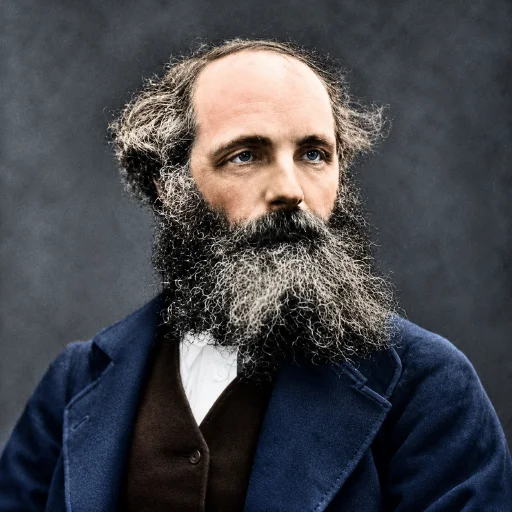
Quick Facts
- Full Name
- James Clerk Maxwell
- Born
- 13 June 1831, Edinburgh, Scotland
- Died
- 5 November 1879, Cambridge, England (aged 48)
- Nationality
- Scottish
- Fields
- Physics, Mathematics, Astronomy, Optics, Thermodynamics
- Institutions
- Marischal College Aberdeen, King's College London, University of Cambridge (Cavendish Laboratory)
- Known For
- Maxwell's Equations, Electromagnetic Theory of Light, Kinetic Theory of Gases, First Colour Photograph, Saturn's Rings Analysis, Maxwell's Demon, Control Theory, Dimensional Analysis
- Key Publications
- A Dynamical Theory of the Electromagnetic Field (1865), A Treatise on Electricity and Magnetism (1873)
- Honours
- Adams Prize (1859), Rumford Medal (1860), Fellow of the Royal Society (1861), First Cavendish Professor of Physics (1871–1879), Member of the American Philosophical Society (1876)
- Buried
- Parton Kirkyard, Dumfries and Galloway, Scotland (memorial inscription at Westminster Abbey)
James Clerk Maxwell was a Scottish physicist and mathematician who achieved the second great unification in physics — after Newton's unification of terrestrial and celestial mechanics. His four equations of electromagnetism proved that electricity, magnetism, and light are different manifestations of a single phenomenon: the electromagnetic field. He calculated that electromagnetic waves travel at 310,740,000 m/s — matching the speed of light — and concluded that light itself is an electromagnetic wave. He predicted radio waves 22 years before Heinrich Hertz confirmed them experimentally in 1887. Maxwell also produced the first colour photograph (1861), proved Saturn's rings must be composed of small particles (confirmed by Voyager over a century later), co-developed the Maxwell–Boltzmann distribution of molecular speeds, proposed the Maxwell's Demon thought experiment, and wrote the founding paper on control theory. Einstein said "I stand on Maxwell's shoulders." Feynman called his discovery "the most significant event of the 19th century." Maxwell died of abdominal cancer on 5 November 1879, aged 48 — the same disease and the same age at which his mother had died.
Childhood and Early Genius
A Curious Child at Glenlair
James Clerk Maxwell was born on 13 June 1831 at 14 India Street, Edinburgh, to John Clerk Maxwell, a practicing lawyer, and Frances Cay. His father came from the Clerk family of Penicuik, holders of the baronetcy of Clerk of Penicuik, and had added "Maxwell" to his surname after inheriting the Middlebie estate in Dumfriesshire as an infant in 1793. James was an only surviving child — his parents had lost an earlier daughter, Elizabeth, in infancy. His parents had married late; his mother was nearly 40 when he was born.
The family soon moved from Edinburgh to Glenlair, their country house on the 1,500-acre Middlebie estate in Kirkcudbrightshire. Maxwell displayed extraordinary curiosity from his earliest years. By the age of three, everything that moved, shone, or made a noise drew the question: "What's the go o' that?" — and when given an answer: "But what's the particular go of it?" His mother wrote in 1834 that he had "great work with doors, locks, keys" and that "show me how it doos" was never out of his mouth.
Tragedy and a Failed Tutor
Frances Maxwell died in December 1839 from abdominal cancer. James was eight years old. It was the same disease that would kill him at exactly the same age of 48.
A private tutor was hired, but he proved dull and uninspired, and treated the boy harshly, chiding him for being slow and wayward. The tutor was dismissed in November 1841. His father then took James on 12 February 1842 to Robert Davidson's demonstration of electric propulsion and magnetic force — an experience with profound implications for the boy's future fascination with electromagnetism.
Edinburgh Academy — "Dafty"
In 1841, ten-year-old Maxwell was sent to the prestigious Edinburgh Academy, lodging with his aunt Isabella during term times. Having been raised in isolation on his father's countryside estate, he arrived on his first day wearing home-made shoes and a tunic designed by his father. His classmates immediately gave him the nickname "Dafty." He never resented the name and bore it without complaint for years.
His academic work went unnoticed at first. But by age 13, he had won the school's mathematical medal and first prizes for both English and poetry. At the Academy he formed two lifelong friendships: with Lewis Campbell, who later became his biographer, and Peter Guthrie Tait, who became a prominent physicist.
First Scientific Paper at Age 14
In early 1846, at just 14 years old, Maxwell wrote his first scientific paper, "On the Description of Oval Curves, and Those Having a Plurality of Foci." He generalised the definition of an ellipse by considering curves traced with pins and thread where the distances from multiple foci are combined in weighted sums. The ideas were not entirely new — René Descartes had studied similar curves in the 17th century — but Maxwell's method was remarkably elegant for a teenager.
The paper was presented to the Royal Society of Edinburgh on 6 April 1846 by Professor James David Forbes, because Maxwell was deemed too young to present it himself.
Maxwell was 14 when his first paper was presented to the Royal Society of Edinburgh — remarkably, he would contribute two more papers to the Transactions before he was considered old enough to present them in person.
University Education
University of Edinburgh (1847–1850)
At 16, Maxwell entered the University of Edinburgh, where he studied natural philosophy under James Forbes, mathematics under Philip Kelland, and logic and metaphysics under Sir William Hamilton. He did not find his classes demanding and used his free time for private study — conducting experiments with improvised chemical, electric, and magnetic apparatus at Glenlair during holidays.
As a teenager at Edinburgh, Maxwell discovered photoelasticity. He constructed shaped blocks of gelatine, subjected them to various stresses, and viewed the coloured fringes through a pair of polarising prisms given to him by William Nicol. This technique — determining stress distribution within physical structures through polarised light — is still used in engineering today.
At age 18, he contributed two papers to the Transactions of the Royal Society of Edinburgh. One, "On the Equilibrium of Elastic Solids," laid the foundation for his later discovery of temporary double refraction in viscous liquids under shear stress. For both papers, he was again considered too young to present them himself.
Cambridge — Second Wrangler and Smith's Prize (1850–1856)
In October 1850, Maxwell transferred to Cambridge, initially at Peterhouse before moving to Trinity College, where he believed it was easier to obtain a fellowship. He was elected to the elite secret society known as the Cambridge Apostles, where he explored the relationship between his Christian faith and science through essays and discussions.
His tutor was William Hopkins, nicknamed the "senior wrangler-maker," whose students included Tait, George Stokes, William Thomson (Lord Kelvin), and Arthur Cayley. Hopkins reportedly said of Maxwell that he was "the most extraordinary man he had ever met, that it seemed impossible for him to think wrongly on any physical subject, but that in analysis he was far more deficient." This assessment proved prophetic — several of Maxwell's most important formulas obtained correct results from mathematically flawed arguments.
"The most extraordinary man he had ever met... it seemed impossible for him to think wrongly on any physical subject, but in analysis he was far more deficient."
— William Hopkins, on Maxwell
In 1854, Maxwell graduated as Second Wrangler (second-highest in the mathematics examinations, behind Edward Routh) and was declared equal First Smith's Prizeman — sharing the prize with Routh. He was elected a Fellow of Trinity on 10 October 1855, sooner than was normal.
As a Fellow, Maxwell began research on two topics that would dominate his career: colour vision and electromagnetism. In March 1855, he presented "Experiments on Colour" to the Royal Society of Edinburgh — this time able to deliver it himself. Using Forbes's coloured spinning tops, he demonstrated that white light results from a mixture of red, green, and blue light. That same year he published "On Faraday's Lines of Force," the paper that began his mathematical translation of Michael Faraday's experimental insights into electricity and magnetism.
Aberdeen — Saturn's Rings and Marriage
Professor at 25
In 1856, at age 24, Maxwell was appointed Professor of Natural Philosophy at Marischal College, Aberdeen — a full 15 years younger than any other professor at the college. His father had helped him prepare the necessary references but died on 2 April 1856, before learning the result. Maxwell inherited the family estate at Glenlair.
At Aberdeen, Maxwell committed himself to lecturing 15 hours a week, including a weekly pro bono lecture to the local working men's college. A former student described him as a man "of middling height, with frame strongly knit... a face expressive at once of sagacity and good humour, but overlaid with a deep shade of thoughtfulness."
Proving Saturn's Rings Are Particles
Maxwell devoted two years to the problem that had eluded scientists for 200 years: the nature of Saturn's rings. St John's College, Cambridge, had chosen this as the topic for the 1857 Adams Prize. Maxwell proved mathematically that a regular solid ring could not be stable, and that a fluid ring would break up into blobs under wave action. Since neither was observed, he concluded the rings must be composed of "an indefinite number of unconnected particles" — countless small solid objects, each independently orbiting Saturn.
He was the only entrant to submit an essay. George Biddell Airy, the Astronomer Royal, commented:
"It is one of the most remarkable applications of mathematics to physics that I have ever seen."
— George Biddell Airy, Astronomer Royal
Maxwell won the £130 Adams Prize in 1859. His conclusion was confirmed over 100 years later by NASA's Voyager spacecraft in the 1980s. The Maxwell Gap in Saturn's rings is named in his honour.
Marriage to Katherine Dewar
In 1857, Maxwell befriended the Reverend Daniel Dewar, Principal of Marischal College. Through him he met Dewar's daughter, Katherine Mary Dewar, seven years his senior. They were engaged in February 1858 and married on 2 June 1858 in the parish of Old Machar, Aberdeen. The couple had no children.
Katherine assisted Maxwell in his laboratory work, particularly experiments on colour vision and the viscosity of gases. Their shared Christian faith was a deep bond. Maxwell wrote to her: "I think the more we enter together into Christ's work, He will have the more room to work His work in us." His biographer Lewis Campbell described their married life as "one of unexampled devotion."
In 1860, Marischal College merged with King's College to form the University of Aberdeen. There was no room for two professors of Natural Philosophy, and Maxwell — despite his scientific reputation — was made redundant. He applied for Forbes's recently vacated chair at Edinburgh but was rejected in favour of his school friend Tait. After recovering from a near-fatal bout of smallpox, he moved to London.
King's College London — The Most Productive Years
The First Colour Photograph (1861)
Maxwell accepted the Chair of Natural Philosophy at King's College, London, in 1860. His five years there were the most productive of his career.
Building on his colour research, Maxwell reasoned that the human eye detects only three colours of light — red, green, and blue — and that any visible colour could be reproduced by mixing these three primaries in varying proportions. To demonstrate this, he had the photographer Thomas Sutton (inventor of the single-lens reflex camera) take three separate photographs of a tartan ribbon through red, green, and blue filters.
On 17 May 1861, at a lecture to the Royal Institution, Maxwell projected the three images simultaneously through their corresponding filters onto a screen. The result was the world's first colour photograph. Researchers in 1961 later discovered that the partial success of the red-filtered image — despite Sutton's plates being insensitive to red light — was due to ultraviolet light strongly reflected by the red dyes in the tartan, which fell within the sensitivity range of the wet collodion photographic process.
Three-Colour Principle
The three-colour principle Maxwell demonstrated is the foundation of all colour television, digital photography, computer displays, and smartphone screens.
Maxwell was awarded the Rumford Medal by the Royal Society in 1860 for his work on colour vision and elected a Fellow of the Royal Society in 1861.
The Kinetic Theory of Gases and Maxwell's Demon
Maxwell made foundational contributions to the kinetic theory of gases, building on earlier work by Daniel Bernoulli, John Herapath, and Rudolf Clausius. Between 1859 and 1866, he developed the theory of velocity distributions in gas particles.
He established that the temperature of a gas depends entirely on the average speed of its molecules, and that molecular speeds are not uniform but follow a statistical distribution. The Maxwell–Boltzmann distribution (later generalised by Ludwig Boltzmann) gives the fraction of gas molecules moving at a specified velocity at any given temperature. This was the first time probability had been applied to fundamental physics, laying the groundwork for statistical mechanics and eventually quantum theory.
Maxwell calculated that each molecule of air at room temperature collides with other molecules approximately 8 billion times per second.
In a letter to his friend Peter Guthrie Tait on 11 December 1867, Maxwell proposed a famous thought experiment. He imagined a hypothetical intelligent being — later named "Maxwell's Demon" by Lord Kelvin — stationed at a door between two chambers of gas at the same temperature. The demon could selectively let fast molecules pass one way and slow molecules the other, creating a temperature difference without expending energy — apparently violating the second law of thermodynamics.
The paradox took over a century to resolve. Its resolution linked thermodynamics to information theory through the principle that acquiring and erasing information about molecules requires energy. This connection remains fundamental to modern computer science, quantum computing, and information theory.
Peter Guthrie Tait called Maxwell the "leading molecular scientist" of his time. After Maxwell's death, it was said that "only one man lived who could understand Gibbs's papers. That was Maxwell, and now he is dead."
Maxwell's Equations — The Electromagnetic Theory of Light (1861–1865)
Maxwell's crowning achievement began with his 1855 paper translating Faraday's "lines of force" into mathematics. At King's College, he came into regular contact with the ageing Michael Faraday at Royal Institution lectures. Though Faraday was 40 years Maxwell's senior and showing signs of decline, the two men maintained a strong mutual respect.
Between 1861 and 1862, Maxwell published "On Physical Lines of Force," in which he constructed a mechanical model for electromagnetic induction using tiny spinning cells of magnetic flux. In this paper, he made a critical correction to Ampère's circuital law by adding the "displacement current" — a term representing the effect of changing electric fields even in the absence of physical charge movement. This correction completed the physics of the theory.
Around 1862, Maxwell calculated that the speed of propagation of an electromagnetic field was approximately the speed of light. He wrote:
"We can scarcely avoid the conclusion that light consists in the transverse undulations of the same medium which is the cause of electric and magnetic phenomena."
— James Clerk Maxwell
On 27 October 1864, Maxwell presented "A Dynamical Theory of the Electromagnetic Field" to the Royal Society of London, published in 1865 in the Philosophical Transactions. This paper contained 20 equations describing the behaviour of electric and magnetic fields. When Maxwell solved them, he found they predicted waves of oscillating electric and magnetic fields propagating through space at a constant speed. Using the electrical and magnetic data available at the time, he calculated this speed as 310,740,000 m/s — within 3% of the modern value of the speed of light (299,792,458 m/s).
"I have also a paper afloat, with an electromagnetic theory of light, which, till I am convinced to the contrary, I hold to be great guns."
— James Clerk Maxwell, to a colleague
His conclusion was revolutionary: light is an electromagnetic wave. Electricity, magnetism, and optics — three apparently separate branches of physics — were manifestations of a single underlying phenomenon. The equations also predicted that electromagnetic waves could exist at any frequency, implying an entire spectrum: radio waves, microwaves, infrared, visible light, ultraviolet, X-rays, and gamma rays.
Maxwell originally derived 20 equations in 20 variables. Oliver Heaviside later simplified them in the 1880s into the four elegant vector equations we know today:
Electric charges create electric fields
There are no magnetic monopoles; magnetic field lines form closed loops
Changing magnetic fields create electric fields
Electric currents and changing electric fields create magnetic fields
These four equations, together with the Lorentz force law, form the complete classical theory of electromagnetism.
Dimensional Analysis, Control Theory, and Chaos
Maxwell's contributions at King's College extended remarkably far beyond electromagnetism and colour. He supervised the experimental determination of electrical units for the British Association for the Advancement of Science, work that led to the establishment of the National Physical Laboratory. He was the first to make explicit use of dimensional analysis (1871) and helped establish the CGS system of measurement.
His 1868 paper "On Governors" — analysing the centrifugal governors used to regulate steam engines — is now regarded as the founding paper of control theory and cybernetics. It was the earliest mathematical analysis of a control system.
Maxwell has also been credited as the first scientist to recognise what we now call chaos — systems exhibiting "sensitive dependence on initial conditions." He was the first to emphasise the butterfly effect, in two discussions during the 1870s.
In his 1867 paper "On the Dynamical Theory of Gases," he introduced the Maxwell model for describing the behaviour of a viscoelastic material and originated the Maxwell–Cattaneo equation for describing heat transport in a medium.
The Glenlair Years — Writing the Treatise
In 1865, Maxwell resigned from King's College London and returned to Glenlair with Katherine. He was 34. For the next six years, he devoted himself to writing his masterwork: A Treatise on Electricity and Magnetism, published by Oxford University Press in 1873.
The Treatise is a two-volume work presenting the complete mathematical theory of electromagnetism. It formalised the equations from his 1865 paper, provided extensive experimental evidence, and explored implications including the investigation of moving frames of reference — work that would later inspire Einstein's theory of special relativity. Maxwell stated in the preface that his major task was "to convert Faraday's physical ideas into mathematical form."
During this period Maxwell also continued work on gas theory, topology, thermodynamics, and the theory of heat. He wrote the textbook Theory of Heat (1871) and the treatise Matter and Motion (1876). He toured Italy in the spring and early summer of 1867. He served as an examiner and moderator for the Cambridge Mathematical Tripos from 1866 to 1870, introducing widely praised reforms to the substance and style of the examinations.
In 1871, Maxwell established his thermodynamic relations — statements of equality among second derivatives of thermodynamic potentials with respect to different variables — which appear in every standard thermodynamics textbook today. In 1874, he constructed a plaster thermodynamic visualisation to explore phase transitions, based on the American scientist Josiah Willard Gibbs's graphical thermodynamics papers.
The Cavendish Laboratory
First Cavendish Professor of Physics
In 1871, Maxwell was appointed the first Cavendish Professor of Experimental Physics at Cambridge. He was initially reluctant to leave Glenlair but accepted the position and took on the task of planning and building the Cavendish Laboratory.
The laboratory was funded by William Cavendish, 7th Duke of Devonshire, the university's chancellor. Maxwell supervised every detail — the building's design, construction, and the purchase of its scientific apparatus. The Cavendish Laboratory would become one of the most famous physics laboratories in the world, the site where the electron was discovered (J.J. Thomson, 1897), the neutron was identified (James Chadwick, 1932), the structure of DNA was determined (Watson and Crick, 1953), and 30 Nobel Prize winners would eventually work.
Maxwell had few students at Cambridge, but they were of the highest calibre: William D. Niven (who later completed the second edition of the Treatise), John Ambrose Fleming (who invented the vacuum tube that made radio broadcasting possible), Richard Tetley Glazebrook, John Henry Poynting, and Arthur Schuster.
Editing Cavendish's Papers
Maxwell also undertook the painstaking task of editing the electrical research papers of Henry Cavendish, the 18th-century scientist after whom the laboratory was named. Published in 1879 as The Electrical Researches of the Honourable Henry Cavendish, this work revealed that Cavendish had anticipated numerous discoveries later attributed to others — including Ohm's Law and Coulomb's Law — but had never published his findings.
Maxwell was elected a member of the American Philosophical Society in 1876.
Death at 48
The Same Disease, the Same Age
In April 1879, Maxwell began having difficulty swallowing. By the summer, his condition had worsened considerably. He and Katherine returned to Glenlair in June, but his health did not improve. He was diagnosed with abdominal cancer — the same disease that had killed his mother at the same age of 48.
Despite severe pain, Maxwell reportedly remained cheerful and calm, hiding his discomfort to avoid worrying Katherine and his colleagues. He continued working as long as he could. The minister who regularly visited him in his final weeks was astonished at his lucidity and the scope of his memory, commenting on "his firm and undoubting faith in the Incarnation and all its results; in the full sufficiency of the Atonement."
"I have been thinking how very gently I have always been dealt with. I have never had a violent shove all my life. The only desire which I can have is like David to serve my own generation by the will of God, and then fall asleep."
— James Clerk Maxwell, to a Cambridge colleague, in his final days
James Clerk Maxwell died on 5 November 1879 in Cambridge, England. He received no public honours at death and was buried quietly in Parton Kirkyard, near Castle Douglas in Galloway, close to where he had grown up. Katherine survived him by seven years, dying on 12 December 1886. She was buried beside him. There is a memorial inscription to Maxwell near the choir screen at Westminster Abbey.
Maxwell was revising the Treatise on Electricity and Magnetism for a second edition at the time of his death. The revision was completed by William Davidson Niven in 1881, and a third edition was prepared by J.J. Thomson in 1892. His biography, The Life of James Clerk Maxwell, by Lewis Campbell, was published in 1882. His collected scientific papers were issued in two volumes by Cambridge University Press in 1890.
The Legacy — Why Maxwell Ranks with Newton and Einstein
What Einstein and Feynman Said
In a survey by Physics World, Maxwell was voted the third greatest physicist of all time, behind only Newton and Einstein. A parallel survey of rank-and-file physicists by PhysicsWeb reached the same ranking.
Einstein kept a photograph of Maxwell on his study wall alongside pictures of Michael Faraday. On the centenary of Maxwell's birth in 1931, Einstein described his work as "the most profound and the most fruitful that physics has experienced since the time of Newton." When Einstein visited Cambridge in 1922 and was told he had done great things by standing on Newton's shoulders, he replied:
"No, I don't. I stand on the shoulders of Maxwell."
— Albert Einstein, at Cambridge, 1922
He also wrote: "The special theory of relativity owes its origins to Maxwell's equations of the electromagnetic field" and "One scientific epoch ended and another began with James Clerk Maxwell."
"From a long view of the history of mankind — seen from, say, ten thousand years from now — there can be little doubt that the most significant event of the 19th century will be judged as Maxwell's discovery of the laws of electrodynamics. The American Civil War will pale into provincial insignificance in comparison with this important scientific event of the same decade."
— Richard Feynman
Hertz Confirms the Prediction
In 1887, eight years after Maxwell's death, the German physicist Heinrich Hertz successfully generated and detected electromagnetic waves in a laboratory — exactly as Maxwell's equations had predicted. This experimental confirmation opened the door to radio, television, radar, wireless communication, and eventually smartphones and Wi-Fi. Maxwell had predicted an entire technology revolution that he did not live to see. The resulting radio industry with all its applications has its origin in Maxwell's publications.
The Technologies Maxwell Made Possible
Maxwell's electromagnetic theory is the foundation of virtually all modern electrical and communications technology: radio, television, radar, microwave ovens, fibre-optic cables, satellite communications, mobile phones, Wi-Fi, GPS, MRI scanners, and particle accelerators. His kinetic theory underpins thermodynamics and materials science. His colour theory is the basis of every screen displaying this text. His work on control theory and cybernetics influenced the development of automation and computing. His thought experiment, Maxwell's Demon, was a factor in the development of information theory. His "equal areas" construction provided an essential constituent of the theory of fluids developed by Johannes van der Waals. His work in geometrical optics led to the discovery of the fish-eye lens.
It is no exaggeration to say that the modern world runs on Maxwell's equations.
A Man of Faith and Poetry
Maxwell was an evangelical Presbyterian who became an Elder of the Church of Scotland in his later years. He underwent an evangelical conversion in April 1853 during his Cambridge years. His faith was deeply personal — he wrote to his fiancée Katherine that entering together into Christ's work would give God "the more room to work His work in us."
Maxwell was also a lover of Scottish poetry. He memorised and wrote poems, the best known being "Rigid Body Sings," based on Robert Burns's "Comin' Through the Rye," which he sang while accompanying himself on a guitar. A collection of his poems was published by Lewis Campbell in 1882.
Commemorations
A statue of Maxwell by sculptor Alexander Stoddart stands on George Street in Edinburgh, near his birthplace. It was commissioned by the Royal Society of Edinburgh and unveiled in 2008. Two identical IEEE Milestone Plaques commemorating Maxwell's equations are installed at his birthplace at 14 India Street, Edinburgh (now the James Clerk Maxwell Foundation museum), and at the family home at Glenlair.
The Maxwell Gap in Saturn's rings is named for him. The maxwell (Mx), a CGS unit of magnetic flux, bears his name. The James Clerk Maxwell Telescope (JCMT) on Mauna Kea, Hawaii, with a 15-metre diameter, is the largest submillimetre-wavelength astronomical telescope in the world.
Maxwell also contributed three articles to the ninth edition of Encyclopædia Britannica (1878) — "Atom," "Attraction," and "Ether" — and three to the eleventh edition (1911): "Capillary Action," "Diagram," and "Faraday, Michael."
Published Works
Papers and Treatises
- "On the Description of Oval Curves, and Those Having a Plurality of Foci" (1846)
- "On the Equilibrium of Elastic Solids" (1850)
- "Experiments on Colour" (1855)
- "On Faraday's Lines of Force" (1855)
- "On the Stability of the Motion of Saturn's Rings" (1859)
- "Illustrations of the Dynamical Theory of Gases" (1860)
- "On Physical Lines of Force" (1861–1862)
- "A Dynamical Theory of the Electromagnetic Field" (1865)
- "On the Dynamical Theory of Gases" (1867)
- "On Governors" (1868) — founding paper of control theory
Books and Edited Works
- Theory of Heat (1871)
- A Treatise on Electricity and Magnetism, 2 vols. (1873; 2nd ed. 1881; 3rd ed. 1892)
- Matter and Motion (1876)
- The Electrical Researches of the Honourable Henry Cavendish (edited, 1879)
- An Elementary Treatise on Electricity (1881, posthumous)
- Articles for Encyclopædia Britannica: "Atom," "Attraction," "Ether" (9th ed., 1878); "Capillary Action," "Diagram," "Faraday, Michael" (11th ed., 1911)
Life Timeline
Frequently Asked Questions About James Clerk Maxwell
What are Maxwell's equations?
Maxwell's equations are four differential equations that describe how electric and magnetic fields are generated and how they interact. They show that a changing electric field creates a magnetic field and vice versa, and that these coupled fields propagate through space as electromagnetic waves at the speed of light. Maxwell originally published 20 equations in 1865. Oliver Heaviside simplified them into the four vector equations used today in the 1880s. The four equations are Gauss's law for electricity, Gauss's law for magnetism, Faraday's law of induction, and Ampère's law with Maxwell's displacement current correction.
What did Maxwell discover about light?
Maxwell proved mathematically that light is an electromagnetic wave. By solving his equations, he calculated that electromagnetic waves travel at approximately 310,740,000 m/s — within 3% of the modern measured speed of light (299,792,458 m/s). This unified optics with electromagnetism and predicted the entire electromagnetic spectrum, including radio waves, which were confirmed experimentally by Heinrich Hertz in 1887.
Did Maxwell take the first colour photograph?
Yes. On 17 May 1861, Maxwell demonstrated the world's first durable colour photograph at the Royal Institution in London. He had the photographer Thomas Sutton take three photographs of a tartan ribbon through red, green, and blue filters, then projected them simultaneously to produce a colour image. This three-colour principle is the foundation of all modern colour photography, television, computer displays, and smartphone screens. Maxwell was awarded the Rumford Medal in 1860 for his work on colour vision.
What is Maxwell's Demon?
Maxwell's Demon is a thought experiment proposed on 11 December 1867 in a letter to Peter Guthrie Tait. Maxwell imagined a hypothetical intelligent being stationed at a door between two gas chambers at the same temperature. The demon selectively opens the door to let fast molecules through one way and slow molecules the other, creating a temperature difference without work — apparently violating the second law of thermodynamics. The resolution, developed over the following century, linked thermodynamics to information theory by showing that the demon must expend energy to acquire and erase information about the molecules. This connection is fundamental to modern computer science and quantum information theory.
What did Maxwell prove about Saturn's rings?
In 1859, Maxwell proved mathematically that Saturn's rings could be stable only if they consisted of numerous small solid particles orbiting independently — not a solid disc or a fluid sheet. He was the only entrant to submit an essay for the Adams Prize that year, and the Astronomer Royal George Biddell Airy called it "one of the most remarkable applications of mathematics to physics that I have ever seen." His conclusion was confirmed over 100 years later by NASA's Voyager spacecraft in the 1980s.
What is the Maxwell–Boltzmann distribution?
The Maxwell–Boltzmann distribution is a statistical function describing the range of speeds of molecules in a gas at a given temperature. Developed by Maxwell from 1859 and later generalised by Ludwig Boltzmann, it was the first application of probability to fundamental physics. It shows that most molecules move near an average speed, but some move much faster or slower. This work laid the foundation for statistical mechanics and quantum theory.
How did Maxwell die?
Maxwell died of abdominal cancer on 5 November 1879 in Cambridge, England, at the age of 48. His mother had died of the same disease at the same age — a coincidence that struck contemporaries. Despite severe pain in his final months, Maxwell remained cheerful and deeply faithful, quoting scripture and expressing gratitude. He was buried quietly in Parton Kirkyard, Scotland, near his childhood home.
Why isn't Maxwell more famous than Newton or Einstein?
Maxwell is ranked third behind only Newton and Einstein in surveys of physicists, but he remains less well known to the general public. This is partly because Maxwell's equations require vector calculus to appreciate fully, unlike Newton's falling apple or Einstein's E = mc². His work does not lend itself to simple visual metaphors. Additionally, Maxwell died at 48 before his predictions were confirmed — Hertz's experimental confirmation came eight years after his death, and radio technology emerged decades later. Among physicists, however, Maxwell is universally regarded as one of the two or three greatest scientists who ever lived.
What other contributions did Maxwell make beyond electromagnetism?
Maxwell's range was extraordinary. He produced the first colour photograph (1861), proved Saturn's rings are made of particles (1859), co-developed the Maxwell–Boltzmann distribution for molecular speeds, proposed Maxwell's Demon linking thermodynamics to information theory (1867), wrote the founding paper on control theory and cybernetics ("On Governors," 1868), was the first to use dimensional analysis explicitly, helped establish the CGS measurement system, discovered photoelasticity as a teenager, was the first to recognise chaos and the butterfly effect, introduced the Maxwell model for viscoelastic materials, established the Maxwell thermodynamic relations, contributed to the theory of elastic solids and geometric optics (leading to the fish-eye lens), and edited Henry Cavendish's unpublished electrical research.