
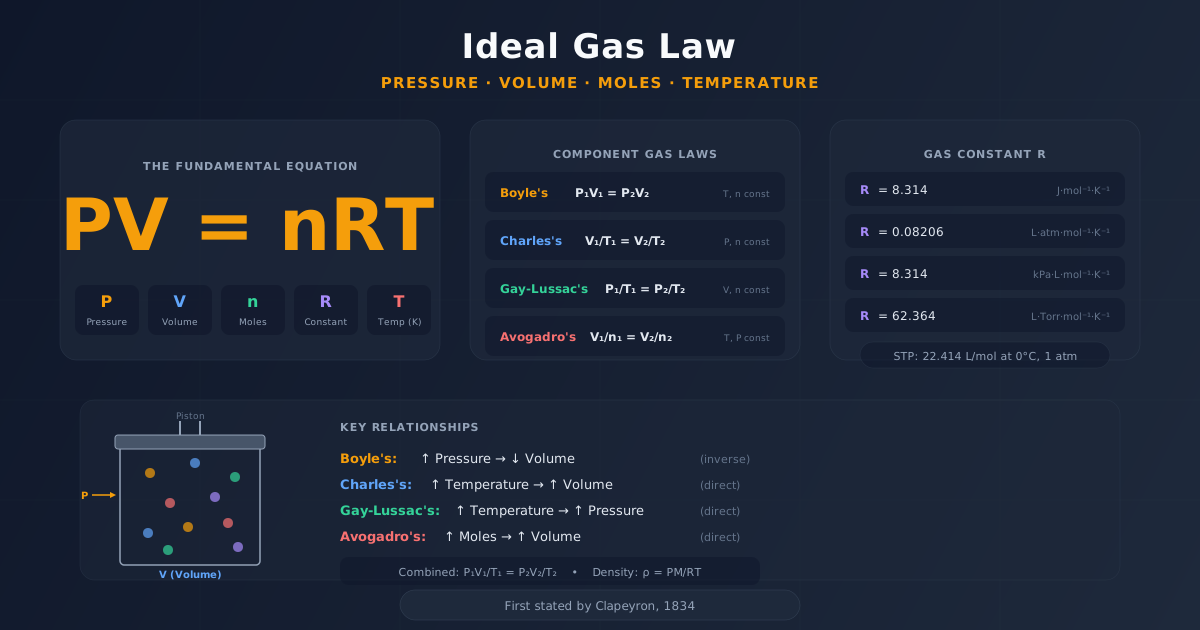
The Ideal Gas Law (PV = nRT): Formula, Derivation, Solved Problems and Real-World Applications
The ideal gas law is the single most useful equation in the study of gases. Written as PV = nRT, it connects four measurable properties — pressure, volume, the amount of gas, and temperature — through one universal constant. Whether you are calculating how much air remains in a scuba tank at depth, predicting tyre pressure on a summer highway, or determining the molar mass of an unknown vapour in a laboratory, this equation is the starting point.
Also referred to as the perfect gas law, the general gas equation, or the universal equation of state, PV = nRT was first stated in 1834 by the French engineer Benoît Paul Émile Clapeyron and, independently, by the Russian chemist Dmitri Mendeleev. It did not emerge from a single experiment. Instead, it unified roughly 170 years of independent discoveries — from Robert Boyle’s pressure–volume work in 1662 through Amedeo Avogadro’s mole–volume insight in 1811 — into a single, elegant relationship.
This article explains every variable in PV = nRT, shows where the equation comes from historically and theoretically, walks through the most common problem types with fully worked solutions, and clarifies exactly when the law can be trusted and when it breaks down. If you need to compute a result right now, you can also use our ideal gas law calculator.
What Is the Ideal Gas Law?
The ideal gas law is an equation of state that describes how the pressure, volume, temperature, and amount of a gas are related under conditions where the gas behaves “ideally” — that is, where its molecules are far enough apart that their own size and any attractive or repulsive forces between them can be ignored.
The equation is:
PV = nRTIdeal Gas LawEach symbol represents a specific, measurable quantity:
P is the absolute pressure of the gas — the total force per unit area that the gas exerts on the walls of its container. In SI units, pressure is measured in pascals (Pa), where 1 Pa = 1 N/m². Other common units include atmospheres (atm), bar, kilopascals (kPa), and millimetres of mercury (mmHg or Torr). It is important to use absolute pressure, not gauge pressure, in PV = nRT. Gauge pressure reads zero at atmospheric pressure, while absolute pressure includes the atmosphere: P_absolute = P_gauge + P_atmospheric.
V is the volume the gas occupies, measured in cubic metres (m³) in SI, though litres (L) are far more common in chemistry. The conversion is straightforward: 1 L = 0.001 m³, or equivalently, 1 m³ = 1000 L.
n is the amount of gas measured in moles. One mole contains exactly 6.02214076 × 10²³ particles (Avogadro’s number, N_A), a value fixed by international agreement in the 2019 redefinition of SI base units. If you are given the mass of a gas in grams, you first convert to moles using n = m / M, where M is the molar mass in g/mol.
R is the universal gas constant (more on its value and meaning in the next section).
T is the absolute temperature in kelvin (K). The kelvin scale starts at absolute zero — the theoretical point where molecular motion ceases entirely — and uses the same degree size as Celsius. The conversion is T(K) = T(°C) + 273.15. Using Celsius or Fahrenheit directly in PV = nRT produces incorrect results because these scales have arbitrary zero points; only an absolute scale preserves the proportionality relationships (V ∝ T, P ∝ T) that underpin the law.
What Is an “Ideal” Gas?
Ideal Gas
A theoretical model in which gas molecules have negligible volume, exert no intermolecular forces except during perfectly elastic collisions of negligible duration, and move in constant, random motion obeying Newton’s laws.
An ideal gas is a theoretical model built on three assumptions. First, the gas consists of a very large number of molecules in constant, random motion that obey Newton’s laws. Second, the volume of the molecules themselves is negligibly small compared with the total volume of the container. Third, no intermolecular forces act between the molecules except during perfectly elastic collisions of negligible duration.
No real gas satisfies these assumptions perfectly. However, most common gases — nitrogen, oxygen, helium, argon, carbon dioxide — behave very nearly ideally at temperatures well above their boiling points and at pressures around or below 1 atm. Under these everyday conditions, the ideal gas law typically predicts real gas behaviour to within 1–2%. Deviations become significant only at high pressures (roughly above 10 atm for most gases) or at temperatures close to the gas’s condensation point, where intermolecular attractions become too strong to ignore.
The Universal Gas Constant R: Value, Units and Physical Meaning
R is the proportionality constant that makes PV = nRT dimensionally consistent. Its value does not depend on the type of gas — it is truly universal, applying equally to hydrogen, nitrogen, argon, or any ideal gas.
The currently accepted value, based on the 2019 SI redefinition, is:
R = 8.31446261815324 J·mol⁻¹·K⁻¹ (exact)Universal Gas Constant (SI)This value became exact when the Boltzmann constant k_B and Avogadro’s number N_A were fixed by definition, because R is their product:
R = N_A × k_B = (6.02214076 × 10²³ mol⁻¹) × (1.380649 × 10⁻²³ J·K⁻¹)R from fundamental constantsPhysically, R represents the amount of energy per mole per kelvin of temperature — it tells you how much the product PV changes when you raise the temperature of one mole of ideal gas by one kelvin. This same constant appears across thermodynamics, statistical mechanics, and physical chemistry whenever you need to connect macroscopic measurements (pressure, volume) with molecular-scale energy.
R in Different Unit Systems
The numerical value of R changes depending on which units you use for pressure and volume. The most common values are:
R = 8.314 J·mol⁻¹·K⁻¹ — Use when pressure is in pascals (Pa) and volume in cubic metres (m³). This is the SI value and the one used in most physics courses.
R = 0.08206 L·atm·mol⁻¹·K⁻¹ — Use when pressure is in atmospheres (atm) and volume in litres (L). This is the most common form in general chemistry courses and textbooks.
R = 8.314 kPa·L·mol⁻¹·K⁻¹ — Use when pressure is in kilopascals (kPa) and volume in litres (L).
R = 62.364 L·Torr·mol⁻¹·K⁻¹ — Use when pressure is in torr (or mmHg) and volume in litres (L).
R = 1.987 cal·mol⁻¹·K⁻¹ — Occasionally used in older thermochemistry texts where energy is expressed in calories.
Unit mismatch is the most common mistake. The rule is simple: choose the R value whose pressure and volume units match your given data, or convert your data to match the R you prefer. Either approach works, but mixing units is guaranteed to produce a wrong answer.
Where PV = nRT Comes From: The Component Gas Laws
The ideal gas law was not discovered in a single experiment. It is the synthesis of four independently discovered empirical laws, each describing how one pair of gas properties behaves when the others are held constant. Over roughly 150 years, from 1662 to 1811, four relationships were established. Clapeyron combined them into PV = nRT in 1834, and two decades later, August Krönig (1856) and Rudolf Clausius (1857) independently showed that the same equation could be derived from first principles using Newton’s laws applied to molecular motion.
Boyle’s Law — Pressure and Volume (1662)
Robert Boyle, working with apparatus built by his assistant Robert Hooke, demonstrated in 1662 that for a fixed amount of gas at constant temperature, pressure and volume are inversely proportional:
P ∝ 1/V (at constant T, n), or equivalently P₁V₁ = P₂V₂Boyle’s LawThis is simply PV = nRT with n, R, and T all held constant, so that PV = constant.
The physical explanation is intuitive: the same number of molecules confined to a smaller space collide with the container walls more frequently, producing higher pressure. Halve the volume and the pressure doubles. Boyle’s law is at work every time you compress a syringe, inflate a bicycle tyre, or watch a diver’s air bubbles expand as they rise toward the surface.
For a complete treatment of Boyle’s law — including its graphical representation, multiple worked examples, and real-world applications from breathing mechanics to deep-sea diving — see our dedicated Boyle’s law article.
Charles’s Law — Volume and Temperature (1787)
Jacques Charles discovered in 1787, and Joseph Louis Gay-Lussac published in 1802, that for a fixed amount of gas at constant pressure, volume is directly proportional to absolute temperature:
V ∝ T (at constant P, n), or equivalently V₁/T₁ = V₂/T₂Charles’s LawThis is PV = nRT with P, n, and R held constant, giving V/T = nR/P = constant.
Charles’s law is why hot air balloons work. Heating the air inside the balloon at atmospheric pressure makes it expand. The same mass of air now occupies a larger volume, reducing its density below that of the cooler surrounding air, and the balloon rises. It is also why a partially inflated balloon left in a cold car appears to shrink — the gas inside contracts as its temperature drops — and why it returns to its original size when brought back indoors.
Gay-Lussac’s Law — Pressure and Temperature (1808)
Joseph Louis Gay-Lussac showed in 1808 that for a fixed amount of gas in a rigid container (constant volume), pressure is directly proportional to absolute temperature:
P ∝ T (at constant V, n), or equivalently P₁/T₁ = P₂/T₂Gay-Lussac’s LawThis is PV = nRT with V, n, and R held constant, giving P/T = nR/V = constant.
Gay-Lussac’s law explains why automobile tyre pressure rises after a long drive. The friction and flexing of the rubber heat the air inside, and since the tyre volume is essentially fixed, the pressure climbs. A tyre inflated to 220 kPa at 15 °C (288 K) will reach approximately 251 kPa at 55 °C (328 K) — a 14% increase — which is exactly why vehicle manufacturers recommend checking tyre pressure when the tyres are cold.
The same principle governs pressure cookers. By sealing the vessel and heating the contents, the internal pressure rises above atmospheric, which raises the boiling point of water (to roughly 121 °C at 2 atm). Food cooks faster at these elevated temperatures, reducing cooking time by up to 70% compared with open boiling.
Avogadro’s Law — Volume and Amount (1811)
Amedeo Avogadro proposed in 1811 that equal volumes of any gas, measured at the same temperature and pressure, contain the same number of molecules:
V ∝ n (at constant T, P), or equivalently V₁/n₁ = V₂/n₂Avogadro’s LawThis is PV = nRT with P, R, and T held constant, giving V/n = RT/P = constant.
Avogadro’s law leads to one of the most useful benchmarks in chemistry: at standard temperature and pressure (0 °C and 1 atm), one mole of any ideal gas occupies 22.414 litres. Under the updated IUPAC standard (0 °C and 1 bar), the molar volume is 22.711 litres. This number provides a quick sanity check for any gas law calculation — if your answer for the volume of a few moles of gas at near-standard conditions is wildly different from a few tens of litres, something has gone wrong.
Unifying All Four
Each of the four laws holds one or two variables constant and describes the relationship between the remaining pair. When you combine them — recognising that PV/T = constant for a fixed amount of gas, and that V is proportional to n at fixed T and P — the result is:
PV = nRT
where R is the single proportionality constant that makes everything consistent. This is why R is called the “universal” gas constant: it absorbs all four empirical proportionalities into one number.
| Law | Year | Held Constant | Relationship | Formula | Everyday Example |
|---|---|---|---|---|---|
| Boyle’s | 1662 | T, n | P ∝ 1/V | P₁V₁ = P₂V₂ | Compressing a syringe |
| Charles’s | 1787 | P, n | V ∝ T | V₁/T₁ = V₂/T₂ | Hot air balloon rising |
| Gay-Lussac’s | 1808 | V, n | P ∝ T | P₁/T₁ = P₂/T₂ | Tyre pressure after driving |
| Avogadro’s | 1811 | T, P | V ∝ n | V₁/n₁ = V₂/n₂ | Inflating a balloon |
The Combined Gas Law
When the amount of gas stays constant but pressure, volume, and temperature all change simultaneously, you need the combined gas law:
P₁V₁ / T₁ = P₂V₂ / T₂Combined Gas LawThis equation is derived directly from PV = nRT. Since n and R are constant, the ratio PV/T must be the same before and after the change. The combined gas law is extremely practical because real-world gas processes rarely hold two variables fixed while changing only one — compression, heating, and expansion often happen together.
Every individual gas law is a special case of the combined gas law. If T is constant, the T terms cancel and you recover Boyle’s law. If P is constant, you get Charles’s law. If V is constant, you get Gay-Lussac’s law. Learning the combined gas law therefore means you need only one equation to handle all three situations, plus any scenario where multiple variables change at once.
All Forms of the Ideal Gas Law Equation
PV = nRT can be rearranged to solve for any unknown variable. Beyond this, there are several alternative forms that are useful in specific contexts.
Standard rearrangements
Solving for pressure:
P = nRT / VPressure from volume, moles, and temperatureSolving for volume:
V = nRT / PVolume from pressure, moles, and temperatureSolving for moles:
n = PV / RTMoles from pressure, volume, and temperatureSolving for temperature:
T = PV / nRTemperature from pressure, volume, and molesThe molecular form
If you are counting individual molecules rather than moles, replace n with N/N_A (where N is the number of molecules) and R with N_A × k_B:
PV = Nk_BTMolecular form of the ideal gas lawThis form is standard in physics and statistical mechanics. It says exactly the same thing as PV = nRT but uses the Boltzmann constant k_B = 1.380649 × 10⁻²³ J/K per molecule instead of R = 8.314 J/(mol·K) per mole.
The density form
Since n = m/M (mass divided by molar mass), you can substitute into PV = nRT and rearrange to express density:
ρ = PM / RTGas density from the ideal gas lawwhere ρ is the gas density in kg/m³ (or g/L). This form is useful in atmospheric science, engineering, and any situation where you know the pressure and temperature of a gas and need its density without first calculating the number of moles.
The molar mass form
Rearranging the density form gives a direct way to determine the molar mass of an unknown gas from measurable quantities:
M = mRT / PVMolar mass from measurable quantitiesHistorically, this technique confirmed the molecular formulas of many gases during the 19th century and it still appears in undergraduate chemistry and physics laboratories today. You measure the mass, pressure, volume, and temperature of a gas sample and calculate its molar mass, which you can then compare against known values to identify the gas.
How to Solve Ideal Gas Law Problems: A Step-by-Step Method
Gas law problems follow a consistent pattern. Developing a systematic approach avoids the most common errors — which almost always involve unit mismatches or forgetting to convert to kelvin.
Step 1 — Convert temperature to kelvin. T(K) = T(°C) + 273.15. This is the single most frequent source of errors in gas calculations. If a problem gives temperature in Fahrenheit, first convert to Celsius using T(°C) = [T(°F) − 32] × 5/9, then add 273.15.
Step 2 — Convert pressure to a consistent unit. Know the key conversions: 1 atm = 101,325 Pa = 760 mmHg = 760 Torr = 101.325 kPa = 1.01325 bar = 14.696 psi. If the problem uses gauge pressure, add atmospheric pressure to get absolute pressure.
Step 3 — Convert volume to a consistent unit. 1 L = 0.001 m³ = 1000 mL = 1000 cm³. If using R = 0.08206, keep volume in litres. If using R = 8.314 (SI), convert to cubic metres.
Step 4 — Choose the correct value of R. Match R’s units to the pressure and volume units you have after conversion. If your pressure is in atm and volume in litres, use R = 0.08206 L·atm/(mol·K). If in Pa and m³, use R = 8.314 J/(mol·K).
Step 5 — Identify the unknown and rearrange PV = nRT to isolate it algebraically before substituting numbers.
Step 6 — Substitute values and calculate. Keep track of units throughout — they should cancel correctly, leaving only the unit of your unknown.
Step 7 — Sense-check. Does the answer have a reasonable magnitude? A few moles of gas at near-standard conditions should occupy tens of litres. A gas compressed to a very small volume should have high pressure. If your answer violates these basic expectations, re-examine your units and arithmetic.
Worked Examples and Solved Problems
Example 1: Finding Volume
Problem: 2.0 mol of nitrogen gas at 300 K is held at a pressure of 1.5 × 10⁵ Pa. What volume does the gas occupy?
Solution:
Rearrange for volume: V = nRT / P
V = (2.0 mol × 8.314 J·mol⁻¹·K⁻¹ × 300 K) / (1.5 × 10⁵ Pa)
V = 4988.4 / 150,000 = 0.0333 m³ = 33.3 L
Sense check: One mole at STP occupies about 22.4 L, so two moles at 300 K (slightly above STP temperature of 273 K) and 1.48 atm should give somewhat less than 44.8 L. The answer of 33.3 L is consistent.
Example 2: Finding Pressure
Problem: 5.0 moles of an ideal gas occupy 15.0 L at 350 K. What is the pressure in atmospheres?
Solution:
Rearrange for pressure: P = nRT / V
P = (5.0 × 0.08206 × 350) / 15.0
P = 143.605 / 15.0 = 9.57 atm
Sense check: Five moles at STP would occupy about 112 L. Squeezing that into 15 L — roughly 7.5 times smaller — at a higher temperature should produce pressure well above 1 atm. The answer of 9.57 atm is reasonable.
Example 3: Finding Moles
Problem: A cylinder contains argon gas at 18.4 atm and 127 °C. The cylinder volume is 50.0 L. How many moles of argon are present?
Solution:
First, convert temperature: T = 127 + 273.15 = 400.15 K ≈ 400 K
Rearrange for moles: n = PV / RT
n = (18.4 × 50.0) / (0.08206 × 400)
n = 920 / 32.824 = 28.0 mol
Example 4: Finding Temperature
Problem: 0.50 mol of helium gas occupies 6.15 L at a pressure of 2.00 atm. What is the temperature?
Solution:
Rearrange for temperature: T = PV / nR
T = (2.00 × 6.15) / (0.50 × 0.08206)
T = 12.30 / 0.04103 = 299.8 K ≈ 300 K (about 27 °C)
Example 5: Combined Gas Law Problem
Problem: A gas starts at P₁ = 1.0 × 10⁵ Pa, V₁ = 0.010 m³, T₁ = 300 K. It is compressed to V₂ = 0.004 m³ and simultaneously heated to T₂ = 400 K. The amount of gas does not change. Find P₂.
Solution:
Using the combined gas law: P₁V₁/T₁ = P₂V₂/T₂
Rearrange for P₂: P₂ = P₁V₁T₂ / (T₁V₂)
P₂ = (1.0 × 10⁵ × 0.010 × 400) / (300 × 0.004)
P₂ = 400,000 / 1.2 = 3.33 × 10⁵ Pa
Understanding the result: Two effects compound here. The compression factor is 0.010/0.004 = 2.5 (reducing volume by 60% multiplies pressure by 2.5). The heating factor is 400/300 = 1.33 (raising temperature by 33% multiplies pressure by 1.33). Combined: 2.5 × 1.33 = 3.33, confirming the answer.
Example 6: Determining Molar Mass of an Unknown Gas
Problem: A 4.50 g sample of an unknown gas occupies 2.00 L at 1.00 atm and 27 °C. What is the molar mass of the gas? Identify it.
Solution:
Convert temperature: T = 27 + 273.15 = 300.15 K ≈ 300 K
First find moles: n = PV / RT = (1.00 × 2.00) / (0.08206 × 300) = 2.00 / 24.618 = 0.0812 mol
Then find molar mass: M = m / n = 4.50 / 0.0812 = 55.4 g/mol
Consulting a periodic table, this is very close to the molar mass of butane (C₄H₁₀, M = 58.12 g/mol) or possibly nitrogen dioxide (NO₂, M = 46.01 g/mol). Given that the calculation is approximate and depends on measurement precision, the gas is most likely butane.
Example 7: Gas Density Calculation
Problem: What is the density of carbon dioxide (CO₂, M = 44.01 g/mol) at 1.00 atm and 25 °C?
Solution:
Using the density form: ρ = PM / RT
Convert units: P = 1.00 atm = 101,325 Pa, T = 25 + 273.15 = 298.15 K, M = 0.04401 kg/mol
ρ = (101,325 × 0.04401) / (8.314 × 298.15)
ρ = 4459.3 / 2478.8 = 1.80 kg/m³ = 1.80 g/L
Context: This is about 1.5 times the density of air at the same conditions (~1.18 kg/m³), which is why CO₂ sinks and pools in low-lying areas — a real hazard in volcanic regions and confined spaces like breweries and wine cellars.
PV = nRT and the Kinetic Molecular Theory
The ideal gas law is not merely an empirical formula stitched together from experimental observations. It can be derived rigorously from Newton’s laws of motion applied to gas molecules — a result achieved independently by August Krönig in 1856 and Rudolf Clausius in 1857.
The derivation proceeds by considering N molecules of mass m bouncing around inside a cubic box of side length L. Each molecule that strikes a wall delivers an impulse (a brief force) to the wall. Summing the average forces from all molecular impacts and connecting the average kinetic energy of a molecule to temperature through the relation:
KE_avg = ½mv² = (3/2)k_BTAverage kinetic energy of a gas moleculeyields:
PV = Nk_BT = nRT
The physical insight here is profound. Temperature is not some vague notion of “hotness” — it is a direct, quantitative measure of average molecular kinetic energy. At 300 K, for instance, nitrogen molecules (the dominant component of air) have a root-mean-square speed of approximately 515 m/s — faster than the muzzle velocity of many handguns. Lighter molecules move faster at the same temperature: hydrogen molecules at 300 K travel at roughly 1,920 m/s, while heavier CO₂ molecules move at about 410 m/s.
Pressure, in turn, is simply the macroscopic result of countless molecular impacts. At atmospheric pressure and room temperature, roughly 10²³ molecules hit every square centimetre of surface every second. Each individual impact is negligible, but their collective effect is the steady force per unit area we experience as atmospheric pressure — about 101,325 Pa, equivalent to 10.33 tonnes of force pressing down on every square metre.
For a deeper exploration of how molecular motion produces the macroscopic properties of gases, including the Maxwell-Boltzmann speed distribution and the meaning of temperature at the molecular level, see James Clerk Maxwell’s contributions to kinetic theory.
Real Gases vs Ideal Gases: When PV = nRT Breaks Down
The ideal gas law assumes molecules have zero volume and zero intermolecular forces. Real molecules violate both assumptions. The question is: by how much?
At moderate conditions (around room temperature and 1 atm): Very little. Nitrogen, oxygen, argon, helium, and most common gases deviate from ideal predictions by less than 1–2% under these conditions. The ideal gas law is more than adequate for engineering estimates, chemistry calculations, and most physics problems.
At high pressures (above roughly 10 atm): Molecules are forced close enough together that their finite volume matters. The “available” volume for molecular motion is noticeably less than V, so the gas is harder to compress than the ideal law predicts. The compressibility factor Z = PV/nRT, which equals 1.00 for an ideal gas, begins to deviate — for nitrogen at 300 atm and 300 K, Z ≈ 1.3, meaning the gas occupies about 30% more volume than the ideal law would predict.
At low temperatures (near the boiling point): Intermolecular attractive forces become significant relative to the kinetic energy of the molecules. These attractions pull molecules toward each other, effectively reducing the pressure below what the ideal law predicts. Near the condensation point, the deviations become dramatic and the gas may liquefy entirely — a phase transition that PV = nRT cannot describe at all.
The Van der Waals Equation
In 1873, the Dutch physicist Johannes Diderik van der Waals proposed a correction to the ideal gas law in his doctoral thesis — work that earned him the Nobel Prize in Physics in 1910. His equation accounts for both non-ideal effects:
(P + an²/V²)(V − nb) = nRTVan der Waals EquationThe constant a corrects for intermolecular attractions. It has units of L²·atm/mol² (or Pa·m⁶/mol²) and is larger for gases with stronger intermolecular forces. Water vapour, with its hydrogen bonds, has a = 5.536 L²·atm/mol², while helium, with its extremely weak forces, has a = 0.0342 L²·atm/mol².
The constant b corrects for the finite volume of molecules. It has units of L/mol and is larger for bigger molecules. For helium, b = 0.0238 L/mol; for carbon dioxide, b = 0.0427 L/mol.
When V is large and n is small — that is, when the gas is dilute — both correction terms become negligible: an²/V² → 0 and nb → 0, and the van der Waals equation reduces exactly to PV = nRT. This confirms that the ideal gas law is a limiting case of the more general real-gas equation, valid when molecules are far apart enough that their size and interactions do not matter.
Real-World Applications of the Ideal Gas Law
The ideal gas law is not just a classroom exercise. It underpins calculations in engineering, medicine, atmospheric science, and daily life.
Internal Combustion Engines
Every stroke of an internal combustion engine is a gas law calculation. During the compression stroke, the piston squeezes the air-fuel mixture into a fraction of its original volume — a typical compression ratio of 10:1 means the volume is reduced by 90%, and by Boyle’s law the pressure rises roughly tenfold. During the power stroke, combustion releases chemical energy that dramatically raises the gas temperature. By Gay-Lussac’s law, this temperature spike produces a further surge in pressure — the force that drives the piston down and ultimately turns the wheels.
Scuba Diving and Underwater Breathing
A standard scuba tank holds air compressed to approximately 200 atm. As a diver descends, ambient water pressure increases by about 1 atm for every 10 metres of depth. At 30 metres, the total pressure is 4 atm, and by Boyle’s law the volume of each breath drawn from the tank is one-quarter of what it would be at the surface — meaning the air supply depletes four times faster at depth. Dive planning relies entirely on PV = nRT to calculate remaining air at each depth and ensure a safe ascent.
Ascending too quickly creates a dangerous reverse application of Boyle’s law: dissolved gases in the blood expand as pressure drops, forming bubbles that can block blood vessels. This condition — decompression sickness, or “the bends” — is why divers must ascend slowly, allowing dissolved gases to be exhaled gradually.
Weather Balloons and Atmospheric Science
A weather balloon launched at sea level expands steadily as it rises because the atmospheric pressure drops with altitude. By Boyle’s law, the decreasing external pressure allows the balloon’s volume to increase. The balloon typically bursts at an altitude of 30–40 km, where ambient pressure is less than 1% of the sea-level value and the balloon has expanded to many times its original diameter.
The ideal gas law, combined with the hydrostatic equation describing how pressure changes with altitude, produces the barometric formula:
P = P₀ × e^(−Mgh/RT)Barometric FormulaThis equation predicts that atmospheric pressure halves roughly every 5.5 km of altitude — a prediction that matches observations closely and forms the basis of altimeter calibration in aircraft, weather forecasting models, and climate science.
Airbag Deployment
Modern automobile airbags use a rapid chemical reaction — the decomposition of sodium azide (NaN₃) — to produce a large volume of nitrogen gas in approximately 30 milliseconds. The ideal gas law determines exactly how much sodium azide is needed to produce enough gas to inflate the bag to the correct volume at the correct pressure, cushioning the occupant without over-inflating and causing injury.
Refrigeration and Air Conditioning
Refrigerators, air conditioners, and heat pumps all exploit gas law relationships. A compressor reduces the volume of the refrigerant gas, increasing its pressure and temperature (Boyle’s and Gay-Lussac’s laws). The hot, high-pressure gas then releases heat through a condenser. When the refrigerant is allowed to expand through an expansion valve, its pressure and temperature drop sharply, enabling it to absorb heat from the space being cooled. The entire cycle is a continuous loop of gas law processes.
Molar Mass Determination in Laboratories
Since PV = nRT can be rearranged to M = mRT/(PV), measuring the mass, pressure, volume, and temperature of an unknown gas sample is sufficient to calculate its molar mass. This technique was instrumental in establishing the molecular formulas of many gases during the 19th century and remains a standard undergraduate experiment today.
Standard Temperature and Pressure (STP)
Scientists use standard conditions as a common reference point for comparing gas properties. The definition of STP has changed over time:
The traditional definition, still used widely in chemistry education, sets STP at 0 °C (273.15 K) and 1 atm (101,325 Pa). Under these conditions, one mole of ideal gas occupies 22.414 litres.
Since 1982, IUPAC has recommended a slightly different standard: 0 °C and 1 bar (100,000 Pa). Under this definition, the molar volume is 22.711 litres.
The difference is small (about 1.3%), but it matters when high precision is required. Always check which definition a problem or textbook uses before plugging in a molar volume value.
Common Unit Conversions for Gas Law Problems
Having the right conversions at hand eliminates the biggest source of errors in gas calculations.
Pressure: 1 atm = 101,325 Pa = 101.325 kPa = 1.01325 bar = 760 mmHg = 760 Torr = 14.696 psi
Volume: 1 m³ = 1000 L; 1 L = 1000 mL = 1000 cm³; 1 cm³ = 10⁻⁶ m³
Temperature: T(K) = T(°C) + 273.15; T(°C) = [T(°F) − 32] × 5/9
Amount: n (mol) = mass (g) / molar mass (g/mol); 1 mol = 6.02214076 × 10²³ particles
Frequently Asked Questions
What is the ideal gas law PV = nRT?
PV = nRT is the ideal gas law — a single equation relating the pressure (P), volume (V), amount in moles (n), and absolute temperature (T) of a gas through the universal gas constant R. It predicts how changing any one of these variables affects the others, and it works well for most gases at moderate temperatures and pressures. The equation synthesises Boyle’s law (P ∝ 1/V), Charles’s law (V ∝ T), Gay-Lussac’s law (P ∝ T), and Avogadro’s law (V ∝ n) into a single, universal relationship.
What does each letter in PV = nRT stand for?
P is pressure in pascals (Pa) or atmospheres (atm). V is volume in cubic metres (m³) or litres (L). n is the number of moles of gas. R is the universal gas constant, equal to 8.314 J/(mol·K) in SI units or 0.08206 L·atm/(mol·K) in chemistry-standard units. T is absolute temperature in kelvin (K).
What is R in PV = nRT and what is its value?
R is the universal gas constant. Its SI value is 8.31446261815324 J/(mol·K). It is defined as the product of Avogadro’s number (6.02214076 × 10²³ mol⁻¹) and the Boltzmann constant (1.380649 × 10⁻²³ J/K). Both of these values were fixed exactly in the 2019 SI redefinition, making R exact as well. When using atmospheres and litres, the equivalent value is R = 0.08206 L·atm/(mol·K).
Why must temperature be in kelvin in PV = nRT?
The gas laws require proportionality with temperature (V ∝ T, P ∝ T). Proportionality only works on a scale that starts at true zero — the point where molecular kinetic energy would theoretically vanish. The kelvin scale starts at absolute zero (−273.15 °C). Celsius has an arbitrary zero (the freezing point of water), and Fahrenheit’s zero is even more arbitrary. Using either in PV = nRT produces physically meaningless results. This is the most common calculation mistake students make.
What is the combined gas law formula?
The combined gas law is P₁V₁/T₁ = P₂V₂/T₂. It applies when the amount of gas (n) stays constant but pressure, volume, and temperature all change. It is derived directly from PV = nRT and contains Boyle’s, Charles’s, and Gay-Lussac’s laws as special cases.
What is an ideal gas? Do ideal gases actually exist?
An ideal gas is a theoretical model in which molecules have negligible volume, exert no intermolecular forces, and collide perfectly elastically. No real gas matches this description exactly. However, most common gases (N₂, O₂, He, Ar) at room temperature and atmospheric pressure behave within 1–2% of ideal predictions. Noble gases like helium come closest to ideal behaviour because their single atoms are small and interact only very weakly with each other.
When does the ideal gas law fail?
PV = nRT fails at high pressures (typically above 10 atm) where molecular volume becomes significant relative to the container, and at low temperatures near the gas’s boiling point where intermolecular attractions cause the gas to deviate from ideal behaviour or even liquefy. The van der Waals equation — (P + an²/V²)(V − nb) = nRT — provides a more accurate model under these conditions by correcting for molecular volume (b) and intermolecular attractions (a).
What is the difference between the ideal gas law and the combined gas law?
The ideal gas law (PV = nRT) can find any one of the four variables (P, V, n, T) when the other three are known. It applies to a single state of the gas. The combined gas law (P₁V₁/T₁ = P₂V₂/T₂) compares two states of the same gas sample when its conditions change, assuming the amount of gas remains constant. The combined gas law is derived from PV = nRT by setting nR equal on both sides.
What is the molar volume of a gas at STP?
At STP defined as 0 °C and 1 atm, the molar volume is 22.414 L/mol. At the IUPAC-recommended standard of 0 °C and 1 bar, it is 22.711 L/mol. These values follow directly from PV = nRT: V = nRT/P = (1 mol × 0.08206 × 273.15) / 1.00 atm = 22.4 L.
How is the ideal gas law related to kinetic molecular theory?
PV = nRT can be derived from Newton’s laws applied to molecular motion. The derivation shows that pressure arises from molecular impacts on container walls and that temperature is a direct measure of average molecular kinetic energy: KE_avg = (3/2)k_BT. This gives the equation its theoretical foundation, establishing that it is not merely empirical but grounded in fundamental mechanics.
For a quick calculation tool, try our ideal gas law calculator. For related topics, explore our articles on entropy, simple harmonic motion, and Newton’s laws of motion.
The Scientists Behind the Ideal Gas Law

Who Provided the Kinetic Theory Foundation
James Clerk Maxwell (1831–1879)
Maxwell’s kinetic theory of gases and the Maxwell-Boltzmann speed distribution gave PV = nRT its theoretical foundation, connecting macroscopic gas behaviour to molecular motion and energy.
Read his full biography →
Whose Laws Underpin the Derivation
Isaac Newton (1643–1727)
Newton’s laws of motion are the foundation from which PV = nRT can be derived from first principles — every molecular collision and impulse calculation in kinetic theory rests on his mechanics.
Read his full biography →