
Kinetic Energy Calculator
Solve for kinetic energy, mass, or velocity from KE = ½mv², work out how much a force changes an object's kinetic energy with the work-energy theorem, or relate kinetic energy to momentum — all in one tool.
Kinetic Energy Calculator Tool
Fill in exactly 2 of the 3 fields below and leave the other blank — the calculator solves for the missing value automatically.
Quick-load a scenario:
Results
Step-by-Step Solution
How This Calculator Works
Kinetic energy is the energy an object has because it is moving. This calculator covers three related ways of working with it: the basic formula KE = ½mv², the work-energy theorem that connects work done to a change in kinetic energy, and a momentum-based form that's useful whenever momentum — not velocity — is what you know.
Pick a mode, fill in the known values, leave the unknown one blank, and the calculator solves for it — showing the equation, the substitution, and the working, the same way you'd write it out by hand.
The Formulas Used
Basic Kinetic Energy
Kinetic energy equals one-half the mass multiplied by velocity squared. Because velocity is squared, doubling speed quadruples kinetic energy — doubling mass only doubles it.
Work-Energy Theorem
The net work done on an object equals the change in its kinetic energy. Positive work speeds an object up; negative work (like braking friction) slows it down.
Momentum-Based Kinetic Energy
Since momentum p = mv, substituting v = p/m into KE = ½mv² gives KE in terms of momentum and mass directly — useful whenever momentum is the known or conserved quantity, such as in collisions.
Real-World Kinetic Energy Comparisons
These figures give a sense of scale for kinetic energy, calculated directly from KE = ½mv² using approximate real-world masses and speeds:
Quick-Load Presets
The Work-Energy Theorem Explained
The work-energy theorem is one of the most useful relationships in mechanics because it connects forces to changes in speed without needing to know acceleration or time directly. If you know how much work a force does on an object — and its starting speed — you can find its final speed, and vice versa.
This is exactly how braking distance and impact-force problems are approached: friction does negative work on a moving vehicle, and the work-energy theorem tells you how much kinetic energy (and therefore speed) is lost over a given braking distance.
Work and kinetic energy share units (joules) precisely because the work-energy theorem defines a direct exchange between them — work is energy transferred by a force acting through a distance.
Kinetic Energy and Momentum
Momentum (p = mv) and kinetic energy (KE = ½mv²) both grow with mass and velocity, but they scale differently — momentum grows linearly with velocity, kinetic energy grows with velocity squared. Two objects with the same momentum do not generally have the same kinetic energy unless their masses are also equal.
Substituting v = p/m into the kinetic energy formula gives KE = p²/(2m) — the momentum-based form this calculator's third mode solves. This is especially useful in collision problems, where momentum is conserved but kinetic energy generally is not (except in perfectly elastic collisions).
Where This Model Breaks Down
KE = ½mv² is the classical, non-relativistic formula for kinetic energy. It assumes speeds are small compared to the speed of light, which is true for essentially every everyday situation — cars, planes, thrown objects, even orbiting spacecraft.
As an object's speed becomes a significant fraction of the speed of light, this formula increasingly understates the true kinetic energy, and Einstein's special relativity is needed for an accurate result. This calculator is intended for classical mechanics problems and does not apply at relativistic speeds.
Related Calculators and Simulations
Calculators
Simulations
Frequently Asked Questions
What is kinetic energy?
Kinetic energy is the energy an object possesses because of its motion. Any moving object — a rolling ball, a flying bullet, a car on a highway — has kinetic energy, and the faster or heavier it is, the more it has. It is measured in joules (J) in the SI system.
What is the kinetic energy formula?
The classical (non-relativistic) formula is KE = ½mv², where m is mass in kilograms and v is velocity in metres per second. Because velocity is squared, doubling speed quadruples kinetic energy, while doubling mass only doubles it.
What is the work-energy theorem?
The work-energy theorem states that the net work done on an object equals its change in kinetic energy: W = ΔKE = ½mv_f² − ½mv_i². It connects forces acting over a distance to the resulting change in speed, and is the basis for calculations like braking distance and impact force.
How is kinetic energy related to momentum?
Kinetic energy and momentum both depend on mass and velocity, but combine them differently. Since momentum p = mv, kinetic energy can be rewritten as KE = p²/(2m). This form is especially useful when momentum is known or conserved, such as in collision problems, without needing velocity directly.
Does kinetic energy depend on direction?
No. Kinetic energy depends only on speed (the magnitude of velocity), not direction — it is a scalar quantity. Momentum, by contrast, is a vector and does depend on direction. This is why kinetic energy is always positive (or zero), never negative.
Why does KE = ½mv² break down at very high speeds?
KE = ½mv² is the low-speed (non-relativistic) approximation of a more general relativistic expression. It becomes noticeably inaccurate once an object's speed approaches a significant fraction of the speed of light, where Einstein's special relativity takes over. For everyday speeds — cars, planes, even orbital spacecraft — the classical formula is accurate to many decimal places.
What units is kinetic energy measured in?
The SI unit is the joule (J), equal to 1 kg·m²/s². Other common units include the kilojoule (kJ), calorie (cal), and kilowatt-hour (kWh) — the same units used for work and other forms of energy, since kinetic energy is interchangeable with them.
The Scientists Behind Kinetic Energy
Who Named "Kinetic Energy"
Lord Kelvin (1824–1907)
Lord Kelvin coined the term "kinetic energy" in 1849, giving a precise name to the energy of motion this calculator computes.
Full biography coming soon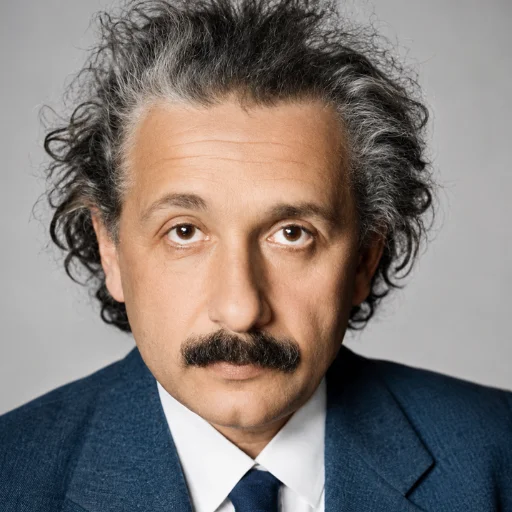
Where the Classical Formula Breaks Down
Albert Einstein (1879–1955)
Einstein's special relativity replaces KE = ½mv² at speeds approaching the speed of light, where mass and energy become interchangeable.
Read his full biography →