Newton’s Third Law of Motion: Definition, Formula, Examples, and the Physics of Action and Reaction
In 1687, Isaac Newton published a book that redefined humanity’s understanding of the physical world. That book, Philosophiae Naturalis Principia Mathematica, known simply as the Principia, contained three laws of motion. The third of those laws, the law of action and reaction, is arguably the most elegant and the most misunderstood principle in all of classical mechanics.
Newton’s third law of motion states that for every action force, there is an equal and opposite reaction force acting on a different object. It sounds deceptively simple. Students memorise it, repeat it, and then consistently misapply it. Researchers have documented that the third law produces the highest rate of misconceptions among all three of Newton’s laws, with studies showing that more than half of physics students hold incorrect beliefs about how action-reaction pairs actually work. One study of 132 eleventh-grade students found that misconceptions were most severe and most persistent specifically on Newton’s third law, particularly when identifying action-reaction force pairs.
This article goes deeper than a textbook summary. It explains what the third law actually says — in Newton’s own words from the original Latin — what it means physically, where students go wrong, how it connects to conservation of momentum, and where it ultimately breaks down at the boundaries of modern physics. Along the way, it uses real numerical data, from the 34,000 kN thrust of the Saturn V to the imperceptible acceleration of the Earth beneath your feet, to ground every concept in measurable, verifiable reality.
What Is Newton’s Third Law of Motion?
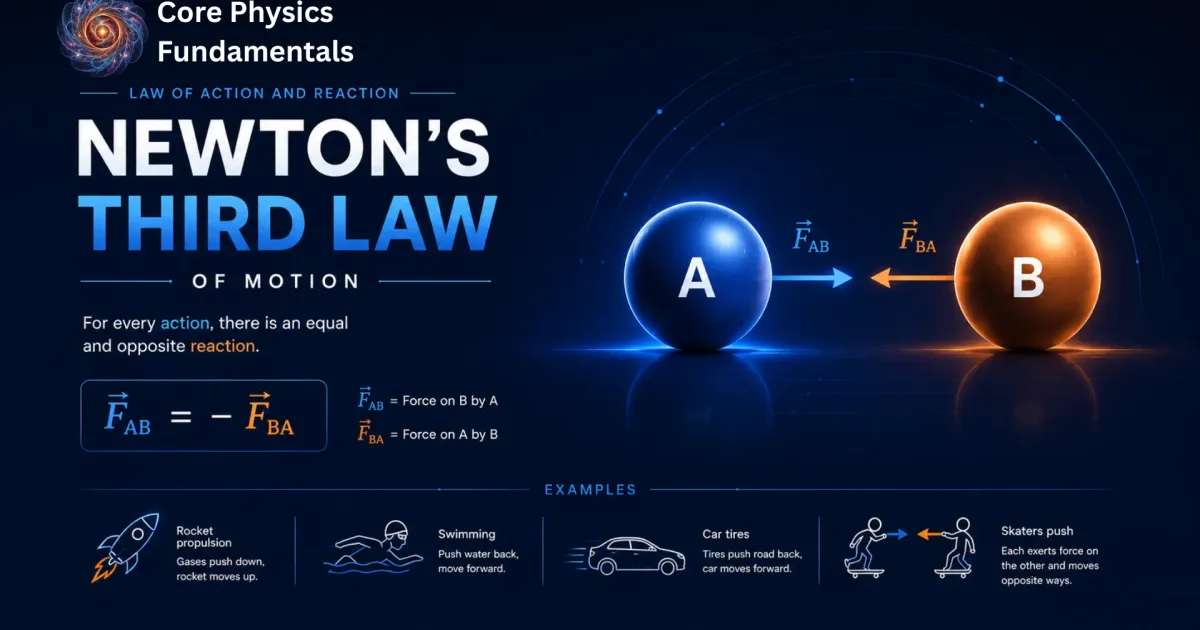
Newton’s third law of motion states that when one object exerts a force on a second object, the second object simultaneously exerts a force equal in magnitude and opposite in direction on the first object. These two forces are called an action-reaction pair, and they always act on two different objects.
Newton’s Third Law of Motion
For every action force, there is an equal and opposite reaction force. The two forces act on different objects, are the same type of force, and exist simultaneously.
The law is sometimes summarised as: for every action, there is an equal and opposite reaction. While this shorthand captures the idea, it also invites the most common misunderstanding — that the two forces somehow cancel each other. They do not, and the reason they do not is the entire conceptual point of the law.
The Original Statement from the Principia
Newton stated the third law in Latin in the Principia, under the heading Axiomata, sive Leges Motus (Axioms, or Laws of Motion). The original text reads:
“Actioni contrariam semper et aequalem esse reactionem: sive corporum duorum actiones in se mutuo semper esse aequales et in partes contrarias dirigi.”
Translated into English by Andrew Motte in 1729 — two years after Newton’s death — this becomes: “To every action there is always opposed an equal reaction: or the mutual actions of two bodies upon each other are always equal, and directed to contrary parts.”
Newton himself followed this statement with a concrete example that remains one of the clearest illustrations of the law ever written. He wrote: “Whatever draws or presses another is as much drawn or pressed by that other. If you press a stone with your finger, the finger is also pressed by the stone. If a horse draws a stone tied to a rope, the horse (if I may so say) will be equally drawn back towards the stone.”
That passage, written over three centuries ago, addresses head-on the very confusion that students still struggle with today. The horse-and-stone example anticipates the famous horse-cart paradox, which we will examine in detail later in this article.
What “Equal and Opposite” Actually Means
The phrase “equal and opposite” specifies two things precisely. The forces in an action-reaction pair are equal in magnitude — if you push a wall with 50 newtons, the wall pushes you with 50 newtons. They are opposite in direction — your push goes into the wall, and the wall’s push comes back toward you. And critically, they act on different objects. Your push acts on the wall. The wall’s push acts on you.
This last point is the one that most people miss, and it is the single most important detail in the entire law. The two forces in a Newton’s third law pair never act on the same object. Because they act on different objects, they cannot cancel. Cancellation of forces — what physicists call equilibrium — only occurs when two or more forces act on the same object and their vector sum is zero. Third-law pairs, by definition, are never in that situation.
Newton’s Third Law Formula
The mathematical representation of Newton’s third law is compact and precise. If object A exerts a force on object B, and object B simultaneously exerts a force on object A, then:
F(AB) = −F(BA)Newton’s Third LawHere, F(AB) is the force that object A exerts on object B, and F(BA) is the force that object B exerts on object A. The negative sign indicates that the two forces point in opposite directions. The magnitudes are identical: |F(AB)| = |F(BA)|.
This equation encodes all four properties that define a valid third-law pair:
-
The two forces are equal in magnitude.
-
The two forces are opposite in direction.
-
The two forces are the same type of force — both gravitational, both normal, both electromagnetic, both tension. A third-law pair never mixes force types.
-
The two forces act on different objects.
Property 3 is frequently overlooked but is essential for correctly identifying third-law pairs. The gravitational pull that Earth exerts on a falling apple is paired with the gravitational pull that the apple exerts on Earth — both are gravitational forces, acting on different objects, equal in magnitude, and opposite in direction. The normal force that a table exerts upward on a book is paired with the normal force the book exerts downward on the table — both are contact (normal) forces.
Identifying third-law pairs correctly: If you ever identify two forces that are equal and opposite but are different types — say, one gravitational and one normal — they are not a third-law pair. They may be in equilibrium on a single object, but that is a consequence of Newton’s second law, not the third.
Why Third-Law Forces Do Not Cancel: The Critical Distinction
This is the concept that causes the most confusion in introductory physics, and the research data bears it out. A 2023 study published in the Jurnal Penelitian Pembelajaran Fisika found that among 132 students tested with a six-tier diagnostic instrument, the highest levels of misconception occurred specifically on Newton’s third law, with the dominant error being the belief that action-reaction forces cancel each other. Separate research has documented misconception rates as high as 54% on Newton’s laws broadly, with the third law consistently producing the worst results.
The confusion is understandable. If two forces are equal and opposite, doesn’t basic arithmetic tell us they add up to zero? In isolation, yes, but that arithmetic only applies when both forces act on the same object. The entire point of Newton’s third law is that the two forces act on different objects. Each object has its own free-body diagram, its own set of forces, and its own resulting acceleration according to Newton’s second law (F = ma).
Equilibrium vs. Third-Law Pairs: The Book on a Table
Consider a physics textbook resting on a table. Two forces act on the book: gravity pulling it downward (approximately 5 N for a 500 g book) and the normal force from the table pushing it upward (also 5 N). These forces are equal in magnitude and opposite in direction. They produce zero net force on the book, which is why the book sits in equilibrium and does not accelerate.
Are these a Newton’s third law pair? No. Both forces act on the same object — the book. They happen to be equal because the book is not accelerating (Newton’s second law: F_net = 0 implies a = 0). This is equilibrium, which is a consequence of the second law, not the third.
The actual third-law pairs in this scenario are:
Pair 1 (gravitational): Earth pulls the book downward with 5 N of gravitational force. The book pulls Earth upward with 5 N of gravitational force. Both are gravitational forces, acting on different objects (book and Earth), equal in magnitude, opposite in direction.
Pair 2 (normal/contact): The table pushes the book upward with 5 N of normal force. The book pushes the table downward with 5 N of normal force. Both are contact forces, acting on different objects (book and table), equal in magnitude, opposite in direction.
Notice that each third-law pair involves two different objects and the same type of force. The gravity-on-book and normal-from-table forces look like a pair because they are equal and opposite, but they are different types of force acting on the same object. That makes them an equilibrium pair under the second law, not a third-law pair.
This distinction is not a technicality. It is the conceptual foundation for correctly analysing forces in every mechanics problem, from a block on an inclined plane to a spacecraft docking with a space station.
The Horse-Cart Paradox: Newton’s Third Law’s Most Famous Puzzle
The horse-cart problem has been discussed in physics classrooms for centuries, and Newton himself anticipated it in the Principia with his horse-and-stone example. The paradox goes like this:
A horse is attached to a cart by a rope. The horse pulls the cart forward. According to Newton’s third law, the cart must pull the horse backward with the same force. If the forces are equal and opposite, how can the horse-cart system ever begin to move? Don’t the forces cancel, making motion impossible?
The answer reveals the deepest lesson of Newton’s third law, and it is worth understanding thoroughly.
Why the Paradox Is Not a Paradox
The forces between the horse and the cart — the tension in the rope — are indeed a third-law pair. The horse pulls the cart forward with force T. The cart pulls the horse backward with force T. These forces are equal in magnitude and opposite in direction. But they act on different objects.
To determine whether the system moves, you must analyse each object separately using Newton’s second law, considering all the forces on each object — not just the third-law pair between them.
Forces on the horse: The ground pushes the horse’s hooves forward (friction, call it F_ground). The cart pulls the horse backward (tension, T). If F_ground is greater than T, the horse has a net forward force and accelerates forward.
Forces on the cart: The horse pulls the cart forward (tension, T). Friction and air resistance push the cart backward (call them F_resistance). If T is greater than F_resistance, the cart has a net forward force and accelerates forward.
The key insight: The third-law pair between horse and cart (T forward on cart, T backward on horse) is internal to the horse-cart system. The force that actually sets the system in motion is external; it comes from the ground pushing on the horse’s hooves. This ground friction is a third-law pair between the horse’s hooves and the Earth, not between the horse and cart. It is what breaks the apparent symmetry.
If you treat the horse and cart as a single combined system, the internal third-law forces between them cancel (as internal forces always do within a system). The net external force on the system is F_ground minus F_resistance. If the horse pushes hard enough on the ground, this net external force is positive, and the whole system accelerates forward.
The paradox dissolves once you recognise that third-law pairs are internal forces within a system and that motion requires an external force; in this case, friction between the horse’s hooves and the ground.
Newton’s Third Law Examples in Real Life
Newton’s third law governs every physical interaction in the classical world. Below are the most important real-life applications, explained with the force-pair analysis that makes the physics explicit.
Walking and Running
Every step you take relies on Newton’s third law. When your foot pushes backward against the ground (action), the ground pushes your foot forward (reaction). It is the ground’s forward push on your foot — not your leg muscles directly — that propels you forward. Your muscles generate the force, but it is transmitted through the foot-ground interaction and returned as a reaction force.
On a frictionless surface like polished ice, you cannot walk because there is no friction to generate the reaction force. Your foot pushes backward, but slides instead of gripping, and the ground cannot push you forward. This is why people slip on icy pavements — the friction force (and therefore the third-law reaction) is too small.
The ground reaction force during walking is approximately equal to your body weight — around 700 N for a 70 kg person. During running, this force increases dramatically, peaking at 2 to 3 times body weight during each stride. Sprinters generate ground reaction forces exceeding 2,000 N, and the horizontal component of that force is what produces forward acceleration.
Swimming
In water, a swimmer’s hands and feet push backward against the water (action). The water pushes forward on the swimmer (reaction), propelling them through the pool. The propulsive force a swimmer generates depends on how much water they displace backward and how quickly they do it.
This is the same fundamental mechanism as walking, but the medium is different. Instead of solid ground providing friction, the water provides hydrodynamic resistance. The reaction force from the water is what moves the swimmer forward, and optimising stroke technique is essentially about maximising the magnitude and direction of that reaction force.
Rocket Propulsion: The Definitive Third-Law Application
Rocket propulsion is the most dramatic and frequently cited example of Newton’s third law, and it is worth examining with real engineering data to appreciate the scale of forces involved.
A rocket engine burns fuel and expels the resulting hot exhaust gases at extremely high velocity out of its nozzle. The rocket pushes the exhaust gases downward (action). The exhaust gases push the rocket upward (reaction). These forces are equal in magnitude and opposite in direction, acting on different objects (the rocket body and the exhaust gases).
Crucially, a rocket does not push against the ground or the atmosphere. The third-law reaction occurs between the rocket and its own exhaust. This is why rockets work in the vacuum of space, where there is no air to push against. The exhaust itself is the second object in the third-law pair. Every modern launch vehicle, from the SpaceX Falcon 9 to NASA’s Space Launch System, operates on this principle.
The following table shows real thrust data from actual rocket systems, demonstrating the scale of third-law reaction forces in aerospace engineering:
| Rocket System | Thrust at Liftoff | Engines |
|---|---|---|
| SpaceX Falcon 9 (first stage) | 6,806 kN (1.53 million lbf) | 9 × Merlin 1D |
| SpaceX Falcon Heavy | 22,819 kN (5.13 million lbf) | 27 × Merlin 1D |
| NASA Saturn V (first stage) | 34,000 kN (7.6 million lbf) | 5 × Rocketdyne F-1 |
| NASA Space Shuttle (per main engine) | ~1,860 kN | 3 main engines + 2 SRBs |
The Saturn V, which carried Apollo astronauts to the Moon, produced 34,000 kilonewtons of thrust, equivalent to roughly 34 million newtons of reaction force. By Newton’s third law, the exhaust gases were pushed downward with exactly 34 million newtons, and the rocket was pushed upward with exactly 34 million newtons. The rocket accelerated upward because its weight (the gravitational force pulling it down) was less than the thrust pushing it up, resulting in a net upward force.
The Tsiolkovsky rocket equation, Δv = v_e × ln(m₀/m_f), governs the maximum velocity change a rocket can achieve. Here v_e is the exhaust velocity, m₀ is the initial mass (with fuel), and m_f is the final mass (without fuel). This equation is a direct mathematical consequence of Newton’s third law applied continuously as fuel is consumed and ejected.
Bird Flight and Fish Propulsion
Birds fly by pushing air downward with their wings (action). The air pushes the bird upward (reaction), generating lift. The reaction force from the air must equal or exceed the bird’s weight for the bird to remain airborne. During active flapping, the wings also push air backward, generating a forward reaction force (thrust) in addition to lift.
Similarly, a fish propels itself by pushing water backward with its fins and tail (action). The water pushes the fish forward (reaction). The streamlined body shape of most fish minimises drag, ensuring that the forward reaction force produces efficient propulsion.
Automotive Safety: Crumple Zones and Airbags
When a car crashes into a wall, the car exerts a force on the wall (action), and the wall exerts an equal force on the car (reaction). The reaction force from the wall is what damages the car and, potentially, injures the occupants.
The magnitude of this force depends on the rate of deceleration, which is governed by Newton’s second law (F = ma). If the car stops in a very short time (a rigid impact), the deceleration is enormous, and the force is devastating. Crumple zones are engineered to extend the time over which the car decelerates by allowing the front structure to deform progressively. A longer stopping time means a smaller deceleration, which means a smaller force — even though the total impulse (force × time) remains the same.
Airbags work on the same principle. They increase the time over which a passenger’s head and torso decelerate during a collision, reducing the peak force on the body. Both crumple zones and airbags are direct engineering applications of Newton’s second and third laws working together.
Sports and Biomechanics
In tennis, when a player strikes the ball, the racket exerts a force on the ball (action), and the ball exerts an equal and opposite force on the racket (reaction). The player feels this reaction force as the impact transmitted through the racket handle. The ball accelerates away from the racket, and the racket (and player’s arm) decelerates slightly.
In a baseball pitch, the pitcher’s hand pushes the ball forward. The ball pushes the pitcher’s hand backward with equal force. Professional pitchers release the ball at speeds exceeding 40 m/s (145 km/h), and the reaction force during the release is substantial — measured at hundreds of newtons over a fraction of a second.
In all sporting events, the dominant force produces motion in one direction, and the reaction force acts in the opposite direction on a different object. Understanding this relationship is central to sports biomechanics, which applies Newton’s laws to optimise athletic performance and reduce injury risk.
Newton’s Third Law and Conservation of Momentum
One of the most profound consequences of Newton’s third law is that it leads directly to the law of conservation of momentum — one of the most powerful principles in all of physics.
How the Third Law Implies Momentum Conservation
Consider two objects, A and B, that interact with each other and with nothing else (an isolated system). By Newton’s third law, the force A exerts on B is equal and opposite to the force B exerts on A:
F(AB) = −F(BA)Third Law Force PairBy Newton’s second law, force equals the rate of change of momentum:
F(AB) = dp(B)/dt and F(BA) = dp(A)/dt
Since F(AB) = −F(BA), it follows that:
dp(B)/dt = −dp(A)/dt
This means that the rate at which B gains momentum is exactly equal to the rate at which A loses momentum. Over any time interval, the momentum gained by B equals the momentum lost by A. Therefore, the total momentum of the system, p(A) + p(B), does not change.
Conservation of Momentum
In any isolated system (one with no net external force), the total momentum is constant. It holds for every interaction — collisions, explosions, rocket propulsion, nuclear decay — and it is a direct mathematical consequence of Newton’s third law combined with the second law.
Conservation of momentum is, from a deeper perspective, actually more fundamental than Newton’s third law itself. It can be derived from Noether’s theorem as a consequence of the translational symmetry of space — the fact that the laws of physics are the same everywhere. This means that conservation of momentum holds even in regimes where Newton’s third law breaks down, such as in electrodynamics and special relativity. We will return to this important point in the section on limitations.
Worked Example: Two-Skater Push-Off
Two ice skaters stand face to face on frictionless ice. Skater A has a mass of 80 kg and Skater B has a mass of 50 kg. They push off each other and separate. If Skater A moves backward at 1.5 m/s, what is Skater B’s velocity?
Solution using conservation of momentum:
Before the push, both skaters are at rest. Total initial momentum = 0.
By conservation of momentum: m(A) × v(A) + m(B) × v(B) = 0
80 × (−1.5) + 50 × v(B) = 0
−120 + 50 × v(B) = 0
v(B) = 120 / 50 = 2.4 m/s (in the direction opposite to Skater A)
The lighter skater moves faster. This follows directly from Newton’s third law: both skaters experience the same force during the push (third law), but the lighter skater has less mass and therefore accelerates more (second law, a = F/m). The product of mass and velocity — momentum — is equal for both, because the forces and time of interaction are identical.
Worked Example: Gun Recoil
A rifle with a mass of 4 kg fires a bullet of mass 0.010 kg (10 grams) at a muzzle velocity of 800 m/s. What is the recoil velocity of the rifle?
Solution:
Initial momentum of the system = 0 (both at rest).
By conservation of momentum: m(rifle) × v(rifle) + m(bullet) × v(bullet) = 0
4 × v(rifle) + 0.010 × 800 = 0
4 × v(rifle) = −8
v(rifle) = −8 / 4 = −2 m/s
The rifle recoils at 2 m/s in the direction opposite to the bullet. The bullet has 400 times less mass than the rifle, so it moves 400 times faster. The momentum of the bullet (0.010 × 800 = 8 kg·m/s) exactly equals the momentum of the rifle (4 × 2 = 8 kg·m/s), confirming conservation. The forces on the bullet and rifle during firing are a Newton’s third-law pair — equal in magnitude, opposite in direction, acting on different objects.
Worked Example: Rocket Initial Acceleration
A rocket has a total mass of 2,000 kg (including fuel) at liftoff. Its engines produce a thrust of 30,000 N. What is its initial acceleration on Earth’s surface?
Solution:
The thrust (30,000 N) is the reaction force from the exhaust gases pushing the rocket upward (Newton’s third law). The rocket’s weight is:
W = mg = 2,000 × 9.8 = 19,600 N (downward)
Net upward force: F_net = Thrust − Weight = 30,000 − 19,600 = 10,400 N
Acceleration: a = F_net / m = 10,400 / 2,000 = 5.2 m/s² (upward)
As the rocket burns fuel, its mass decreases. With the same thrust but less mass, the acceleration increases over time. This is why rockets accelerate faster as they ascend — a direct consequence of Newton’s second law (a = F/m) combined with the continuous application of the third law (thrust from exhaust reaction).
Common Misconceptions About Newton’s Third Law
Physics education research over the past three decades has consistently documented how deeply students misunderstand Newton’s third law. These misconceptions are not limited to beginners; studies show they persist even among graduate engineering students and practising teachers. Addressing them explicitly is essential for genuine understanding.
Misconception 1: “Action and reaction forces cancel each other out.”
This is the most widespread error and the most damaging to understanding. As explained above, third-law forces act on different objects. They cannot cancel because cancellation requires forces on the same object. The book sitting on the table is in equilibrium (second law), not because of the third law. The third-law partner of gravity on the book is the book pulling Earth upward — a force that acts on Earth, not on the book.
Misconception 2: “The bigger or more powerful object exerts more force.”
When a truck collides with a small car, many students believe the truck exerts a larger force on the car than the car exerts on the truck. Newton’s third law says this is wrong. The force of the truck on the car is exactly equal to the force of the car on the truck. What differs is the effect of that force. The car has less mass, so by Newton’s second law (a = F/m), it experiences a much larger acceleration — and therefore much more damage. The forces are equal; the accelerations are not.
A study using the Force Concept Inventory found that only 18% of students correctly identified that the forces between a large car and a small car are equal during a collision. The remaining 82% believed the larger car exerts more force. This is one of the most persistent misconceptions in all of physics education.
Misconception 3: “A moving object must have a force acting on it in the direction of motion.”
This is an Aristotelian misconception that contradicts Newton’s first law, but it also distorts understanding of the third law. A hockey puck sliding across frictionless ice has no forward force acting on it. The force that set it in motion (the stick hitting the puck) was a brief interaction. After the stick lost contact, the forward force vanished. The puck continues at constant velocity because of the first law, no force is needed to maintain motion, only to change it.
Students who believe otherwise often draw imaginary “force of motion” arrows on free-body diagrams and then attempt to find third-law partners for those non-existent forces, compounding their confusion.
Misconception 4: “Newton’s third law only applies when objects are in contact.”
Newton’s third law applies to all forces — contact forces and action-at-a-distance forces alike. Gravitational attraction between Earth and the Moon is a third-law pair: Earth pulls the Moon, and the Moon pulls Earth, with equal gravitational forces. Electromagnetic attraction between a proton and an electron is a third-law pair. The forces need not involve physical contact.
Misconception 5: “Action happens first, then reaction follows.”
The language of “action and reaction” suggests a time sequence — first the action, then the reaction. This is misleading. Both forces arise simultaneously. When you push a wall, the wall pushes you at the same instant. There is no delay. The terms “action” and “reaction” are arbitrary labels; either force can be called the action, and the other becomes the reaction. Modern physics textbooks increasingly prefer the term “interaction pair” or “third-law pair” to avoid this temporal implication.
Where Newton’s Third Law Breaks Down
Newton’s laws, including the third law, are the exact description of motion for macroscopic objects moving at everyday speeds. But they are not universal. Understanding where and why the third law fails deepens appreciation for both its power and its boundaries.
Electromagnetic Forces Between Moving Charges
The most well-known failure of Newton’s third law occurs in electrodynamics. Consider two charged particles moving with constant velocities along perpendicular paths. Each particle creates a magnetic field, and each experiences a force from the other’s magnetic field. However, these two magnetic forces are not equal and opposite — they differ in both magnitude and direction. Newton’s third law, in its strict form, is violated.
The resolution comes from recognising that electromagnetic fields themselves carry momentum. When the field momentum is included in the total momentum of the system, conservation of momentum is restored. As a 2016 paper in the European Journal of Physics demonstrated through concrete examples, in electromagnetism the equivalence between Newton’s third law and conservation of momentum breaks down — both ideas decouple. The third law fails, but momentum conservation holds, because the electromagnetic field absorbs and carries the “missing” momentum.
This is why many physicists regard conservation of momentum — derived from Noether’s theorem and the translational symmetry of space — as the deeper, more fundamental principle. Newton’s third law is a special case that holds when interactions are instantaneous (action at a distance). When interactions propagate at finite speed (such as the speed of light for electromagnetic forces), the third law no longer applies in its simple form, but conservation of momentum remains valid once field momentum is included.
Relativistic Regime
At speeds approaching the speed of light (c = 3 × 10⁸ m/s), Newton’s third law encounters conceptual problems because simultaneity is relative in special relativity. Two events that are simultaneous in one reference frame may not be simultaneous in another. Since Newton’s third law requires that action and reaction occur simultaneously, the concept itself becomes frame-dependent. The correct framework at relativistic speeds is relativistic mechanics, where the conservation of four-momentum replaces Newton’s third law as the governing principle.
For all practical engineering applications on Earth — even for spacecraft moving at tens of thousands of kilometres per hour — relativistic corrections are negligibly small. The speed of the fastest human-made object, NASA’s Parker Solar Probe, reached approximately 635,000 km/h (about 176 km/s), which is still only 0.06% of the speed of light. Newton’s third law works perfectly at these speeds.
The Deeper Principle: Conservation of Momentum
Modern physics regards conservation of momentum as the deeper principle underlying Newton’s third law, not the other way around. Newton originally used the third law to derive momentum conservation, but we now understand that conservation of momentum arises from something more fundamental, Noether’s theorem, which links it to the translational symmetry of space (the fact that the laws of physics are the same at every point in the universe).
This is why conservation of momentum holds even in situations where Newton’s third law breaks down, such as when electromagnetic fields carry momentum or when interactions are governed by quantum mechanics rather than classical forces.
For introductory and intermediate physics — for everything from bridge engineering to orbital mechanics to automotive crash analysis — Newton’s third law is perfectly exact. Its limitations matter only at the frontier of theoretical physics.
Newton’s Third Law Compared with the First and Second Laws
Newton’s three laws of motion are distinct but interconnected. Understanding how the third law relates to the other two clarifies its unique contribution.
| Aspect | First Law (Inertia) | Second Law (F = ma) | Third Law (Action-Reaction) |
|---|---|---|---|
| Core idea | Objects resist changes in motion | Force causes acceleration, not velocity | Forces always come in interaction pairs |
| What it governs | The behaviour of a single object when no net force acts | The quantitative relationship between net force, mass, and acceleration for a single object | The relationship between forces that two interacting objects exert on each other |
| Mathematical form | Special case of F = ma when F_net = 0 | F_net = ma (vector equation) | F(AB) = −F(BA) |
| Key insight | Motion does not require a force; change in motion requires a force | Greater force produces greater acceleration; greater mass reduces acceleration for the same force | You cannot push without being pushed back; forces are born from interactions, not isolated events |
| Common misconception | “Moving objects need a force to keep moving” | “Force produces velocity” | “Action-reaction forces cancel” |
Newton’s first law establishes the conceptual framework: that uniform motion is the natural state, not rest. The second law provides the quantitative tool: the equation F = ma that solves every mechanics problem. The third law reveals the relational nature of forces: that forces are not properties of single objects but products of interactions between pairs of objects.
Together, the three laws form a complete framework for classical mechanics. The first law is logically contained within the second (it is the special case when F_net = 0). The third law is logically independent — it adds new information about the nature of forces that cannot be derived from the second law alone. And the combination of the second and third laws produces conservation of momentum, one of the most powerful principles in all of physics.
Free-Body Diagrams and Newton’s Third Law
A free-body diagram (FBD) is a sketch of a single object showing every external force acting on it. Drawing correct FBDs is the most important practical skill in classical mechanics, and Newton’s third law imposes a strict discipline on the process.
The Rule: Third-Law Partners Never Appear on the Same FBD
If you are drawing the FBD of a book on a table, you include the forces acting on the book: gravity (downward) and the normal force from the table (upward). You do not include the force the book exerts on the table; that force acts on the table, not on the book, and belongs on the table’s FBD.
Critical FBD rule: When students violate this rule, they double-count forces and arrive at contradictory results. The discipline of the FBD — one object, only forces on that object — is what prevents third-law confusion from corrupting calculations.
Applying the Third Law Through Separate FBDs
For a system of interacting objects (like the horse and cart), the correct procedure is:
-
Draw a separate FBD for each object.
-
Identify the third-law pairs between objects. These appear as equal-magnitude, opposite-direction forces on different FBDs.
-
Apply Newton’s second law (F_net = ma) to each FBD independently.
-
Solve the resulting system of equations.
This method works for every problem — from two blocks connected by a string to a multi-stage rocket to a chain of coupled railway wagons. The physics is always the same. What changes is which forces are present and how many objects are interacting.
Historical Context: Why Newton’s Third Law Mattered
Before Newton, the prevailing understanding of forces was rooted in Aristotelian physics, which held that forces were properties of individual objects and that sustained motion required a sustained cause. Newton’s third law shattered this view by establishing that forces are relational — they arise from interactions between objects and always come in pairs.
The Principia was published on July 5, 1687, funded by the astronomer Edmond Halley after the Royal Society ran out of money. Newton was consumed by the writing for eighteen months, reportedly forgetting to eat and sleeping only when overcome by exhaustion. The book, originally written in Latin, was not translated into English until 1729. Despite its complex mathematical language, it has been described as the greatest work of science ever published, establishing the framework that would dominate physics for the next two centuries until Einstein’s theory of relativity.
Newton himself acknowledged building on the work of Galileo Galilei, who had established the concept of inertia and conducted systematic experiments on motion and falling bodies. But it was Newton who unified these insights into a coherent mathematical framework and, crucially, established the third law as a fundamental axiom of mechanics, a step that neither Galileo nor any predecessor had taken.
The third law’s importance extends beyond pure physics. It provided the theoretical foundation for the conservation of momentum, which in turn enabled the development of rocket science in the 20th century. Robert Goddard’s early experiments with liquid-fuelled rockets in the 1920s, the V-2 programme of World War II, and the Apollo missions that landed humans on the Moon all depended on the third law as the operating principle of propulsion.
When Neil Armstrong stepped onto the lunar surface in 1969, the Saturn V that carried him there was generating 34,000 kilonewtons of thrust; every single newton of it was a direct consequence of the action-reaction principle Newton had described 282 years earlier.
Frequently Asked Questions
What is Newton’s third law of motion?
Newton’s third law of motion states that for every action force, there is an equal and opposite reaction force acting on a different object. When object A exerts a force on object B, object B simultaneously exerts a force of equal magnitude but opposite direction on object A. These paired forces are called action-reaction pairs, or third-law pairs. The law was first published by Isaac Newton in his 1687 work Principia Mathematica and forms one of the three foundational laws of classical mechanics.
What is the formula for Newton’s third law?
The formula is F(AB) = −F(BA), where F(AB) is the force object A exerts on object B, and F(BA) is the force object B exerts on object A. The negative sign indicates that the forces point in opposite directions. The magnitudes are always equal: the force A exerts on B is the same size as the force B exerts on A, regardless of differences in mass, size, or speed between the two objects.
What is a real-life example of Newton’s third law?
Walking is an everyday example. When you step forward, your foot pushes backward against the ground. The ground pushes your foot forward with an equal reaction force, and that forward push is what propels you. Other examples include swimming (pushing water backward to move forward), rocket propulsion (ejecting exhaust gases to generate thrust), a ball bouncing off a wall, and a gun recoiling when a bullet is fired. In every case, the action and reaction forces are equal in size, opposite in direction, and act on different objects.
Do action and reaction forces cancel each other?
No. Action and reaction forces never cancel because they act on different objects. Cancellation of forces (equilibrium) only occurs when two or more forces act on the same object and sum to zero. The force you exert on a wall and the force the wall exerts on you are a third-law pair — they act on different objects (you and the wall) and therefore cannot cancel. This is the most common misconception about Newton’s third law, with research showing that more than half of students mistakenly believe the forces cancel.
How does Newton’s third law apply to rockets?
A rocket engine burns fuel and expels hot exhaust gases at high velocity out of the nozzle (action). By Newton’s third law, the exhaust gases push the rocket in the opposite direction with equal force (reaction). This reaction force is called thrust. The rocket does not need air or ground to push against — it pushes against its own exhaust. This is why rockets work in the vacuum of space. The SpaceX Falcon 9 generates 6,806 kN of thrust at liftoff, while the Saturn V produced 34,000 kN — all from the reaction force of expelled gases.
What is the horse-cart paradox?
The horse-cart paradox asks: if the horse pulls the cart forward and the cart pulls the horse backward with equal force (Newton’s third law), how can they ever move? The resolution is that the horse-cart tension forces are internal to the system. The external force that moves the system is friction between the horse’s hooves and the ground. When the horse pushes backward on the ground, the ground pushes the horse forward. If this forward ground force exceeds the total backward resistance (friction on the cart wheels, air resistance), the system accelerates forward.
Where does Newton’s third law fail?
Newton’s third law fails in electromagnetic interactions between moving charges. Two charged particles moving along perpendicular paths exert magnetic forces on each other that are not equal and opposite, violating the third law. However, conservation of momentum is still preserved when the momentum of the electromagnetic field is included. The third law also breaks down conceptually in special relativity, where simultaneity is relative. In both cases, conservation of momentum — the deeper, more fundamental principle derived from Noether’s theorem — continues to hold exactly.
Why doesn’t the Earth accelerate noticeably when you jump?
It does accelerate — but by an immeasurably tiny amount. By Newton’s third law, when you jump, your feet push on Earth with the same force that Earth pushes on you. Earth’s mass is approximately 6 × 10²⁴ kg. For a 70 kg person exerting about 700 N during a jump, Earth’s acceleration is a = F/m = 700 / (6 × 10²⁴) ≈ 1.2 × 10⁻²² m/s². This acceleration is so infinitesimally small that it would take billions of years to produce any detectable displacement. The physics is perfectly symmetrical — the forces are equal. The effects are wildly asymmetrical — because the masses are wildly different.
What is the difference between Newton’s third law and equilibrium?
Equilibrium occurs when the net force on a single object is zero — all forces acting on that object cancel. This is a consequence of Newton’s second law (F_net = 0 implies a = 0). Newton’s third law describes the relationship between forces on two different objects — when A pushes B, B pushes A with equal force. The forces in equilibrium act on the same object and may be different types (gravity and normal force). The forces in a third-law pair act on different objects and are always the same type (both gravitational, both normal, both tension). Confusing these two concepts is the most common source of error in introductory mechanics.
For related topics, explore our articles on Newton’s laws of motion, Newton’s first law, Newton’s second law, and SUVAT equations.
The Scientists Behind Newton’s Third Law

Who Formulated the Three Laws of Motion
Isaac Newton (1643–1727)
Newton published his three laws of motion in the Principia Mathematica in 1687, establishing the third law — that every action has an equal and opposite reaction — as a fundamental axiom of mechanics.
Read his full biography →
Whose Relativity Revealed the Third Law’s Limits
Albert Einstein (1879–1955)
Einstein’s special theory of relativity showed that Newton’s third law breaks down at relativistic speeds, where simultaneity is frame-dependent and conservation of four-momentum replaces the classical action-reaction principle.
Read his full biography →