
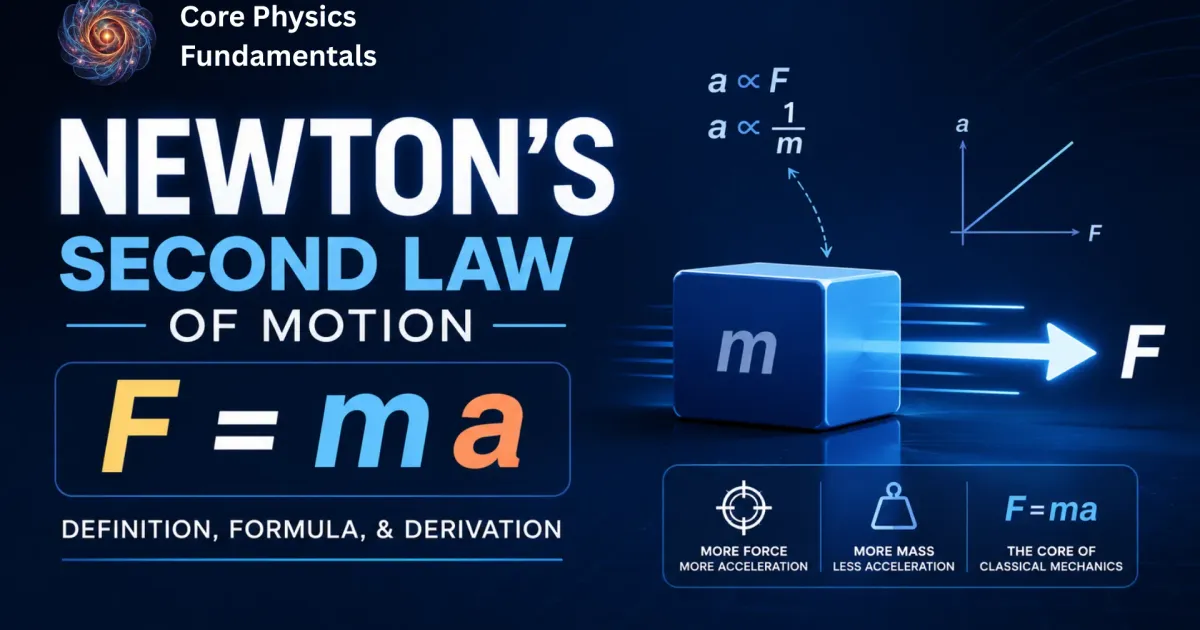
Newton’s Second Law of Motion (F=ma): Definition, Formula, & Derivation
Newton’s second law of motion states that the net force acting on an object equals the product of its mass and its acceleration: F_net = ma. In practical terms, it means that force doesn’t produce speed — it produces a change in speed. The harder you push, the faster the velocity changes. The heavier the object, the more force you need to achieve the same change. That single relationship governs everything from the arc of a thrown ball to the braking distance of a car, from the thrust stage of a rocket launch to the micro-forces inside a crash-test dummy’s ribcage.
Most students memorise the equation early. Fewer understand what it actually claims about the physical world. This guide walks through the law from its definition and formula all the way to its derivation, problem-solving applications, real-world engineering use cases, and the specific conditions where it stops working — giving you both the conceptual clarity and the mathematical toolkit to apply it confidently.
What Is Newton’s Second Law of Motion?
Newton’s second law of motion is the quantitative relationship between force, mass, and acceleration. Where the first law tells you that an object won’t change its velocity without a net force, the second law tells you by how much the velocity changes — and in which direction.
Formal Definition & Statement
Newton’s Second Law of Motion
The acceleration of an object is directly proportional to the net force acting on it, inversely proportional to its mass, and occurs in the direction of the net force.
Expressed as an equation:
F_net = maNewton’s Second LawOr equivalently:
a = F_net / mAcceleration FormThis was published by Sir Isaac Newton in 1687 as the second of three laws in Philosophiae Naturalis Principia Mathematica — though, as we’ll see, Newton’s original version looked quite different from the F = ma formula taught today.
Conceptual Breakdown: Force, Mass, and Acceleration
Each variable in F = ma carries specific physical meaning that’s worth unpacking.
Force (F) is a push or pull measured in newtons (N). Crucially, the F in Newton’s second law is never a single force acting in isolation. It is the net force, the vector sum of every force acting on the object: gravity, friction, tension, the normal force, air resistance, applied pushes, and anything else. If three forces pull an object in different directions, you add them as vectors first, and only the resultant goes into the equation.
Mass (m) is measured in kilograms (kg) and quantifies an object’s resistance to being accelerated. This property is called inertial mass. A shopping trolley accelerates easily under a small push; a loaded freight container barely budges under the same force. The difference is mass. Importantly, mass is not the same thing as weight — a distinction that becomes critical once gravity enters the picture.
Acceleration (a) is the rate at which velocity changes, measured in metres per second squared (m/s²). It is a vector quantity: it has both magnitude and direction. If the net force points east, the acceleration points east. If the net force is zero, the acceleration is zero — and the object either stays still or keeps moving at constant velocity.
Force Causes Acceleration, Not Velocity — The Core Insight
The most important conceptual point in introductory mechanics: Force produces acceleration, not velocity. A constant net force produces a constant acceleration — meaning the velocity changes at a steady rate, not that it stays fixed. Constant velocity requires zero net force.
Apply a steady horizontal force to a box on a perfectly frictionless floor. The box doesn’t cruise along at a steady speed. It accelerates — it gets faster and faster for as long as the force acts. Remove the force, and the box continues at whatever speed it reached, neither speeding up nor slowing down (that’s the first law in action).
Now consider a car travelling at a steady 100 km/h on a flat motorway. Is there a net forward force on it? No. The engine’s thrust is balanced exactly by air drag and rolling friction. Net force is zero, acceleration is zero, and the car maintains constant velocity. A net force is required to change velocity, not to maintain it.
Once this distinction clicks — force produces acceleration, not velocity — nearly every common confusion in classical mechanics dissolves.
The Mathematical Formula: F_net = ma
Understanding Vector Quantities — Direction Matters
Both force and acceleration are vector quantities, meaning they carry direction as well as magnitude. The equation F_net = ma is a vector equation: the acceleration vector always points in the same direction as the net force vector.
In two-dimensional problems, this means Newton’s second law splits into independent component equations:
ΣF_x = ma_xHorizontal ComponentΣF_y = ma_yVertical ComponentThis decomposition is what makes inclined-plane problems, projectile motion, and circular motion tractable. Horizontal and vertical motions are coupled only through the shared time variable t — the forces in each direction are handled separately.
Why We Use Net Force (F) Instead of a Single Force
Real objects rarely experience just one force. A book resting on a table has gravity pulling it down and the table’s normal force pushing it up. A car in motion has engine thrust forward, air resistance backward, gravity downward, and the road’s normal force upward. Using any single one of these forces in F = ma gives a meaningless answer.
The correct procedure is always:
- Identify every force acting on the object.
- Add them as vectors (accounting for direction).
- The resultant — the net force F — is what goes into F = ma.
This is also why a free-body diagram is the essential first step in every Newtonian mechanics problem.
The Third Law Connection: Why Action-Reaction Pairs Don’t Cancel
A common sticking point: if Newton’s third law says every force has an equal and opposite reaction, why doesn’t net force always equal zero?
Because third-law pairs act on different objects, while net force sums forces on a single object. When you push a wall with 50 N, the wall pushes you back with 50 N — but those forces live on two separate free-body diagrams (yours and the wall’s), so they never enter the same F calculation.
A book on a table has gravity and normal force both acting on the book, so those do sum to zero net force — but they aren’t a third-law pair. The third-law partner of the book’s weight is the pull the book exerts on the Earth; the partner of the normal force is the push the book exerts on the table.
The distinction: The second law handles forces on one body; the third law links forces between two bodies.
SI Units & Units Breakdown
The SI unit of force is the newton (N), defined directly from the second law:
1 N = 1 kg·m/s²Definition of the NewtonOne newton is the force required to accelerate a 1 kg mass at 1 m/s². For everyday reference: an average apple weighs roughly 1 N, and a typical smartphone weighs about 2 N.
| Quantity | Symbol | SI Unit |
|---|---|---|
| Force | F | Newton (N = kg·m/s²) |
| Mass | m | Kilogram (kg) |
| Acceleration | a | Metres per second squared (m/s²) |
How Did Newton Actually Write the Second Law?
The Original Formulation: Rate of Change of Momentum
When Newton published the second law in the Principia in 1687, he did not write F = ma. He expressed it in terms of momentum — specifically, the rate of change of an object’s momentum:
F = Δp / ΔtImpulse-Momentum FormOr in the language of calculus:
F = dp/dt = d(mv)/dtDifferential Momentum FormNewton called the product mv the “quantity of motion.” His second law stated that an impressed force produces a change in this quantity of motion proportional to the force and in the direction of the force.
The modern algebraic shorthand F = ma was formalised decades later, primarily by the Swiss mathematician Leonhard Euler in the 1740s and 1750s. Euler recast Newton’s geometric proofs into the analytical notation we use today. So while the physics is entirely Newton’s, the equation as written on a whiteboard is really Newton’s idea in Euler’s notation.
Deriving F = ma from Linear Momentum
The derivation is straightforward for the constant-mass case that applies to the vast majority of everyday situations.
Start with Newton’s original momentum formulation:
F = d(mv)/dt
If mass m is constant (the object isn’t gaining or losing material), it can be pulled out of the derivative:
F = m(dv/dt)
Since the derivative of velocity with respect to time is acceleration (a = dv/dt):
F = maConstant-Mass FormThis reveals an important hierarchy: F = dp/dt is the fundamental form of Newton’s second law. F = ma is a special case that applies only when mass does not change over time. For virtually all problems involving solid objects moving at everyday speeds, the constant-mass assumption holds perfectly, and F = ma is all you need.
Variable Mass Systems — Rockets & Mass Changes
For systems where mass changes — a rocket burning fuel, a raindrop growing as it falls through a cloud, a conveyor belt receiving sand — the F = ma form gives incorrect results. You must return to the momentum form.
For a rocket, the generalised equation becomes:
F_ext = m(dv/dt) = −v_e(dm/dt)
Where v_e is the exhaust velocity and dm/dt is the rate of mass ejection. This is the foundation of the Tsiolkovsky rocket equation, which governs how much velocity change (Δv) a given amount of propellant can produce:
Δv = v_e × ln(m₀ / m_f)Tsiolkovsky Rocket EquationEvery orbital manoeuvre, every launch trajectory, and every interplanetary transfer is calculated using this direct descendant of Newton’s second law in its momentum form.
How to Apply Newton’s Second Law: Step-by-Step Problem Solving
The Role of Free-Body Diagrams (FBDs)
A free-body diagram is a simplified sketch showing a single object isolated from its surroundings, with every external force acting on that object drawn as a labelled arrow. It is the most reliable way to avoid missing a force or accidentally including a force that acts on a different object.
Rules for a correct FBD:
- Draw the object as a simple shape (dot, box, or circle).
- Include only forces acting on the chosen object — not forces the object exerts on other things.
- Label every force: weight (mg), normal force (N), friction (f), tension (T), applied force (F_app), air resistance, etc.
- Draw arrows with lengths roughly proportional to force magnitudes.
- Choose a coordinate system (usually one axis aligned with the direction of motion).
Once the FBD is drawn, the rest is systematic: resolve forces into components, write ΣF_x = ma_x and ΣF_y = ma_y, and solve the resulting algebra.
Setting Up Coordinate Systems (X and Y Components)
The choice of coordinate system is not arbitrary — a smart choice reduces algebra significantly.
For horizontal surfaces: align x with the direction of motion and y perpendicular to the surface. Gravity acts entirely in the −y direction.
For inclined planes: tilt the axes so that x runs parallel to the slope and y runs perpendicular to it. This means gravity has components in both directions (mg sin θ along the slope, mg cos θ perpendicular to it), but the normal force and friction act purely along your chosen axes — which simplifies the equations enormously.
Worked Example 1: Horizontal Motion with Friction
Problem: A 12 kg crate is pushed across a warehouse floor with a horizontal force of 80 N. The coefficient of kinetic friction between the crate and the floor is μ_k = 0.25. Find the crate’s acceleration.
Step 1 — FBD: Forces on the crate: applied force F_app = 80 N (right), friction f_k (left), weight W = mg = 12 × 9.8 = 117.6 N (down), normal force N (up).
Step 2 — y-direction: The crate doesn’t accelerate vertically, so ΣF_y = 0:
N − mg = 0 → N = 117.6 N
Step 3 — Friction force:
f_k = μ_k × N = 0.25 × 117.6 = 29.4 N
Step 4 — x-direction: Apply Newton’s second law:
ΣF_x = ma_x
80 − 29.4 = 12 × a
a = 50.6 / 12 = 4.22 m/s²
The crate accelerates at 4.22 m/s² in the direction of the applied force.
Worked Example 2: Block on an Inclined Plane
Problem: A 5 kg block is placed on a frictionless ramp inclined at 30° to the horizontal. Determine the block’s acceleration down the ramp.
Step 1 — FBD: Weight mg = 49 N straight down; normal force N perpendicular to the ramp surface. No friction.
Step 2 — Tilted coordinate system: x-axis parallel to the slope (positive pointing down the ramp), y-axis perpendicular to the slope (positive pointing away from the surface).
Step 3 — Resolve gravity:
- Component along the slope: mg sin 30° = 49 × 0.5 = 24.5 N
- Component perpendicular to the slope: mg cos 30° = 49 × 0.866 = 42.4 N
Step 4 — y-direction (perpendicular):
N − mg cos 30° = 0 → N = 42.4 N
Step 5 — x-direction (along the slope):
mg sin 30° = ma
a = g sin 30° = 9.8 × 0.5 = 4.9 m/s²
Key insight: Notice that mass cancels entirely in the symbolic form (a = g sin θ). A 5 kg block and a 500 kg block both slide down the same frictionless ramp at the same acceleration — only the angle and g matter.
Worked Example 3: Connected Objects — The Atwood Machine
Problem: Two masses m₁ = 8 kg and m₂ = 3 kg are connected by a light, inextensible string draped over a frictionless, massless pulley. Find the acceleration of the system and the tension in the string.
Step 1 — FBDs for each mass:
- Mass m₁: Weight m₁g = 78.4 N (down), tension T (up).
- Mass m₂: Weight m₂g = 29.4 N (down), tension T (up).
Because m₁ > m₂, m₁ accelerates downward and m₂ accelerates upward, both with the same magnitude a (the string is inextensible).
Step 2 — Newton’s second law for each mass:
For m₁ (taking downward as positive):
m₁g − T = m₁a …(i)
For m₂ (taking upward as positive):
T − m₂g = m₂a …(ii)
Step 3 — Add equations (i) and (ii): The tension cancels:
m₁g − m₂g = (m₁ + m₂)a
a = (m₁ − m₂)g / (m₁ + m₂) = (8 − 3) × 9.8 / (8 + 3) = 49 / 11 = 4.45 m/s²
Step 4 — Find tension: Substitute a back into equation (ii):
T = m₂(g + a) = 3 × (9.8 + 4.45) = 3 × 14.25 = 42.76 N
The Atwood machine is a classic demonstration of how writing separate F = ma equations for each object in a system — then combining them algebraically — lets you solve for both the shared acceleration and the internal forces (tension) that single-system equations would hide.
Real-World Applications & Examples of Newton’s Second Law
Automotive Safety — Airbags & Crumple Zones
Every crash test is a Newton’s second law problem. When a car decelerates from 50 km/h to zero, the force on the occupant depends on mass and deceleration: F = ma. The physics goal of every passive safety system — crumple zones, airbags, seatbelt pretensioners — is to increase the stopping time, which reduces the deceleration and therefore the force.
Rearranging the impulse-momentum theorem (a direct consequence of F = ma):
F × Δt = m × ΔvImpulse-Momentum TheoremIf the change in velocity Δv is fixed (say, from 50 km/h to zero), increasing Δt proportionally decreases F. A rigid car frame that stops in 0.05 seconds produces roughly 10 times the force of a crumple zone that collapses over 0.5 seconds. That factor of 10 is the difference between survivable and fatal.
Sports Science & Athletics
A sprinter’s block start is governed by F = ma. Force plates embedded in starting blocks measure ground reaction forces in real time — the harder the sprinter pushes backward against the block, the greater the forward net force, and the greater the forward acceleration off the line.
In cricket or baseball, the bat’s impact on the ball illustrates the impulse form. A ball arriving at 40 m/s and leaving at 50 m/s in the opposite direction undergoes a velocity change of 90 m/s. If the contact lasts ~1 millisecond, the average force exceeds 13,000 N — roughly 1.3 tonnes of equivalent weight — all derived from F = Δp/Δt.
Rocketry & Space Physics
NASA’s entire trajectory planning infrastructure is built on Newton’s second law in its momentum form. The thrust of a rocket engine equals the mass flow rate of expelled propellant multiplied by the exhaust velocity:
F_thrust = ṁ × v_eRocket Thrust EquationAs fuel burns and the rocket’s mass decreases, the same thrust produces progressively greater acceleration — which is why astronauts experience increasing g-forces as the fuel depletes. The Saturn V’s first-stage engines generated about 34 million newtons of thrust, accelerating 2.8 million kilograms of rocket and payload off the launch pad. By first-stage cutoff, with most of the fuel spent, the acceleration had roughly tripled.
From Linear to Rotational: The Rotational Analogue (τ = Iα)
Newton’s second law has a direct rotational counterpart. Replace force with torque (τ), mass with moment of inertia (I), and linear acceleration with angular acceleration (α):
τ_net = IαRotational Second LawThe parallel is exact. Torque measures how effectively a force causes rotation (it depends on both the force magnitude and how far from the pivot it’s applied). Moment of inertia measures how much an object resists angular acceleration — the rotational equivalent of mass. A figure skater pulling her arms inward reduces I, so the same torque produces a larger α, and she spins faster.
| Linear (F = ma) | Rotational (τ = Iα) |
|---|---|
| Force F (N) | Torque τ (N·m) |
| Mass m (kg) | Moment of inertia I (kg·m²) |
| Acceleration a (m/s²) | Angular acceleration α (rad/s²) |
| Momentum p = mv | Angular momentum L = Iω |
If you can set up F = ma for a block on a ramp, you already have the framework to analyse gears, turbines, flywheels, and rotating machinery — the structure of the problem is identical, only the variables change.
Mass vs. Weight: What F = ma Reveals About Gravity
Weight is Newton’s second law applied to gravitational acceleration. Near Earth’s surface, every object experiences a downward gravitational acceleration of g ≈ 9.8 m/s². Substituting into F = ma:
W = mgWeight EquationA 70 kg person has a weight of 70 × 9.8 = 686 N on Earth. On the Moon, where g = 1.62 m/s², the same person weighs only 70 × 1.62 = 113 N — about one-sixth of their Earth weight. Their mass hasn’t changed; the gravitational field has.
This also explains the “weightlessness” experienced by astronauts aboard the International Space Station. They are not beyond Earth’s gravitational pull — at orbital altitude, g is still about 8.7 m/s². They feel weightless because both they and the station are in free fall together. No contact force pushes against them, so they perceive zero weight even though gravitational force is very much present.
A deeper point: The mass that resists acceleration (inertial mass) and the mass that gravity pulls on (gravitational mass) have been measured to be identical to a precision of roughly 1 part in 10¹³. This equivalence, unexplained by Newtonian mechanics alone, became the foundational insight behind Einstein’s general theory of relativity.
Limitations: Where F = ma Breaks Down
Newton’s second law in the form F = ma works with extraordinary precision across an enormous range of scales and speeds. But it is not universal. Two physical regimes expose its limits.
Relativistic Speeds — Einstein’s Special Relativity
At speeds approaching the speed of light (c ≈ 3 × 10⁸ m/s), the relationship between force and acceleration is no longer linear. Special relativity replaces F = ma with:
F = d(γmv)/dt
Where γ = 1/√(1 − v²/c²) is the Lorentz factor. At everyday speeds, γ ≈ 1, and the equation reduces back to F = ma. But at 90% of the speed of light, γ ≈ 2.3, meaning the same force produces less than half the acceleration you’d predict from F = ma alone. Protons at CERN’s Large Hadron Collider travel at 99.99999% of c, where γ exceeds 7,000; Newtonian mechanics would be off by a factor of thousands.
The practical threshold: F = ma remains accurate to better than 1% for speeds below about 10% of c (~30,000 km/s). Virtually everything in everyday engineering and terrestrial physics falls comfortably within that range.
Quantum Scales — Subatomic Particles
At atomic and subatomic dimensions, the very concept of a particle following a definite trajectory under a calculable force breaks down. Quantum mechanics replaces the classical equation of motion with the Schrödinger equation, and particles are described by probability amplitudes rather than precise positions and velocities.
The Heisenberg uncertainty principle (Δx·Δp ≥ ℏ/2) means that the exact simultaneous knowledge of position and momentum, which F = ma required as initial conditions, is physically impossible at quantum scales. Newton’s second law doesn’t give a wrong answer for an electron in an atom; it gives a meaningless one, because the electron doesn’t have a definite trajectory to compute.
Accelerating Reference Frames & Fictitious Forces
F = ma in its standard form only holds in inertial reference frames — frames that are not themselves accelerating. Inside an accelerating elevator, a turning car, or a spinning merry-go-round, objects appear to accelerate without any identifiable contact force, and the equation breaks down.
The fix is to add fictitious (pseudo) forces — centrifugal force in rotating frames, the Coriolis force on planetary scales — that correct for the frame’s own acceleration. The modified law becomes F_real + F_fictitious = ma′, where F_fictitious = −ma_frame. This is why a bathroom scale reads higher in an upward-accelerating elevator: from the passenger’s perspective, a fictitious force adds to gravity.
The underlying physics hasn’t changed — an inertial observer outside can describe everything with standard F = ma. Fictitious forces are a mathematical convenience for working inside non-inertial frames.
Common Misconceptions & Pitfalls to Avoid
“A constant force produces a constant velocity.” This is the most widespread misconception. A constant net force produces a constant acceleration — meaning the velocity changes at a steady rate, not that it stays fixed. Constant velocity requires zero net force.
“Heavier objects fall faster.” In a vacuum, all objects fall at the same rate (a = g). This follows directly from F = ma: the gravitational force is mg, so a = mg/m = g. Mass cancels. In air, drag complicates things: a feather falls slower than a hammer because of air resistance, not because of any failure in the second law.
“If an object is moving, there must be a net force on it.” Motion does not require force. Change in motion requires force. A hockey puck sliding on frictionless ice moves at constant velocity with zero net force. This confusion is a direct misreading of the second law.
“Net force and velocity always point in the same direction.” Net force and acceleration always share the same direction. But acceleration can oppose velocity — that’s how deceleration works. A car braking has a forward velocity but a backward net force (and backward acceleration).
“You can apply F = ma to a whole system and simultaneously find internal forces.” When you treat a multi-body system as a single object, internal forces (tension between connected blocks, for instance) cancel and vanish from the equation. To find internal forces, you must write separate F = ma equations for each object.
A Brief History of the Second Law
The story of Newton’s second law begins well before Newton. In the 4th century BCE, Aristotle taught that a force was needed to sustain any motion — remove the force and the object stops. This seemed intuitive (push a cart and it stops when you let go), but it confused the role of friction with a fundamental law.
In the early 1600s, Galileo Galilei challenged Aristotle’s framework. Through experiments with balls rolling on inclined planes, Galileo demonstrated that objects naturally maintain their velocity unless an external influence (like friction) acts on them. He also showed that falling bodies accelerate uniformly regardless of their mass — a result that would later become a direct consequence of Newton’s second law.
Isaac Newton, building on Galileo’s insights and the work of René Descartes on conservation of motion, synthesised these observations into a rigorous mathematical framework. In 1687, Newton published the Principia Mathematica, presenting three laws of motion alongside his law of universal gravitation. The second law was stated in Latin in terms of the “change of motion” (momentum), not as an algebraic formula.
Over the following century, Leonhard Euler reformulated Newton’s geometric and proportionality-based statements into the vector calculus and algebraic equations used today. Euler wrote the explicit form F = ma and developed the framework of rigid-body dynamics that extended the second law to rotation (τ = Iα). The equation as taught in every physics classroom worldwide is, in a meaningful sense, a Newton-Euler collaboration across generations.
Conclusion
Newton’s second law of motion F_net = ma is more than an equation to memorise for an exam. It is the operational rule that connects force to motion across nearly every domain of physics and engineering. From the momentum-based formulation Newton originally published in 1687 to the algebraic form refined by Euler, from the free-body diagrams of classroom problem sets to the thrust calculations of rocket engines, the second law provides the quantitative bridge between why something moves and how it moves.
Its power lies in its generality: the same equation handles a crate sliding across a warehouse floor, a satellite entering orbit, and a crash-test analysis determining whether an airbag deployment meets safety standards. Its limitations — at relativistic speeds and quantum scales — are equally instructive, marking precisely where Newtonian mechanics ends, and deeper theories take over.
Master the second law, and you hold the key to the rest of classical mechanics.
Frequently Asked Questions
What is Newton’s second law of motion in simple terms?
Newton’s second law says that the net force on an object equals its mass multiplied by its acceleration (F = ma). If you push harder, the object accelerates faster. If the object is heavier, the same push produces less acceleration. The acceleration always points in the direction of the net force.
What is the formula of the second law of motion?
The formula is F_net = ma, where F_net is the net (total) force in newtons, m is the mass in kilograms, and a is the acceleration in m/s². It can be rearranged to a = F/m (to find acceleration) or m = F/a (to find mass).
What is the 2nd law of motion with an example?
If you kick a football (mass ≈ 0.43 kg) and your foot applies a net force of 860 N during the 10 ms of contact, the ball’s acceleration during the kick is a = 860/0.43 = 2000 m/s². That enormous acceleration over a very short time is what launches the ball at high speed.
Why is F = ma so important?
It is the central equation of classical mechanics. Every prediction about how objects move, from engineering load calculations to orbital mechanics to vehicle crash analysis, is ultimately built on Newton’s second law. It connects the cause of motion (force) to the result (acceleration) through the property of the object (mass).
Is F = ma always valid?
No. It breaks down at speeds approaching the speed of light (where special relativity applies) and at atomic/subatomic scales (where quantum mechanics governs). It also requires modification when an object’s mass changes over time. For everyday speeds and macroscopic objects, however, it is accurate to extraordinary precision.
What is the difference between Newton’s first and second law?
The first law states that an object with zero net force has zero acceleration — it remains at rest or moves at constant velocity. The second law generalises this: when the net force is not zero, the resulting acceleration is a = F_net/m. The first law is the special case of the second law where F_net = 0.
How does F = ma relate to W = mg?
Weight (W = mg) is Newton’s second law applied specifically to gravitational acceleration. Near Earth’s surface, every object accelerates downward at g ≈ 9.8 m/s² due to gravity. Substituting g for a in F = ma gives the gravitational force — which we call weight.
For related topics, explore our articles on Newton’s first law of motion, Newton’s third law of motion, Newton’s laws of motion, and SUVAT equations.
The Scientists Behind Newton’s Second Law

Who Formulated the Laws of Motion
Isaac Newton (1643–1727)
Newton published the second law of motion in the Principia Mathematica in 1687, expressing it as the rate of change of momentum — the foundation from which F = ma was later derived.
Read his full biography →
Whose Relativity Revealed F = ma’s Limits
Albert Einstein (1879–1955)
Einstein’s special relativity showed that F = ma breaks down at speeds approaching the speed of light, and his general relativity revealed that inertial and gravitational mass are equivalent — a fact Newton’s framework could not explain.
Read his full biography →