
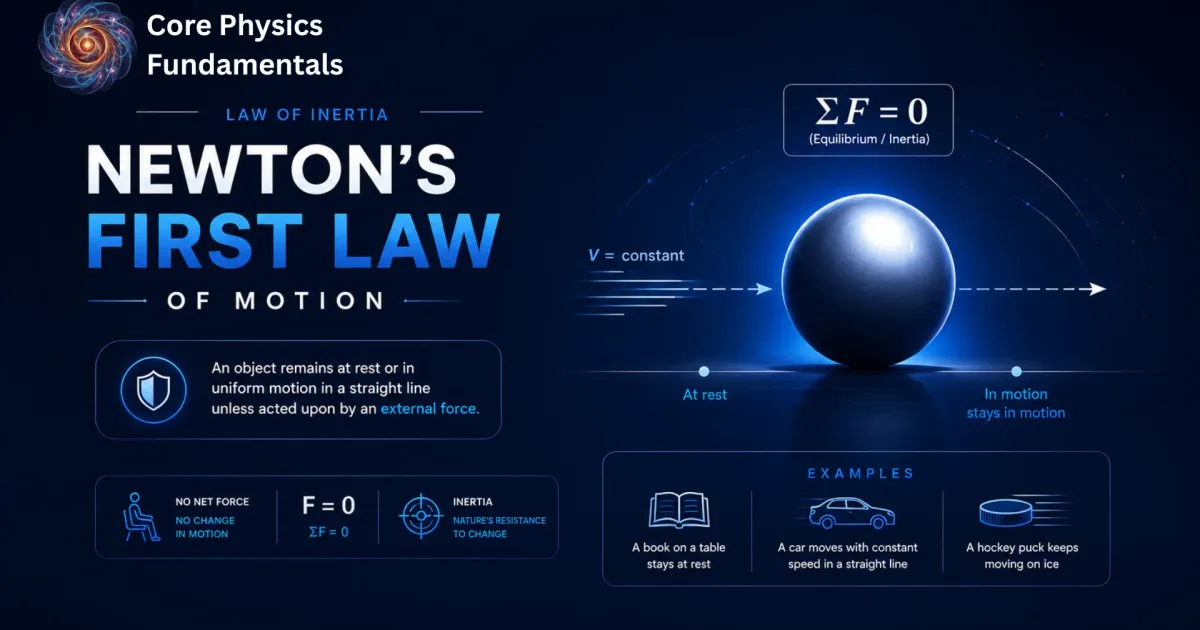
Introduction to Newton’s First Law
Brief History
The Great Physics Shift — Aristotle vs. Newton: This old belief came from the Greek philosopher Aristotle (384–322 BC). Aristotle taught that rest is the natural state of all objects. He said things only move when a force pushes them, and they stop the moment the force is removed. This idea seemed correct because it matched everyday experience — push a box, and it stops when you let go.
For nearly 2,000 years, no one seriously challenged Aristotle’s view. It was accepted as fact across Europe and the Middle East.
Newton flipped this idea completely. He showed that objects do not stop because “rest is natural.” They stop because external forces like friction and air resistance slow them down. Without those forces, a moving object would keep moving forever. Rest is not special — it is simply zero velocity. This shift from Aristotle’s thinking to Newton’s thinking is one of the biggest breakthroughs in the history of science.
Then came Sir Isaac Newton. He was born in England in 1643. In 1687, Newton published a famous book called Principia Mathematica. In this book, he gave the world three laws of motion. The first law of motion was the very first one. It changed the way we think about movement forever.
A scientist named Galileo Galilei had a similar thought years before Newton. Galileo noticed that a ball rolling on a smooth surface keeps rolling. It does not stop on its own. Newton took this idea further and turned it into a clear law.
Why This Law Is Important
Newton’s first law of motion is the starting point of all physics. It tells us something very important. Objects do not change their motion by themselves. You need a force to make them start, stop, or change direction.
This law helps us understand the world around us. It explains why seat belts keep us safe. It explains why a ball keeps rolling. Without this law, we could not build cars, planes, or rockets. It is the base of everything in motion.
What Is Newton’s First Law of Motion?
Official Statement
Newton’s First Law of Motion
An object at rest stays at rest. An object in motion stays in motion with the same speed and in the same direction. This continues unless an unbalanced external force acts on it.
This is the law of inertia. It is one of the most famous laws in all of science.
Explanation in Simple Words
Let us break this down in easy words.
Imagine a book on a table. It just sits there. It does not move. It will stay there forever unless someone picks it up or pushes it. That is the “rest” part.
Now imagine a ball rolling on a very smooth floor. There is no friction. No air to slow it down. The ball will keep rolling forever at the same speed. It will never stop. That is the “motion” part.
So Newton’s first law of motion says: things do not change on their own. A push or a pull is needed to make a change.
Meaning of “Unless Acted Upon by an External Force”
This part is very important. It tells us when things change.
An “external force” is a push or pull from outside. Gravity is an external force. Friction is an external force. Your hand pushing a box is an external force.
- Without any external force, nothing changes
- A still object stays still
- A moving object keeps moving
- But the moment a force acts, things change — the object may speed up, slow down, or turn
In real life, forces are everywhere. Friction slows things down. Gravity pulls things down. That is why we do not see objects move forever. But if there were no forces, motion would never stop.
Formula of Newton’s First Law
Net Force Formula (ΣF = 0)
The first law of motion can be written as a formula:
ΣF = 0Newton’s First Law — Net Force ConditionHere, the symbol Σ means “sum of all.” And F means force. So this formula says: the sum of all forces is zero.
When all forces add up to zero, the object does not change its motion. It stays at rest or keeps moving at a constant speed.
What the Formula Means
This formula is simple but powerful. It tells us that when forces are balanced, nothing changes.
Think of a 1 kg book on a table. Gravity pulls it down with a force of about 9.81 Newtons. The table pushes it up with the same 9.81 Newtons. These two forces are equal and opposite. They cancel out. The net force is zero. So the book stays still.
Now think of a car moving at a steady 80 km/h on a straight road. The engine pushes it forward. Friction and air push it backward. If these forces are equal, the net force is zero. The car keeps moving at the same speed.
Why Zero Net Force Does Not Always Mean Zero Motion
Common Misconception: Many people think zero net force means the object is not moving. But that is wrong. Zero net force means no change in motion. The object could be sitting still — or it could be moving at a constant speed in a straight line. Both are possible.
A spacecraft floating in deep space has zero net force on it. But it is still moving. NASA’s Voyager 1, launched in 1977, is still travelling at about 17 km/s (61,200 km/h) even though its engines stopped firing decades ago. Zero force does not stop it. Zero force just means no change.
Understanding the Concept of Inertia
What Is Inertia?
Inertia is the tendency of an object to resist change. If it is still, it wants to stay still. If it is moving, it wants to keep moving.
The word inertia comes from Latin. It means “laziness” or “idleness.” And that makes sense. Objects are “lazy.” They do not want to change what they are doing.
The law of inertia is just another name for Newton’s first law. They mean the same thing.
Why Objects Resist Changes in Motion
Objects resist change because of their mass. Mass is both the quantity of matter and the quantitative measure of an object’s inertia. The more matter an object has, the more it resists change.
- A bowling ball weighs about 6 kg — it is hard to start moving, and once it is moving, it is hard to stop. It has a lot of mass, so it has a lot of inertia.
- A tennis ball weighs only about 58 grams (0.058 kg) — it is easy to start and easy to stop. It has less mass, so it has less inertia.
How Mass Affects Inertia
Mass and inertia are directly connected. More mass means more inertia. Less mass means less inertia.
A truck has more inertia than a bicycle. A ship has more inertia than a boat. A planet has more inertia than a rock.
That is why heavy things are harder to push. And once they are moving, they are harder to stop. Mass is the measure of inertia.
Types of Inertia
There are three types of inertia. Each type deals with a different kind of change.
Inertia of Rest
This is the tendency of a still object to stay still. The object does not want to start moving.
Example: A coin sits on a card placed on a glass. Flick the card quickly. The card flies away. But the coin drops into the glass. The coin wanted to stay where it was. That is inertia of rest.
Inertia of Motion
This is the tendency of a moving object to keep moving. The object does not want to stop.
Example: You are riding in a bus. The bus stops suddenly. Your body keeps moving forward. You feel a jerk. That is because your body wanted to keep moving. That is inertia of motion.
Inertia of Direction
This is the tendency of an object to keep moving in the same direction. The object does not want to turn.
Example: When a car turns a sharp corner, your body leans to the side. Your body wants to keep going straight. But the car turns. So you feel pushed to the side. That is inertia of direction.
Why Changing Direction Counts as Acceleration: Velocity is a vector quantity. This means it includes both speed and direction. A car driving around a roundabout at a steady 30 km/h is constantly changing direction — even though its speed stays the same. Because the direction is changing, the velocity is changing. And any change in velocity is acceleration.
That acceleration requires a net force (ΣF ≠ 0). In the roundabout example, friction between the tires and the road provides that inward force (called centripetal force). Without it, the car would keep going in a straight line and fly off the roundabout — exactly as Newton’s first law predicts.
This is why inertia of direction matters so much. An object does not just resist speed changes. It also resists changes in direction. Any turn, curve, or orbit needs a force to make it happen.
Balanced and Unbalanced Forces
What Are Balanced Forces?
Balanced forces are forces that cancel each other out. They are equal in size but opposite in direction. When forces are balanced, the net force is zero.
A book sitting on a table has balanced forces. Gravity pulls it down. The table pushes it up. These two forces are equal. They cancel. The book stays still.
What Are Unbalanced Forces?
Unbalanced forces do not cancel out. One force is bigger than the other. When forces are unbalanced, the net force is not zero. The object will change its motion.
If you push a box and friction is smaller than your push, the box moves. The forces are unbalanced. There is a net force. So the box speeds up.
Their Effect on Motion
- Balanced forces keep things the same — the object stays at rest or keeps moving at the same speed
- Unbalanced forces cause change — the object may start moving, stop moving, speed up, slow down, or change direction
Newton’s first law of motion is all about this. When forces are balanced, nothing changes. When forces are unbalanced, things change.
Rest and Uniform Motion
Objects at Rest
An object at rest is not moving. It has zero speed. It will stay at rest unless a net force pushes or pulls it.
A parked car is at rest. A ball on the ground is at rest. A book on a shelf is at rest. None of these will move unless something makes them move.
Objects Moving with Constant Velocity
An object can also move without changing. If it moves at the same speed in the same direction, we call this uniform motion or constant velocity.
Newton’s first law says this kind of motion also continues on its own. No net force is needed to keep it going. The object just keeps moving.
This is hard to see in real life because friction always slows things down. But in space, where there is no friction, objects move at constant velocity forever.
The Role of Friction and Air Resistance
Friction and air resistance are forces that act against motion. They slow things down.
- When you roll a ball on the ground, friction makes it stop
- When you throw a ball in the air, air resistance slows it down
- These forces are always there in daily life
That is why objects on Earth do not move forever. Friction and air resistance always act on them. But if we could remove these forces, objects would keep moving at the same speed forever. That is what the law of inertia tells us.
Everyday Examples of Newton’s First Law
Let us look at some examples of Newton’s first law of motion from real life.
Seat Belts in Cars
When a car crashes, it stops very quickly. But your body wants to keep moving forward. That is inertia. The seat belt holds you back. It applies a force on your body and stops you from flying forward.
Passenger Moving Forward During Sudden Braking
You are sitting in a moving bus. The driver hits the brakes hard. The bus stops. But your body keeps moving forward. You feel a jerk. This happens because of inertia of motion. Your body was moving with the bus. When the bus stopped, your body wanted to keep going.
Pulling a Tablecloth from Under Dishes
This is a famous trick. A tablecloth sits under plates and glasses. Someone pulls the cloth very quickly. The dishes stay in place. Why? Because the dishes have inertia of rest. They wanted to stay where they were. The quick pull did not give them enough time to move.
Dusting a Carpet
When you shake or beat a carpet, the dust falls off. The carpet moves when you shake it. But the dust has inertia of rest. It wants to stay still. So it separates from the carpet and falls.
Shaking Fruits from a Tree
When you shake a tree branch, the fruits fall. The branch moves suddenly. But the fruits have inertia. They want to stay where they are. The sudden shake breaks them loose. And gravity pulls them down.
Hockey Puck Sliding on Ice
A hockey puck slides across smooth ice. Ice has very little friction. So the puck keeps sliding for a long time. It barely slows down. This is a great example of the law of inertia. Less friction means the puck moves closer to how Newton described — constant speed in a straight line.
Simple Experiments to Understand Newton’s First Law
Coin and Card Experiment
Place a card on top of a glass. Put a coin on the card. Now flick the card quickly with your finger. The card flies off. But the coin drops straight into the glass.
The coin had inertia of rest. It wanted to stay in place. When the card moved away, the coin did not move sideways. Gravity pulled it straight down into the glass.
Tablecloth Trick
Place a smooth cloth on a table. Put some plates on it. Now pull the cloth very fast in one quick motion. If you are fast enough, the plates stay in place.
The plates have inertia. They resist the sudden pull. The cloth slides out from under them.
Rolling Ball Experiment
Roll a ball on a rough surface like a carpet. It stops quickly. Now roll it on a smooth surface like a wooden floor. It goes much farther. Finally, roll it on ice. It goes even farther.
This shows that friction is what stops the ball. Less friction means the ball moves longer. With no friction at all, it would move forever. That is the first law of motion in action.
Applications of Newton’s First Law
Vehicle Safety Systems
Seat belts, airbags, and headrests all use the idea of inertia. In a crash, your body wants to keep moving. These safety systems apply a force to stop you gently.
Engineers design these systems using Newton’s first law. They know your body will keep moving unless something stops it. So they build devices that provide that stopping force safely.
Spacecraft in Space
In space, there is almost no friction. No air. No ground. Once a spacecraft moves, it keeps moving forever at the same speed. It only needs fuel to start, stop, or change direction. This is the law of inertia at its purest.
Sports
In every sport, inertia plays a role:
- A soccer ball keeps moving after you kick it
- A cricket ball keeps going after the bowler releases it
- Players use force to change the motion of the ball
- Every kick, hit, throw, or catch fights against inertia
Everyday Transportation
When a bus starts moving, you lean backward. When it stops, you lean forward. When it turns, you lean sideways. All of this is because of inertia. Your body resists changes in motion every time a vehicle speeds up, slows down, or turns.
Industrial Machinery
Machines in factories use inertia too. Heavy flywheels keep spinning because of their inertia. Once they start, they resist stopping. Conveyor belts also use inertia. If a belt stops suddenly, the objects on it slide forward because of inertia.
Inertial Frames of Reference
What Is an Inertial Frame?
An inertial frame of reference is a place where Newton’s first law works perfectly. In this frame, no fake forces exist. Objects at rest stay at rest. Objects in motion stay in motion.
A room sitting still on the ground is close to an inertial frame. A train moving at constant speed on a straight track is also close to one.
Why Newton’s First Law Applies Only in Inertial Frames
Newton’s first law only works in inertial frames. In a spinning or accelerating frame, objects seem to move on their own. But no real force is acting on them.
For example, sit in a car that turns sharply. You feel pushed to the side. But no one is pushing you. The car is accelerating, so it is not an inertial frame. Your body just wants to go straight because of inertia.
In a true inertial frame, you would not feel these fake forces. Newton’s first law of motion works cleanly only in such frames.
Relationship Between Newton’s First and Second Laws
How the First Law Leads to the Second Law
Newton’s first law tells us what happens when there is no net force — things stay the same. Newton’s second law tells us what happens when there is a net force — things change. The second law says F = ma.
The first law is actually a special case of the second law. When the net force is zero (F = 0), acceleration is also zero (a = 0). That means no change in motion. So the first law leads naturally to the second law. The first law is the starting idea. The second law gives us the full math.
Key Differences Between the Two Laws
| Newton’s First Law | Newton’s Second Law |
|---|---|
| The first law of motion tells us about balance. When forces are balanced, motion does not change. | The second law tells us about change. When forces are unbalanced, motion changes. |
| The first law is a concept. | The second law is a formula. |
| The First Law explains how objects behave. | The Second Law explains how to calculate changes in their motion. |
Common Misconceptions About Newton’s First Law
Objects Need Continuous Force to Keep Moving
This is the most common mistake. Many people think you must keep pushing an object to keep it moving. But that is wrong.
An object in motion stays in motion on its own. You only need force to start it, stop it, or change its direction. We see things stop because of friction and air resistance. But those are forces too. They are the external forces that change the motion.
Zero Force Means Zero Motion
Another common mistake. Zero net force does not mean the object is still. It means the object is not changing its motion. It could be moving at a constant speed or sitting still. Both are possible with zero net force.
Inertia and Momentum Are the Same
Inertia and momentum are related but different:
- Inertia is the tendency to resist change — it depends only on mass
- Momentum is mass times velocity — it depends on both mass and speed
- An object sitting still has inertia but zero momentum
Heavy Objects Always Move More Slowly
Heavy objects have more inertia. They are harder to speed up. But once they are moving fast, they are also harder to slow down. So heavy objects do not always move slowly. They just take more force to change their motion.
Limitations of Newton’s First Law
Non-Inertial Reference Frames
Newton’s first law does not work in accelerating or rotating frames. In these frames, objects seem to move without any real force. You need to add imaginary forces (like centrifugal force) to explain the motion.
Relativistic Motion
At speeds close to the speed of light, Newton’s laws need corrections. Einstein’s theory of special relativity takes over. At these extreme speeds, mass, time, and length all behave differently.
Quantum-Scale Motion
For very tiny particles like electrons and photons, Newton’s laws do not apply. These particles follow the rules of quantum mechanics. They can behave like waves. They can be in two places at once. Classical inertia does not describe them well.
Key Takeaways
Definition: Newton’s first law says an object at rest stays at rest, and an object in motion stays in motion, unless a net external force acts on it.
Formula: ΣF = 0 means the net force is zero and there is no change in motion.
Inertia: Inertia is the resistance to change. More mass means more inertia.
Balanced Forces: When all forces cancel out, motion does not change. This is what the first law describes.
Real-Life Importance: Seat belts, airbags, sports, space travel, and transportation all depend on this law.
Conclusion
Newton’s first law of motion is one of the simplest ideas in physics. But it is also one of the most powerful. It tells us a basic truth about nature — things do not change on their own. A force is always needed.
The law of inertia shows us why a book stays on a table. It shows us why a ball keeps rolling. It shows us why we jerk forward when a bus stops suddenly. Every example comes back to one idea: objects resist change.
We learned that inertia depends on mass. Heavier objects have more inertia. We also learned about three types of inertia — rest, motion, and direction. We saw how balanced forces keep things the same and how unbalanced forces cause change.
This law has some limits. It breaks down at very high speeds and very tiny scales. But for daily life, it works perfectly.
Newton’s first law of motion is the foundation. It leads to the second and third laws. Together, these three laws explain how everything in the universe moves. If you are learning physics, start here. Once you get it, the rest will make a lot more sense.
Frequently Asked Questions
What is Newton’s first law of motion?
Newton’s first law says that an object at rest stays at rest. An object in motion stays in motion at the same speed and direction. This only changes when a net external force acts on it.
What is the law of inertia?
The law of inertia is another name for Newton’s first law of motion. It says objects resist changes in their motion. They want to keep doing what they are already doing.
What is the formula of Newton’s first law?
The formula is ΣF = 0. This means the sum of all forces is zero. When the net force is zero, the object does not change its motion.
What is inertia?
Inertia is the tendency of an object to resist change. A still object wants to stay still. A moving object wants to keep moving. More mass means more inertia.
What are the three types of inertia?
The three types are inertia of rest, inertia of motion, and inertia of direction. Each type describes a different way objects resist change.
What are some examples of Newton’s first law?
Seat belts in cars, jerking forward when a bus brakes, pulling a tablecloth from under dishes, and a hockey puck sliding on ice are all common examples.
What is the difference between balanced and unbalanced forces?
Balanced forces are equal and opposite. They cancel out. The object does not change its motion. Unbalanced forces are not equal. The object speeds up, slows down, or changes direction.
Does an object need force to keep moving?
No. An object in motion stays in motion on its own. Force is only needed to start, stop, or change the direction of motion. Friction is what usually stops things in real life.
What is the difference between inertia and momentum?
Inertia depends only on mass. It is the resistance to change. Momentum depends on both mass and velocity. An object at rest has inertia but zero momentum.
Where does Newton’s first law not work?
It does not work well in spinning or accelerating frames. It also breaks down at speeds close to the speed of light and for very tiny particles like electrons.
The Scientists Behind This Law

Who Created This Law
Isaac Newton (1643–1727)
Newton formulated the three laws of motion in his 1687 masterpiece Principia Mathematica, laying the foundation for classical mechanics.
Read his full biography →Who Inspired the Law of Inertia
Galileo Galilei (1564–1642)
Galileo’s experiments with rolling balls and inclined planes first challenged Aristotle’s view that objects naturally come to rest, directly inspiring Newton’s first law.
Read his full biography →