
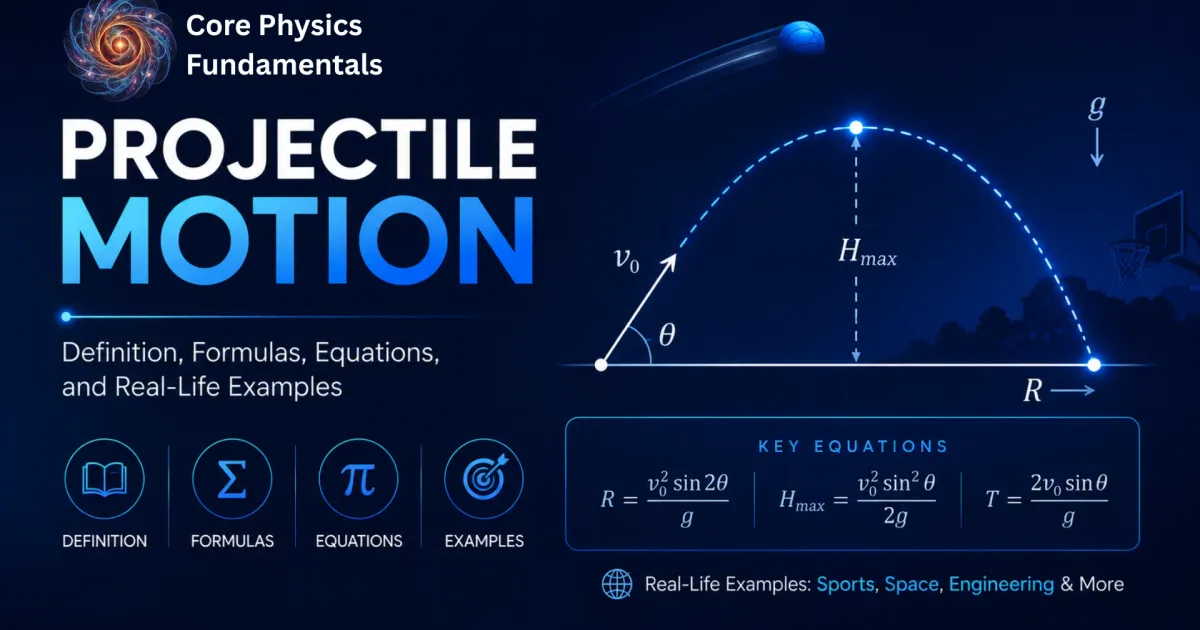
Introduction
Have you ever thrown a ball to your friend and watched it fly through the air in a curved path? Or have you seen water shooting out of a garden hose and bending downward? That curved path is not random. It follows a set of rules that scientists have studied for hundreds of years. This is called projectile motion.
In this guide, we will break down everything about projectile motion in the simplest way possible. You will learn what it means, how it works, what formulas and equations are used, and where you can see it happening in real life. Whether you are a student just starting to learn physics or someone who wants to understand how things move through the air, this article is for you.
What Is Projectile Motion?
A projectile is any object that is thrown, kicked, hit, or launched into the air and then moves on its own without any engine or fuel pushing it forward. Once it leaves your hand or a machine, the only force acting on it is gravity, the invisible pull of the Earth.
So, what is projectile motion? It is the movement of a projectile through the air. Once the object is in the air, it follows a curved path shaped like the letter “U” turned upside down. Scientists call this curved shape a parabola.
Example Imagine you are standing on top of a tall table. You roll a marble off the edge of the table. The marble does not just fall straight down. It moves forward while also falling. It hits the ground a little distance away from the table. That forward-and-down movement is projectile motion.
Factual data: Galileo Galilei first proved in the early 1600s that a projectile’s horizontal and vertical motions are completely independent — a breakthrough that transformed physics. Later, Sir Isaac Newton’s laws of motion, published in 1687, gave us the math to predict exactly where a projectile will land.
Characteristics of Projectile Motion
Now that you know the basic definition for projectile motion, let’s look at what makes it special. Projectile motion has a few important characteristics that set it apart from other types of movement.
Motion in Two Dimensions
Most of the motion we see every day is in one direction. A car drives forward on a road. An elevator goes up and down. But projectile motion is different. It happens in two dimensions at the same time.
These two motions are horizontal and vertical motion happen at the same time, but they do not affect each other.
Factual data: NASA uses the principles of two-dimensional projectile motion when planning spacecraft landings. When the Mars Curiosity Rover was landing on Mars in 2012, engineers had to calculate both the horizontal distance the rover would travel and the vertical drop due to Mars’s gravity, which is only about 3.7 m/s² — roughly 38% of Earth’s gravity.
Horizontal and Vertical Motion
Let us look more closely at the two parts of projectile motion.
Horizontal Motion (Sideways Movement): Once a projectile is launched, there is no force pushing it sideways (we ignore air resistance to keep things simple). Because there is no sideways force, the object moves at a constant speed in the horizontal direction. It does not speed up or slow down sideways.
For example, if you throw a ball forward at 10 meters per second, it will keep moving forward at 10 meters per second for the entire time it is in the air. The horizontal speed stays the same from launch to landing.
Vertical Motion (Up-and-Down Movement): The vertical part is different. Gravity is constantly pulling the object downward. This means the vertical speed keeps changing. When you throw a ball upward, gravity slows it down as it rises. At the very top of its path, the ball’s upward speed becomes zero for just a tiny moment. Then gravity pulls it back down, and it starts moving faster and faster downward.
The vertical speed changes by 9.8 m/s every single second on Earth. If a ball is thrown straight up at 20 m/s, after 1 second it will be going at about 10.2 m/s upward. After about 2 seconds, it will stop at the top. Then it starts falling back down, gaining speed at 9.8 m/s every second.
Here is a quick comparison:
| Feature | Horizontal Motion | Vertical Motion |
|---|---|---|
| Force acting | No force (no air resistance) | Gravity (9.8 m/s² downward) |
| Speed | Stays the same (constant) | Keeps changing |
| Acceleration | Zero | 9.8 m/s² downward |
| Direction | Sideways (forward) | Up and then down |
This table shows why the two directions are so different even though they happen at the exact same time.
Effect of Gravity on the Projectile
Gravity is the star of the show in projectile motion. Without gravity, a thrown ball would just keep going in a straight line forever. But gravity bends the path of the ball into that curved, parabolic shape.
Here is what gravity does step by step.
- When you throw a ball at an angle, gravity does not affect the sideways speed at all.
- It only pulls the ball downward.
- As the ball rises, gravity slows down the upward movement.
- At the highest point of the path (called the maximum height), the upward speed becomes zero.
- After that, gravity speeds the ball up as it falls back toward the ground.
Factual data: The strength of gravity is different on different planets. On the Moon, gravity is only about 1.6 m/s², which is roughly one-sixth of Earth’s gravity. This is why astronauts on the Moon could jump much higher and stay in the air much longer than on Earth.
During the Apollo 14 mission in 1971, astronaut Alan Shepard hit a golf ball on the Moon. Because of the low gravity, the ball traveled an estimated 200 meters — far more than any golf shot on Earth. If you use the projectile motion calculator with Moon gravity, you can see how much farther objects travel there compared to here.
Assumptions in Projectile Motion
Before we jump into the projectile motion equations and formulas, there is something important to understand. When scientists and students solve projectile motion problems, they make a few assumptions to keep things simple. These assumptions are not always true in real life, but they help us learn the basic rules without making the math too hard.
Think of it like learning to ride a bicycle with training wheels first. You keep things simple at the start so you can understand the basics. Later, you can remove the training wheels and handle the harder stuff. The same idea applies here.
Let’s look at the three main assumptions we make when solving problems for projectile motion.
Neglecting Air Resistance
The first and biggest assumption is that we ignore air resistance. In real life, when a ball flies through the air, the air pushes against it and slows it down. You can feel this yourself if you stick your hand out of a moving car window — the air pushes your hand backward. That push is called air resistance, or drag.
Factual data: In reality, air resistance can make a big difference. A professional soccer ball kicked at 30 m/s (about 108 km/h) loses roughly 10% of its range because of air drag. For heavier and smaller objects like a cannonball, the effect is much less. For light objects like a badminton shuttlecock, air resistance is so strong that it slows down almost immediately. The shuttlecock can leave a racket at over 400 km/h but stops traveling forward within just a few meters.
Constant Gravitational Acceleration
The second assumption is that gravity stays the same throughout the entire flight of the projectile. On Earth, we use the value g = 9.8 m/s² and treat it as constant — meaning it does not change whether the object is close to the ground or high up in the air.
In reality, gravity does get a tiny bit weaker as you go higher. But for the kinds of projectile motion we study in school — balls thrown across a field, stones dropped from a building — the height is so small compared to the size of the Earth that the change in gravity is too tiny to matter.
Factual data: The Earth has a radius of about 6,371 kilometers. For gravity to drop by even 1%, you would need to go about 32 kilometers above the surface. Most projectiles in everyday life stay well below 100 meters in height. At 100 meters, the change in gravity is less than 0.003%. So treating gravity as constant is an extremely accurate assumption for everyday projectile movement.
Independent Motion Along Two Axes
The third assumption is one we already talked about, but it is so important that it deserves its own section. We assume that the horizontal motion and vertical motion are completely independent of each other.
This means we can solve the horizontal part and the vertical part as two separate, simple problems. Then we combine the answers at the end. This is the secret trick that makes projectile motion problems much easier than they look.
Factual data: Galileo proved this independence with a clever experiment. He rolled a ball off the edge of a table while dropping another ball from the same height at the same time. Both balls hit the ground at the exact same moment — even though one was moving sideways and the other was not. This showed that the sideways motion of the first ball did not change how fast it fell.
Projectile Motion Equations
These are the formulas that let you calculate exactly how far, how high, and how fast a projectile will travel.
When a projectile is launched at a speed v₀ (called the initial velocity) at an angle θ (theta) from the ground, we first break that speed into two parts. One part goes sideways (horizontal) and the other part goes upward (vertical). This is called resolving into components.
The horizontal part of the speed is: v₀ₓ = v₀ × cos θ
The vertical part of the speed is: v₀ᵧ = v₀ × sin θ
Here, cos and sin are math functions that help us split the speed based on the angle. If the angle is 0° (thrown flat along the ground), all the speed is horizontal. If the angle is 90° (thrown straight up), all the speed is vertical. Any angle in between gives a mix of both.
Horizontal Motion Formula
Since there is no force acting sideways (we ignore air resistance), the horizontal speed never changes. The object moves at the same sideways speed from start to finish.
The horizontal distance (x) the projectile covers is:
x = v₀ₓ × t
Or written in full:
x = v₀ × cos θ × t
This is one of the simplest projectile motion equations. It just says: sideways distance equals sideways speed multiplied by time.
Vertical Motion Formula
The vertical direction is more interesting because gravity is pulling the object down the whole time. The vertical equations here come from the same SUVAT equations used in straight-line motion, just applied in the up-and-down direction. The vertical distance (y) the projectile reaches above its starting point is:
y = v₀ᵧ × t − ½ × g × t²
Or written in full:
y = v₀ × sin θ × t − ½ × 9.8 × t²
Let’s break this down. The first part (v₀ × sin θ × t) is how high the object would go if there was no gravity — just moving upward at a steady speed. The second part (½ × g × t²) is how far gravity pulls it back down. You subtract the gravity part because gravity works against the upward motion.
Velocity Components
As the projectile flies, its speed in each direction behaves differently.
Horizontal velocity stays the same throughout the flight:
vₓ = v₀ × cos θ
It does not change because no force acts sideways.
Vertical velocity changes every second because of gravity:
vᵧ = v₀ × sin θ − g × t
At the start, the vertical speed is positive (moving upward). Gravity keeps subtracting from it. At the highest point, vᵧ becomes exactly zero — the object stops going up for just an instant. After that, vᵧ becomes negative, meaning the object is now falling downward and getting faster.
If you want to know the total speed of the projectile at any moment, you combine both parts using this formula:
v = √(vₓ² + vᵧ²)
This gives you the actual speed of the object, combining its sideways and vertical motion into one number. This is useful when solving problems for projectile motion that ask for the speed at impact or at a certain time.
Position Equations
The position equations tell you exactly where the projectile is at any time t during its flight. Think of them as a GPS for the projectile.
Horizontal position:
x(t) = v₀ × cos θ × t
Vertical position:
y(t) = v₀ × sin θ × t − ½ × g × t²
Together, these two equations give you the full picture. For any value of time t, you can plug it into both equations and find out exactly how far forward (x) and how high up (y) the projectile is.
If you remove time from these two equations and combine them (by solving for t in the horizontal equation and putting it into the vertical equation), you get the path equation:
y = x × tan θ − (g × x²) / (2 × v₀² × cos² θ)
This equation shows that the path of a projectile is always a parabola — a smooth, symmetric curve. This is why a thrown baseball, a kicked football, and a shot-put all trace out the same basic shape in the air.
Factual data: These equations were fully developed by Isaac Newton and other scientists in the late 1600s. Today, engineers use computerized versions of these same projectile motion equations in everything from designing roller coasters to programming video games. In fact, every sports video game — like FIFA, NBA 2K, or Angry Birds — uses these exact formulas to make the ball or character fly through the air in a realistic way. The projectile motion solver tools available online also use these same equations to give you instant answers.
Important Quantities in Projectile Motion
When you solve projectile motion problems, there are four main things you usually need to find. These are the most common values that teachers ask about in exams and that engineers calculate in real life. Let’s go through each one with its formula and a simple explanation.
Time of Flight
The time of flight is the total time the projectile stays in the air — from the moment it is launched to the moment it lands back on the ground.
For a projectile launched at speed v₀ at an angle θ from the ground and landing at the same height, the projectile motion formula for time of flight is:
T = 2 × v₀ × sin θ / g
Let’s break this down in plain words. The part v₀ × sin θ is the starting upward speed. Dividing by g (9.8 m/s²) tells you how long it takes for gravity to stop the upward motion. Multiplying by 2 accounts for the fact that the object takes the same amount of time going up as it does coming back down.
Example: If you kick a ball at 20 m/s at a 30° angle, the time of flight is:
T = 2 × 20 × sin 30° / 9.8 = 2 × 20 × 0.5 / 9.8 = 20 / 9.8 = 2.04 seconds
So the ball stays in the air for about 2 seconds before hitting the ground.
Factual data: In professional soccer, a long goal kick can stay in the air for about 3 to 4 seconds. A punt in American football, kicked at steeper angles, can have a hang time of over 5 seconds. The NFL record for hang time on a punt is around 5.8 seconds — meaning the ball was flying through the air for nearly 6 seconds before someone caught it.
Maximum Height
The maximum height is the highest point the projectile reaches during its flight. At this point, the vertical speed is exactly zero — the object has stopped going up and is about to start falling back down.
The formula for maximum height is:
H = (v₀ × sin θ)² / (2 × g)
This formula says: take the starting upward speed, square it, and divide by twice the gravity. The faster the object goes upward, the higher it will reach. But gravity always wins in the end and pulls it back down.
Example: Using the same ball kicked at 20 m/s at 30°:
H = (20 × sin 30°)² / (2 × 9.8) = (10)² / 19.6 = 100 / 19.6 = 5.10 meters
The ball reaches a maximum height of about 5 meters — roughly the height of a one-story building.
Factual data: When a baseball player hits a pop fly in Major League Baseball, the ball can reach a maximum height of over 60 meters (about 200 feet). The highest recorded pop fly in MLB history reached an estimated height of around 90 meters. At that height, the ball takes over 6 seconds just to come back down, giving fielders plenty of time to get underneath it.
Horizontal Range
The horizontal range is the total forward distance the projectile covers from launch to landing. This is the value most people care about — how far did it go?
The range formula projectile motion gives us:
R = v₀² × sin(2θ) / g
This is one of the most famous projectile motion equations. Notice that the range depends on sin(2θ), which means the angle is doubled before taking the sine. This has an interesting result: the maximum value of sin(2θ) is 1, and that happens when 2θ = 90°, meaning θ = 45°. So a launch angle of 45° gives the maximum range.
Example: Same ball at 20 m/s and 30°:
R = (20)² × sin(60°) / 9.8 = 400 × 0.866 / 9.8 = 346.4 / 9.8 = 35.3 meters
The ball lands about 35 meters away. If the same ball was kicked at 45° instead, the range would increase to about 40.8 meters — the farthest possible distance for that speed.
Factual data: The world record for a javelin throw is 98.48 meters, set by Jan Železný in 1996. Javelin throwers do not throw at exactly 45° because of air resistance and the shape of the javelin. The ideal real-world angle for a javelin is closer to 33-36°.
Final Velocity
The final velocity is the speed of the projectile just before it hits the ground. Since the horizontal speed stays constant and the vertical speed keeps increasing due to gravity, the final speed is usually greater than the starting speed for objects that land below their launch height.
The horizontal speed at landing: vₓ = v₀ × cos θ
The vertical speed at landing: vᵧ = v₀ × sin θ − g × T (this will be negative, meaning downward)
The total final speed is:
v = √(vₓ² + vᵧ²)
For a projectile that lands at the same height it was launched from, the final speed is actually equal to the launch speed. The object comes back with the same speed it left with — just pointing downward instead of upward.
Why Does a Projectile Follow a Parabolic Path?
One of the most common questions students ask is: why is the path always a curve? Why doesn’t a thrown ball travel in a straight line or a circle? The answer comes from the way horizontal and vertical motions combine.
Understanding the Shape Without Mathematics
Here is a simple way to picture it. Imagine you could turn off gravity. If you threw a ball forward, it would fly in a perfectly straight line forever — like a laser beam. It would never come down.
Now turn gravity back on. Gravity starts pulling the ball downward. In the first second, the ball drops a little. In the next second, it drops more. In the third second, it drops even more. The ball keeps falling faster and faster while still moving forward at the same steady speed.
The forward motion stays even, but the downward drop keeps getting bigger. When you combine a steady forward motion with an increasing downward drop, the shape you get is a parabola — a smooth curve that gets steeper as the object falls. Think of it like moving your pencil to the right at a steady speed while also moving it downward faster and faster — the line you draw will naturally curve into a parabola.
Mathematical Explanation of the Parabolic Trajectory
For those who want to see the math behind it, here is the simple version.
We know the horizontal position is: x = v₀ cos θ × t
From this, we can find time: t = x / (v₀ cos θ)
Now we put this into the vertical position equation:
y = v₀ sin θ × t − ½ g t²
After replacing t with x / (v₀ cos θ), we get:
y = x × tan θ − g × x² / (2 × v₀² × cos² θ)
Look at this equation carefully. It has the form y = ax − bx², where a and b are just numbers. This is exactly the equation of a parabola in math. The x term makes the path rise, and the x² term makes it curve back down.
Factual data: The parabolic shape of projectile motion was first described mathematically by Galileo in his 1638 book “Two New Sciences.” Before Galileo, most people — including the famous Greek philosopher Aristotle — believed that a projectile traveled in a straight line upward, then fell straight down. Galileo’s discovery that the path is a smooth parabola was one of the biggest breakthroughs in the history of physics.
Factors That Affect Projectile Motion
Several things can change how far, how high, and how long a projectile flies. Let’s look at the four main factors.
Launch Speed
This one is easy to understand. The faster you throw something, the farther and higher it goes. If you double the launch speed, the range does not just double — it increases by four times. This is because in the range formula projectile motion (R = v₀² sin 2θ / g), the speed is squared. So small changes in speed lead to big changes in distance.
Factual data: A professional baseball pitcher throws at about 40 m/s (145 km/h). If that same pitcher could somehow throw at 80 m/s, the ball would travel four times farther — not just twice. This squared relationship is why athletes train so hard to increase their throwing or kicking speed even by a small amount.
Launch Angle
The angle at which you launch a projectile has a huge effect on the result. As we discussed, 45° gives the maximum range on flat ground. But the angle also affects height and time of flight.
At low angles (like 15° or 20°), the projectile stays close to the ground and covers distance quickly but does not go very high. At high angles (like 70° or 80°), the projectile goes very high but does not travel far forward. The angle of 45° gives the best balance between height and distance.
An interesting fact is that complementary angles give the same range. This means launching at 30° and launching at 60° will make the projectile land at the exact same distance — but the 60° throw goes much higher and takes longer to get there.
Initial Height
If you launch a projectile from a height — like throwing a ball from the top of a building — it will travel farther than if you threw it from the ground. This is because the object gets extra time in the air while it falls from that height down to the ground.
Factual data: This is why shot put athletes release the shot from near their shoulder height (about 2 to 2.2 meters above the ground). Because of this added height, the ideal launch angle for shot put is not 45° but closer to 40-42°. The extra starting height means a slightly flatter throw actually gives a better range.
Gravity
Gravity determines how quickly the projectile is pulled back down to Earth. Stronger gravity means the object falls faster, stays in the air for less time, and covers less distance. Weaker gravity has the opposite effect.
If you kicked a soccer ball at 20 m/s at 45° on each of these worlds, here is how far it would travel using the projectile motion formula:
| Planet | Gravity (m/s²) | Range at 45° |
|---|---|---|
| Moon | 1.6 | 250.0 m |
| Mars | 3.7 | 108.1 m |
| Earth | 9.8 | 40.8 m |
| Jupiter | 24.8 | 16.1 m |
Types of Projectile Motion
There are two main types of projectile motion. Each type depends on how the object is launched.
Horizontal Projectile Motion
This happens when an object is launched straight sideways with no upward push at all. The launch angle is 0°. Think of a ball rolling off the edge of a table, a package dropped from a moving airplane, or a bullet fired from a gun held perfectly flat.
In horizontal projectile movement, the starting vertical speed is zero. The object only moves sideways at first, then gravity pulls it downward, creating a curved path that looks like half of a parabola. The equations become simpler here because sin 0° = 0 and cos 0° = 1, The only thing that decides how long the object stays in the air is the height it was launched from.
Factual data: Rescue helicopters use horizontal projectile motion when dropping supply packages. Pilots must release the package before they are directly above the target because it keeps moving forward at the helicopter’s speed while falling. If the helicopter is flying at 50 m/s at a height of 80 meters, the package needs to be dropped about 200 meters before the target.
Oblique Projectile Motion
This is the more common type and the one we have been discussing throughout this article. Oblique means “at an angle.” The object is launched at an angle between 0° and 90°, so it has both horizontal and vertical speed from the very start.
A kicked soccer ball, a thrown javelin, a projectile thrown up at an angle; these are all examples of oblique projectile motion.
Energy Changes During Projectile Motion
A projectile does not just change position and speed — its energy also changes throughout the flight. Understanding these energy changes helps you see projectile motion from a completely different angle.
Kinetic Energy
Kinetic energy is the energy of motion. It is calculated as KE = ½ × m × v². At the moment of launch, the projectile has maximum kinetic energy because its speed is at its highest. As the object rises, it slows down vertically, so its kinetic energy decreases.
At the highest point, kinetic energy is at its lowest (but not zero, because the object still has horizontal speed). As the object falls back down, it speeds up again and kinetic energy increases.
Potential Energy
Potential energy is the stored energy due to height. It is calculated as PE = m × g × h. At launch from the ground, potential energy is zero. As the projectile rises, potential energy increases. At maximum height, potential energy is at its greatest. As the object falls, potential energy decreases again.
Everyday Examples of Projectile Motion
Projectile motion examples are all around us. You see them every single day without even thinking about it.
Throwing a Basketball
When a basketball player takes a shot, the ball follows a parabolic curve from their hands to the hoop. The player gives the ball both forward speed and upward speed. Gravity pulls it down in a smooth arc. Professional players release the ball at about 52° to give it the best chance of going through the hoop cleanly.
Water Spraying from a Fountain
Watch any water fountain and you will see perfect parabolas. Each stream of water acts as a projectile — it shoots out at an angle, rises to a peak, and curves back down. The shape of every water stream follows the exact same projectile motion formula that we discussed earlier.
Fireworks in the Sky
When a firework shell explodes, each glowing spark becomes its own projectile. The sparks shoot outward in all directions at different angles and speeds, and gravity pulls each one downward. That is why fireworks create beautiful round shapes that slowly droop downward — each spark is tracing its own parabolic path.
Practical Applications of Projectile Motion
Beyond everyday life, projectile motion equations are used in some very important fields.
Sports
Every sport that involves throwing, kicking, or hitting a ball relies on projectile motion. Soccer players, baseball pitchers, golfers, and javelin throwers all use these principles — whether they know the math or not. Coaches use projectile motion solver tools to study launch angles and improve athlete performance.
Engineering
Civil engineers use projectile motion when designing drainage systems where water must arc from one point to another. Aerospace engineers apply these same principles when calculating how spacecraft and rockets move after their engines shut off. Even roller coaster designers use projectile motion physics to create those thrilling moments when riders feel weightless at the top of a hill.
Military and Defense
The entire science of ballistics — how bullets, shells, and missiles travel — is based on projectile motion. Artillery soldiers have used the range equation projectile motion for centuries to aim cannons at distant targets. Modern defense systems use computers that solve these equations thousands of times per second to track and intercept incoming threats.
Solved Numerical Examples
Here are four quick problems for projectile motion with step-by-step solutions.
Example 1 — Finding Maximum Height
A ball is thrown at 25 m/s at 60°. Find the maximum height.
H = (v₀ sin θ)² / (2g) = (25 × 0.866)² / (2 × 9.8) = (21.65)² / 19.6 = 468.7 / 19.6 = 23.9 meters
Example 2 — Calculating Time of Flight
Same ball at 25 m/s at 60°. Find the time of flight.
T = 2 × v₀ sin θ / g = 2 × 25 × 0.866 / 9.8 = 43.3 / 9.8 = 4.42 seconds
Example 3 — Finding Horizontal Range
Same ball. Find the horizontal range.
R = v₀² × sin(2θ) / g = 625 × sin(120°) / 9.8 = 625 × 0.866 / 9.8 = 541.25 / 9.8 = 55.2 meters
Want to check your own answers instantly? Try our free projectile motion calculator — just enter the launch speed, angle, and height and it does all the work for you.
Conclusion
In this guide, we covered everything you need to know. We started with the definition of a projectile and explored what is projectile motion. We looked at how horizontal and vertical motions work independently of each other. We learned the key projectile motion equations for time of flight, maximum height, and horizontal range. We explored why every projectile follows a parabolic path, and we saw how factors like launch speed, launch angle, initial height, and gravity change the outcome.
We also covered the two types of projectile movement horizontal and oblique and understood how energy changes during flight. We saw real-life projectile motion examples like basketball shots, water fountains, and fireworks. And finally, we solved actual numerical problems for projectile motion step
Frequently Asked Questions (FAQs)
1. What is projectile motion?
It’s the curved (parabolic) path an object follows when launched into the air, moving forward and falling due to gravity simultaneously.
2. What are the three main equations?
Time of flight: T = 2v₀sinθ/g; Maximum height: H = (v₀sinθ)²/2g; Range: R = v₀²sin2θ/g.
3. What’s the best angle for maximum range?
45°, because sin(2×45°) = 1, maximizing the range formula (assuming launch and landing heights are equal).
4. Why ignore air resistance?
It simplifies the math. Air resistance depends on shape, size, and speed, making problems far more complex with minimal gain in accuracy for most classroom scenarios.
5. Horizontal vs. oblique projectile motion?
Horizontal: launched sideways (0° angle), producing half a parabola. Oblique: launched at an angle (0°–90°), producing a full parabolic arc.
6. Does mass affect projectile motion?
No. Without air resistance, all objects follow the same path regardless of mass when launched at the same speed and angle.
7. What happens at the highest point?
Vertical speed becomes zero momentarily, but horizontal speed remains unchanged — the object is still moving sideways.
8. Can a calculator solve any projectile problem?
Standard calculators handle basic problems (known speed, angle, height). Problems involving air resistance, spin, or wind require more advanced solvers.
9. Why is the path a parabola?
Constant horizontal speed combined with accelerating vertical fall produces a parabolic curve (y = ax − bx²), not a circle or straight line.
10. Real-life examples? Basketball shots, kicked soccer balls, fountain streams, fireworks, long jumps, thrown stones — any object moving through air under gravity alone.