
Introduction
Drop a stone into a calm pond. Watch the ripples spread outward in every direction. Each bit of water moves up and down, but the wave itself moves sideways, toward the shore. That is a transverse wave in action.
Transverse waves are one of the two main types of waves in physics. They show up everywhere — in the light that travels 150 million kilometers from the Sun to reach your eyes, in the music from a guitar string vibrating at 440 Hz, in the Wi-Fi signal on your phone operating at 2.4 or 5 GHz, and even deep inside the Earth during an earthquake when shear waves rip through solid rock at speeds of up to 7,000 m/s.
In this guide, you will learn what transverse waves are, how they work, and why they matter. Every section includes real numbers, clear examples, and easy explanations. Whether you are studying for a school exam or just curious about how the world works, this article will give you a solid understanding of transverse waves.
What Is a Transverse Wave? (Definition & Fundamental Concept)
A transverse wave is a wave in which the particles of the medium move perpendicular (at a 90° angle) to the direction the wave travels. The word “transverse” comes from Latin and means “across.” The medium shakes across the path of the wave, not along it.
Here is the simplest example. Hold one end of a rope and shake it up and down. A wave travels along the rope from your hand to the other end. The wave moves horizontally. But each piece of the rope moves vertically — up and down. The rope’s motion and the wave’s motion are at right angles. That is what makes it a transverse wave.
Transverse Wave Definition: A transverse wave is a wave where the displacement of the medium is perpendicular to the direction of energy propagation.
This is the opposite of a longitudinal wave. In a longitudinal wave, particles move back and forth in the same direction the wave travels. Sound in air is a good example — air molecules push and pull along the same axis the sound moves through, traveling at about 343 m/s at room temperature (20°C).
So the key question is simple: Does the medium move perpendicular to the wave, or parallel to it? Perpendicular means transverse. Parallel means longitudinal.
Perpendicular Particle Motion vs. Energy Propagation
In every transverse wave, there are two directions to track.
Propagation direction is the direction the wave itself moves. It is the path the energy follows. Oscillation direction is the direction each particle of the medium moves. In a transverse wave, this is always at 90° to the propagation direction.
When you flick a rope to the right, the wave moves to the right. But each segment of the rope moves up and down. The wave’s propagation is horizontal. The particle oscillation is vertical. These two directions are perpendicular to each other — and that perpendicular relationship is the defining feature of every transverse wave.
In a light wave, this relationship becomes even more interesting. The electric field oscillates vertically, the magnetic field oscillates horizontally, and the light itself travels forward — three directions, all at 90° to each other. This three-way perpendicular structure, predicted by James Clerk Maxwell’s equations in 1865, is what makes all electromagnetic radiation transverse.
Diagram Note: A simple diagram here would show a horizontal arrow labeled “wave propagation direction” and a vertical double-headed arrow labeled “particle oscillation direction,” with a 90° angle marked between them.
How Energy Transport Works Without Medium Displacement
This is one of the most misunderstood facts about waves: the medium does not travel with the wave. Only energy does.
When you send a wave down a rope, no piece of rope moves from your hand to the far end. Each segment of the rope goes up, comes back down, and returns to where it started. The rope particles remain roughly in the same place. What moves is the pattern — the shape of the wave — and the energy it carries.
Think of a stadium wave (La Ola). Fans stand up and sit down one after another. No fan runs around the stadium. Each person just goes up and comes back down. But the “wave” circles the entire stadium. The people are the medium. The wave pattern is the energy. The medium stays put. The energy moves.
As each particle oscillates, its energy switches between two forms. At the crest (highest point) or trough (lowest point), the particle is momentarily still, and all its energy is stored as elastic potential energy. At the equilibrium position (the middle), the particle moves at its fastest speed, and all its energy is kinetic.
This constant back-and-forth exchange of kinetic and potential energy is how the wave carries energy through the medium — just like a mass bouncing on a spring. Ocean waves carry enormous amounts of energy this way. A single wave front hitting a coastline can deliver about 30 to 70 kilowatts of power per meter of coast, yet the water molecules themselves only bob up and down in small circles. They do not rush toward the shore.
Can Transverse Waves Travel Through Liquids and Gases?
This is a question that trips up many students. The answer depends on the type of transverse wave.
Mechanical transverse waves (like waves on a rope or seismic S-waves) need a medium that can resist shear stress — the force that makes layers of material slide against each other. Solids resist shear stress because their molecules are locked in a rigid structure.
Liquids and gases cannot resist shear stress because their molecules flow freely past one another. This is why mechanical transverse waves can travel through solids but not through the bulk of liquids or gases.
Electromagnetic transverse waves (like light, radio waves, and X-rays) do not need any medium at all. They are oscillations of electric and magnetic fields, not particles. They travel perfectly through space, air, water, and solids — all at about 3 × 10⁸ m/s in a vacuum.
The strongest proof of this difference comes from earthquakes. Earthquakes produce P-waves (longitudinal), which travel through solids, liquids, and gases, and S-waves (transverse), which travel through solid rock but stop at the liquid outer core.
In 1906, geologist Richard Dixon Oldham noticed that seismographs beyond about 104° from an earthquake detected P-waves but no S-waves — creating an “S-wave shadow zone.” This proved that Earth has a liquid outer core made mostly of iron and nickel, extending from 2,900 km to 5,150 km below the surface, that blocks transverse waves completely.
Danish seismologist Inge Lehmann refined this in 1936 by discovering the solid inner core. Transverse wave physics mapped Earth’s entire interior without ever drilling that deep.
At the surface of a liquid, transverse-like ripples can form. When you drop a pebble in water, the surface moves up and down while the wave spreads outward. But these exist only at the surface. Deep inside the bulk of a liquid, mechanical transverse waves cannot exist.
Anatomy of a Transverse Wave: Key Parts & Diagram
Every transverse wave has the same basic structure. Whether it is a wave on a rope, a light wave, or a seismic S-wave, the parts are identical. Being able to draw and label this diagram is one of the most tested skills in physics exams.
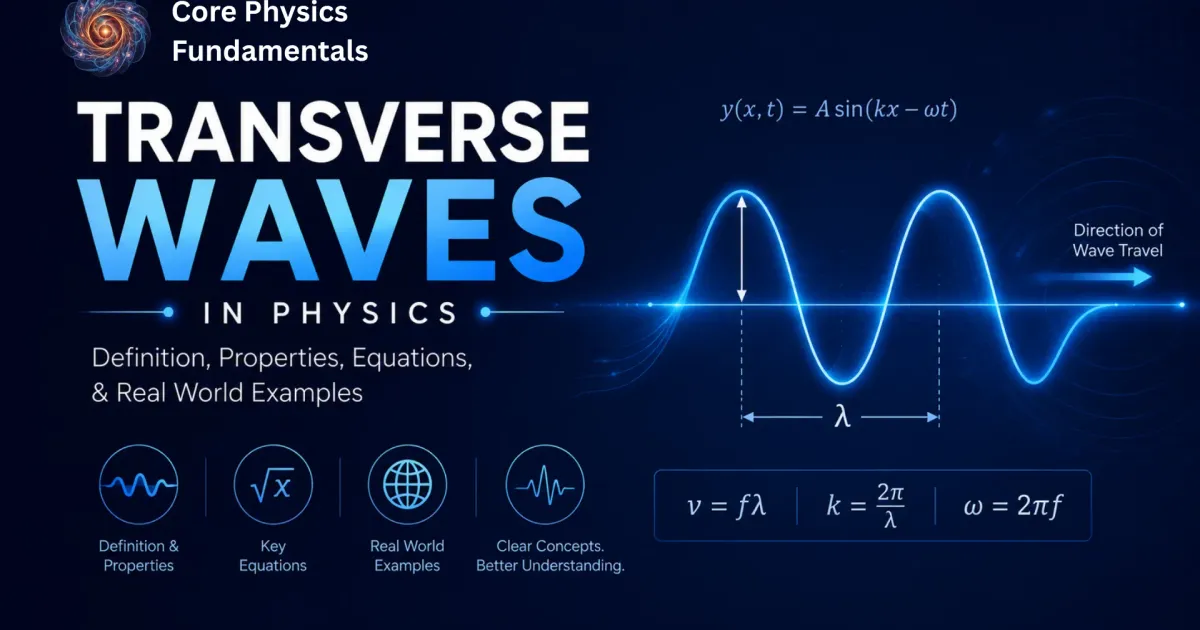
Diagram Note: Draw a smooth S-shaped curve (a sine wave) running horizontally across the page. Draw a horizontal dashed line through the middle (the equilibrium line). Label the highest point “Crest,” the lowest point “Trough,” a vertical arrow from the equilibrium line to the crest “Amplitude (A),” and a horizontal arrow from one crest to the next “Wavelength (λ).” Add a rightward arrow below for “Propagation direction” and a vertical double arrow for “Oscillation direction.”
Crests and Troughs (Points of Maximum Displacement)
A crest is the highest point on a transverse wave. It is where the medium is displaced the farthest above the equilibrium line — like the peak of a hill.
A trough is the lowest point. It is where the medium is displaced the farthest below the equilibrium line — like the bottom of a valley.
Crests and troughs are the points of maximum displacement. The medium is stretched the most at these points. At the exact top of a crest or bottom of a trough, the particle is momentarily at rest — all its energy is stored as potential energy. In deep ocean waves, the crest-to-trough height (called wave height) can reach over 30 meters during extreme storms.
Equilibrium Line (Rest Position)
The equilibrium line (also called the rest position or undisturbed position) is the horizontal line that represents where the medium would be if no wave were passing through it. It is the “zero” line. When the wave passes, particles move above and below this line.
The distance from the equilibrium line to a crest (or to a trough) is called the amplitude. When the wave is gone, the medium returns to this rest position.
The 5 Core Properties of Transverse Waves
Every transverse wave — whether it is light traveling at 3 × 10⁸ m/s, a wave on a guitar string, or an earthquake S-wave — is fully described by five measurable quantities. These properties show up in every wave equation and every wave problem.
Amplitude (A): Measuring Wave Energy
Amplitude is the maximum displacement of the medium from the equilibrium line, measured in meters (m). On a wave diagram, amplitude is the vertical distance from the equilibrium line to the top of a crest or the bottom of a trough.
Amplitude tells you how much energy the wave carries. The relationship is Energy ∝ A² — energy is proportional to the square of the amplitude. This means doubling the amplitude increases the energy by 2² = 4 times, tripling the amplitude increases the energy by 3² = 9 times, and halving the amplitude drops the energy to just 1/4 of the original.
This is why a large ocean wave is so much more destructive than a small ripple. A wave that is 3 meters tall carries 9 times more energy than a wave that is 1 meter tall. The height difference is only 3×, but the energy difference is 9×.
Wavelength (λ): Spatial Periodicity
Wavelength (written as the Greek letter lambda, λ) is the distance between two consecutive identical points on a wave — most commonly measured from one crest to the next crest, or one trough to the next trough. It is measured in meters (m).
Wavelength tells you how “stretched out” the wave is in space. A long wavelength means the wave is spread out. A short wavelength means it is compressed. The range of wavelengths in nature is staggering. Visible light has wavelengths from 380 nanometers (violet) to 700 nanometers (red) — a nanometer is one-billionth of a meter.
FM radio waves are about 2.8 to 3.4 meters long, roughly the height of a room. AM radio waves stretch from 180 to 560 meters, longer than most buildings. Seismic S-waves from earthquakes can span tens to hundreds of kilometers. Gamma rays, on the other extreme, have wavelengths smaller than 0.01 nanometers — tinier than an atom.
Diagram Note: On your transverse wave diagram, draw a horizontal arrow from one crest to the very next crest and label it “λ (wavelength).”
Frequency (f) and Period (T): Temporal Relationship
Frequency (f) is the number of complete wave cycles that pass a fixed point every second, measured in hertz (Hz) — one hertz means one cycle per second.
Period (T) is the time it takes for one complete wave cycle to pass, measured in seconds (s).
Frequency and period are exact reciprocals of each other. They are connected by the formula: T = 1/f and f = 1/T. If you know one, you always know the other.
To see how wildly frequency varies across different transverse waves, consider these examples. Concert pitch A (the note orchestras tune to) has a frequency of 440 Hz, so its period is 1/440 = 0.00227 seconds per cycle.
A typical ocean wave hitting a beach has a frequency of about 0.1 Hz, meaning one wave arrives roughly every 10 seconds. Visible red light oscillates at approximately 4.3 × 10¹⁴ Hz — that is 430 trillion cycles per second — with a period of just 2.3 × 10⁻¹⁵ seconds, which is unimaginably fast. This is why ultraviolet light (high frequency) causes sunburn, while radio waves (low frequency) pass through your body without harm.
Wave Speed (v): Medium-Dependent Velocity
Wave speed (v) is how fast the wave pattern moves through the medium, measured in meters per second (m/s). The most important fact about wave speed is that it depends on the medium, not on the wave itself. In a given medium, all waves of the same type travel at the same speed, regardless of their frequency or amplitude.
When a wave crosses from one medium into another — for example, light going from air into glass — its speed changes. But its frequency stays the same. The wavelength adjusts to keep the equation v = fλ balanced. This change in speed is what causes refraction, the bending of light when it enters glass or water.
To appreciate how wave speed varies, look at the numbers. Light in a vacuum travels at 299,792,458 m/s (approximately 3 × 10⁸ m/s), which is the fastest speed anything can travel in the universe. Light in glass slows to about 2 × 10⁸ m/s, roughly two-thirds of its vacuum speed. Light in water moves at about 2.25 × 10⁸ m/s. Waves on a guitar string typically travel at 100 to 400 m/s, depending on the string’s tension and thickness.
Phase Difference and Phase Angle
Phase describes where a particle is in its oscillation cycle at any given moment. Two particles on a wave can be “in phase” (doing the same thing at the same time) or “out of phase” (doing different things).
Phase difference is measured in degrees (°) or radians (rad), where a full cycle equals 360° or 2π radians.
When two points are at 0° phase difference (in phase), they are at the same position in their cycle — for example, both at a crest. They are exactly one full wavelength apart. At 180° phase difference (completely out of phase), one point is at a crest while the other is at a trough. They are half a wavelength apart. At 90° (quarter cycle apart), one point is at a crest while the other is crossing through the equilibrium line.
Phase difference matters because it determines what happens when two waves meet. If they are in phase, they add up (constructive interference). If they are 180° out of phase, they cancel out (destructive interference).
This principle is the basis of noise-canceling headphones, which use a microphone to detect ambient sound and then play a wave exactly 180° out of phase to cancel it. High-end models can reduce ambient noise by up to 30 decibels using this technique.
The Universal Wave Equation (v = fλ) & Derivations
The three most important wave quantities — speed, frequency, and wavelength — are connected by one equation:
v = fλ
This is the universal wave equation. It works for every wave — transverse or longitudinal, mechanical or electromagnetic, on a rope or in outer space.
The logic behind it is straightforward. If a wave completes f cycles every second, and each cycle is λ meters long, then the wavefront moves forward f × λ meters every second. That product is the speed.
For example, a wave with a frequency of 500 Hz and a wavelength of 0.68 meters has a speed of v = 500 × 0.68 = 340 m/s — which happens to be close to the speed of sound in air at room temperature.
Rearranging the Formula for Speed, Frequency, and Wavelength
From v = fλ, you can solve for any one quantity if you know the other two:
| You Know | You Want | Use This Formula |
|---|---|---|
| f and λ | v (speed) | v = fλ |
| v and λ | f (frequency) | f = v / λ |
| v and f | λ (wavelength) | λ = v / f |
| f | T (period) | T = 1 / f |
| λ and v | T (period) | T = λ / v |
This single equation, in its various rearrangements, governs everything from sound in a concert hall to light crossing the 4.24 light-years of space between our Sun and the nearest star, Proxima Centauri.
Wave Speed on a Stretched String: Tension (T) and Linear Mass Density (μ)
For a transverse wave on a string or rope, the speed depends on two physical properties of the string:
v = √(T / μ)
Here, T is the tension in the string (in newtons, N) — how tightly the string is pulled — and μ is the linear mass density (in kg/m) — the mass of the string per unit length.
Higher tension means a faster wave. Pull a guitar string tighter (by turning the tuning peg), and the wave travels faster. Since the string length and wavelength stay roughly the same, v = fλ tells you the frequency must go up — the note gets higher.
Higher mass density means a slower wave. A thicker, heavier string vibrates more slowly, producing a lower pitch. That is why the bass strings on a guitar are thicker and heavier than the treble strings — they have higher μ, which gives lower wave speed and lower frequency.
A standard steel guitar high-E string has a linear mass density = 0.000386 kg/m and is typically tuned to a tension of about 72 N.
Plugging into the formula: v = √(72 / 0.000386)
= √(186,528) ≈ 432 m/s.
Combined with a string length of about 0.648 m, this produces a fundamental frequency of about 330 Hz — the note E₄.
Graph Note: A graph here could show wave speed (y-axis) vs. tension (x-axis) for a fixed string. The curve would be a square root shape — speed increases as tension increases, but the increase gradually slows down at higher tensions.
Key Phenomenon: Polarization (Proof That Light Is Transverse)
Polarization is one of the most important concepts in wave physics. It is the strongest proof that light is a transverse wave, and it powers many technologies you use every day.
What is polarization? Polarization is the restriction of a transverse wave’s oscillation to a single plane. Unpolarized light vibrates in all directions perpendicular to its direction of travel — up-down, left-right, diagonal, and everything in between, all at once. A polarizing filter blocks all directions except one. The light that passes through vibrates in only one plane. This is called linearly polarized light.
Why this proves light is transverse: This filtering process is only possible if the wave has oscillation directions perpendicular to its travel. If the wave vibrated along its direction of travel (like a longitudinal wave), there would be no perpendicular component to filter. The fact that light can be polarized is direct experimental proof that it is a transverse wave. This was first demonstrated convincingly in the early 1800s by physicists like Étienne-Louis Malus, who discovered that light reflected off glass at a specific angle becomes polarized.
Diagram Note: Draw unpolarized light (multiple arrows pointing in all perpendicular directions) approaching a vertical polarizing filter. On the other side of the filter, show only vertical arrows (linearly polarized light). Label the filter and the output clearly.
Linear, Circular, and Elliptical Polarization
There are three types of polarization, each with distinct real-world uses.
Linear polarization means the electric field oscillates back and forth in a single straight line. This is what you get when light passes through a standard polarizing filter, like polarized sunglasses. The direction of that line is called the “plane of polarization.”
Circular polarization means the electric field vector rotates in a circle as the wave moves forward. Imagine looking at the wave coming toward you — the electric field traces out a perfect circle. It can rotate clockwise (right circular) or counterclockwise (left circular). 3D movie glasses use this principle — the projector shows one image with right circular polarization for your right eye and another with left circular polarization for your left eye. Each lens of the glasses passes only one type, so each eye sees a slightly different image, and your brain combines them into a 3D picture.
Elliptical polarization is the most general case. The electric field traces out an ellipse (a stretched circle) as the wave moves forward. Linear and circular polarization are actually special cases of elliptical polarization — a circle is an ellipse with equal axes, and a straight line is an ellipse with one axis equal to zero.
Why Longitudinal Waves (Like Sound) Cannot Be Polarized
Sound waves are longitudinal. The air molecules compress and expand along the same direction the sound travels. There is no perpendicular component at all. Since polarization means filtering perpendicular oscillation directions, and longitudinal waves have no perpendicular oscillation, it is physically impossible to polarize sound. You cannot build a “polarizing filter” for sound waves. The physics simply does not allow it.
This difference — transverse waves can be polarized, longitudinal waves cannot — is one of the clearest and most testable distinctions between the two wave types.
Real-World Applications: Polarized Sunglasses, LCD Screens, and Telecommunications
Polarization is not just a textbook concept. It has everyday applications that affect your life directly.
Polarized sunglasses work because light reflecting off flat surfaces like roads, water, and snow becomes partially horizontally polarized. The lenses of polarized sunglasses contain vertical polarizing filters that block this horizontal glare, reducing reflected brightness by up to 50% and dramatically improving contrast. This is why fishermen, drivers, and skiers prefer polarized sunglasses over regular tinted lenses.
LCD screens on phones, laptops, and TVs use two polarizing filters oriented at 90° to each other. Between them sits a layer of liquid crystal. Without any voltage, the liquid crystal rotates the polarization of incoming light by 90°, allowing it to pass through both filters — the pixel appears bright.
When voltage is applied, the crystal stops rotating the light, and the second filter blocks it — the pixel goes dark. By controlling the voltage pixel by pixel, the screen creates images. Every LCD screen you have ever looked at works on this polarization principle.
Fiber optic telecommunications use a technique called polarization-division multiplexing to double data capacity. Two separate data signals are sent through the same optical fiber using two perpendicular polarizations of light. This effectively doubles the bandwidth of the cable without laying new fiber — a major engineering advantage, since laying undersea fiber optic cables can cost $30,000 to $50,000 per kilometer.
Quantum cryptography protocols like BB84 use the polarization states of individual photons to create encryption keys. Any attempt by an eavesdropper to intercept and measure the photons changes their polarization state, which alerts the sender and receiver that the communication has been compromised. This makes the encryption theoretically unbreakable — a direct application of transverse wave physics at the quantum level.
| Application | How Polarization Is Used |
|---|---|
| Polarized sunglasses | Block horizontally polarized glare from roads, water, and snow |
| LCD screens | Two crossed polarizing filters with liquid crystal; voltage controls light passage per pixel |
| 3D cinema | Left and right eye images use different circular polarizations; glasses separate them |
| Photography filters | Remove glare from reflective surfaces; deepen sky color |
| Fiber optic telecom | Two perpendicular polarizations carry two signals in one fiber, doubling capacity |
| Quantum cryptography | Photon polarization states encode unbreakable encryption keys |
Wave Behavior: Interference, Superposition, & Standing Waves
When two or more transverse waves meet in the same medium, they interact. Understanding this interaction is key to explaining many phenomena — from the colors of soap bubbles to how musical instruments produce specific notes.
Principle of Superposition: Constructive vs. Destructive Interference
The principle of superposition states: when two or more waves overlap, the resultant displacement at any point is the sum of the individual displacements at that point. The waves do not bounce off each other or destroy each other. They simply add up, pass through each other, and continue on their way unchanged.
Constructive interference happens when two waves arrive in phase — crest meets crest, trough meets trough. Their displacements add up, and the result is a wave with larger amplitude. When two identical waves meet in phase, the resultant amplitude doubles to 2A, and the energy at that point becomes 4 times either wave alone (since energy ∝ A²).
Destructive interference happens when two waves arrive out of phase — crest meets trough. Their displacements cancel, and the result is a wave with smaller or zero amplitude. When two identical waves meet exactly 180° out of phase, the resultant amplitude is zero — complete cancellation. The energy is not destroyed, however. It is redistributed to areas of constructive interference nearby.
Diagram Note: Draw two identical sine waves. In one panel, show them perfectly aligned (in phase) with a resulting wave of double amplitude — label it “Constructive Interference.” In another panel, show one wave shifted by half a wavelength (crest meeting trough) with a flat line result — label it “Destructive Interference.”
Standing Waves: Nodes, Antinodes, and Harmonics on Strings
When a transverse wave reflects off a fixed boundary (like the end of a guitar string) and overlaps with the incoming wave, something special can happen. Under the right conditions, the overlapping waves create a standing wave — a wave pattern that appears to stand still instead of traveling.
Nodes are points on a standing wave that never move. The displacement is always zero at a node because the two overlapping waves always cancel at these points.
Antinodes are points that oscillate with maximum amplitude because the two waves always add up at these points.
The distance between two consecutive nodes (or two consecutive antinodes) is exactly λ/2 (half a wavelength).
For a string of length L fixed at both ends, standing waves can only form when a whole number of half-wavelengths fits exactly between the ends. This gives a series of special frequencies called harmonics, described by the formula: fₙ = n × v / (2L), where n = 1, 2, 3, and so on.
| Harmonic | n | Antinodes | Frequency |
|---|---|---|---|
| Fundamental (1st harmonic) | 1 | 1 | f₁ = v / 2L |
| 2nd harmonic | 2 | 2 | f₂ = 2f₁ |
| 3rd harmonic | 3 | 3 | f₃ = 3f₁ |
| 4th harmonic | 4 | 4 | f₄ = 4f₁ |
The fundamental frequency (f₁) determines the pitch of the note you hear. The mix of higher harmonics determines the timbre — the tonal quality that makes a guitar sound different from a violin, even when both play the same note at the same pitch.
A standard guitar A-string is 0.648 m long and produces a fundamental frequency of 110 Hz (the note A₂). Its second harmonic is at 220 Hz (A₃), its third at 330 Hz (E₄), and its fourth at 440 Hz (A₄ — concert pitch). These harmonics all sound simultaneously when you pluck the string, which is why a single pluck sounds rich and full rather than like a plain beep.
Diagram Note: Draw a string fixed at both ends. Show the fundamental mode (one antinode in the middle, nodes at both ends). Below it, show the 2nd harmonic (two antinodes, a node in the middle and at both ends). Below that, show the 3rd harmonic (three antinodes, four nodes). Label all nodes (N) and antinodes (AN)
Transverse vs. Longitudinal Waves: Complete Comparison
Understanding the difference between transverse and longitudinal waves is a fundamental skill in physics. These are the two main categories of waves, and they behave differently in almost every way.
Side-by-Side Comparison Table (Direction, Medium, Polarization, Speed)
| Property | Transverse Wave | Longitudinal Wave |
|---|---|---|
| Oscillation direction | Perpendicular (⊥) to wave travel | Parallel (∥) to wave travel |
| Wave features | Crests and troughs | Compressions and rarefactions |
| Can travel in vacuum? | Yes — electromagnetic waves do | No — always needs a medium |
| Can be polarized? | Yes | No |
| Can travel through solids? | Yes | Yes |
| Can travel through liquids? | EM waves: yes. Mechanical: no (bulk) | Yes |
| Can travel through gases? | EM waves: yes. Mechanical: no | Yes |
| Common examples | Light, radio waves, guitar strings, seismic S-waves, water surface ripples | Sound in air, seismic P-waves, ultrasound, spring compressions |
| Typical speed examples | Light: 3 × 10⁸ m/s; S-waves in mantle: ~4,500 m/s | Sound in air: ~343 m/s; P-waves in mantle: ~6,000 m/s |
Diagram Note: A split diagram works well here. On the left, show a transverse wave (rope moving up and down while wave moves horizontally). On the right, show a longitudinal wave (spring coils bunching together and spreading apart in the same direction the wave moves). Label the oscillation and propagation directions for both.
How Seismic Waves Combine Both (S-Waves vs. P-Waves)
Earthquakes are one of the best real-world demonstrations of both wave types happening at the same time from the same source.
When an earthquake strikes, the fault releases energy that travels outward through the Earth as seismic waves.
P-waves (Primary waves) are longitudinal — they compress and expand the rock along the direction of travel. They are called “primary” because they travel faster (about 6,000 to 8,000 m/s in Earth’s mantle) and arrive at seismograph stations first. They can travel through solids, liquids, and gases.
S-waves (Secondary waves) are transverse — they shear the rock, with particles moving perpendicular to the wave’s direction. They are slower (about 3,500 to 5,000 m/s in the mantle) and arrive second. The critical difference is that S-waves cannot travel through liquids because liquids have no shear rigidity.
This is one of the most remarkable achievements in all of geophysics — scientists mapped the entire internal structure of a planet using nothing but wave physics and seismograph recordings at the surface.
Real-World Examples of Transverse Waves
Transverse waves are everywhere in daily life and in advanced science. Here are the most important examples, each with the real numbers that bring the physics to life.
Electromagnetic Waves (Radio, Microwaves, Visible Light, X-Rays)
All electromagnetic (EM) radiation consists of transverse waves. The electric field and the magnetic field oscillate perpendicular to each other and to the direction of travel. EM waves do not need a medium — they travel through space at c = 3 × 10⁸ m/s.
The electromagnetic spectrum covers a staggering range of frequencies and wavelengths, yet every EM wave is the same fundamental type — a transverse oscillation of electric and magnetic fields. They differ only in frequency and wavelength.
| EM Wave Type | Frequency Range | Wavelength Range | Everyday Uses |
|---|---|---|---|
| Radio waves | 3 Hz – 300 MHz | 1 mm – 100,000 km | AM/FM radio, TV broadcasts, MRI scans |
| Microwaves | 300 MHz – 300 GHz | 1 mm – 1 m | Microwave ovens, Wi-Fi (2.4 & 5 GHz), radar, satellites |
| Infrared | 300 GHz – 430 THz | 700 nm – 1 mm | TV remotes, thermal cameras, heat lamps |
| Visible light | 430 THz – 750 THz | 380 nm – 700 nm | Human vision — wavelength determines color |
| Ultraviolet | 750 THz – 30 PHz | 10 nm – 400 nm | Sunburn, sterilization, black lights |
| X-rays | 30 PHz – 30 EHz | 0.01 nm – 10 nm | Medical imaging, airport security scanners |
| Gamma rays | Above 30 EHz | Below 0.01 nm | Cancer radiotherapy, nuclear energy, sterilization |
Visible light is just a tiny sliver of this enormous spectrum. Our eyes can detect only wavelengths between about 380 nm (violet) and 700 nm (red). Everything else — from radio to gamma — is invisible to us.
| Color | Approximate Wavelength | Approximate Frequency |
|---|---|---|
| Red | 620–700 nm | 4.3–4.8 × 10¹⁴ Hz |
| Orange | 590–620 nm | 4.8–5.1 × 10¹⁴ Hz |
| Yellow | 560–590 nm | 5.1–5.4 × 10¹⁴ Hz |
| Green | 490–560 nm | 5.4–6.1 × 10¹⁴ Hz |
| Blue | 450–490 nm | 6.1–6.7 × 10¹⁴ Hz |
| Violet | 380–450 nm | 6.7–7.9 × 10¹⁴ Hz |
When white light enters a glass prism, shorter wavelengths (violet) slow down more than longer wavelengths (red), causing them to refract at different angles and separating the light into the familiar rainbow of colors — a phenomenon called dispersion.
Diagram Note: An electromagnetic wave diagram should show a wave moving to the right, with the electric field oscillating vertically and the magnetic field oscillating horizontally. The propagation arrow points forward in the third direction. Label E-field, B-field, and propagation direction, and mark the 90° angles.
Mechanical Transverse Waves (Guitar Strings, Water Surface Ripples)
Not all transverse waves are electromagnetic. Mechanical transverse waves need a physical medium to travel through.
Guitar strings and stringed instruments produce transverse standing waves when plucked. The string moves up and down while the wave pattern stands still, with nodes at the fixed ends. The vibrating string pushes on the surrounding air, creating sound waves (which are longitudinal) at the same frequency.
A standard guitar A-string vibrates at 440 Hz (the note A₄) when properly tuned. When a guitarist presses the 12th fret, they cut the effective string length exactly in half, which doubles the frequency and produces a note one octave higher. Tighter strings vibrate faster (higher pitch), and thicker strings vibrate slower (lower pitch) — all governed by the formula f₁ = (1/2L) × √(T/μ).
Water surface ripples are the other common mechanical transverse wave example. When you drop a pebble into still water, the surface moves up and down while the wave pattern moves outward horizontally. Each water molecule actually traces a small circular or elliptical path rather than simply going straight up and down.
At the surface, this motion is mostly vertical (transverse). Deeper down, the circles get smaller. At a depth of about half the wavelength, the wave motion is essentially zero — which is why submarines dive deep to avoid surface storms. Typical ocean wind waves have wavelengths of 60 to 150 meters in the open ocean, meaning their energy reaches down to about 30 to 75 meters. Below that, the water is calm.
Geophysics: Secondary Seismic Waves (S-Waves)
Seismic S-waves (Secondary waves or Shear waves) are transverse mechanical waves generated by earthquakes. They travel through solid rock at about 3,500 to 5,000 m/s in Earth’s mantle, making them slower than longitudinal P-waves (6,000 to 8,000 m/s), which is why they arrive second at seismograph stations — the “S” stands for both “secondary” and “shear.”
The most important property of S-waves is that they cannot travel through liquids or gases because fluids do not resist shear forces.
The 2011 magnitude 9.1 Tōhoku earthquake in Japan produced S-waves detected by seismographs around the world — except in the shadow zone on the opposite side of the planet. The S-waves that reached nearby stations had peak frequencies of about 0.1 to 1 Hz and wavelengths of several kilometers, carrying enough energy to cause violent ground shaking hundreds of kilometers from the epicenter.
Step-by-Step Worked Examples & Practice Problems
Working through problems is the best way to master wave physics. Here are three fully solved examples covering the most common types of transverse wave calculations.
Problem 1: Calculating Wave Speed from Wavelength and Frequency
Problem: A transverse wave on a rope has a frequency of 250 Hz and a wavelength of 0.8 m. Find the wave speed.
Solution:
Use the universal wave equation: v = fλ
v = 250 Hz × 0.8 m
v = 200 m/s
The wave pattern moves along the rope at 200 meters per second. Each point on the rope still only moves up and down — the 200 m/s describes how fast the crest pattern travels horizontally.
Problem 2: Determining Wavelength of EM Waves in a Vacuum
Problem: An FM radio station broadcasts at a frequency of 98.6 MHz (98.6 × 10⁶ Hz). All electromagnetic waves travel at c = 3 × 10⁸ m/s in a vacuum. Find the wavelength.
Solution:
Use λ = v / f. For EM waves in a vacuum, v = c.
λ = c / f = (3 × 10⁸ m/s) / (98.6 × 10⁶ Hz)
λ ≈ 3.04 m
Each radio wave from this station is about 3.04 meters long — roughly the height of a room from floor to ceiling. This is why FM radio antennas are typically about 75 cm to 1.5 m long, since the most efficient antenna length is a quarter-wavelength to half-wavelength of the signal.
Problem 3: Calculating String Wave Speed Using Tension and Mass
Problem: A guitar string has a tension of 120 N and a linear mass density of 0.006 kg/m. Find the wave speed on this string, then calculate its fundamental frequency if the string is 0.65 m long.
Solution:
Use the string wave speed formula: v = √(T / μ)
v = √(120 / 0.006) = √(20,000)
v ≈ 141.4 m/s
Now find the fundamental frequency:
f₁ = v / (2L) = 141.4 / (2 × 0.65) = 141.4 / 1.30
f₁ ≈ 108.8 Hz
This is very close to the note A₂ (110 Hz) — a typical bass string on a guitar. The small difference comes from rounding the tension and mass density values.
Conclusion
Transverse waves are one of the most important concepts in all of physics. They are defined by one simple idea: the medium moves perpendicular to the direction the wave travels. From that single definition, a huge range of phenomena follows.
Light is a transverse electromagnetic wave — and because it is transverse, it can be polarized. That polarization makes LCD screens, 3D movies, polarized sunglasses, fiber optic telecommunications, and quantum encryption possible. Guitar strings vibrate as transverse standing waves, producing the harmonics that give every instrument its unique sound. Seismic S-waves are transverse, and their inability to pass through liquids revealed that Earth has a liquid outer core — a discovery made entirely from the surface by analyzing which waves arrived and which did not.
The five core properties — amplitude, wavelength, frequency, period, and wave speed — describe every transverse wave in the universe.
The universal wave equation (v = fλ) connects three of these properties and works for every wave. For waves on a string, v = √(T/μ) shows how tension and mass control the wave speed and, ultimately, the pitch of the note. The energy relationship E ∝ A² explains why doubling a wave’s amplitude quadruples its energy and why tsunamis are so much more destructive than ordinary swells.
Whether you are looking at the light from a distant star that has traveled for years across space, listening to music produced by vibrating strings, using a smartphone that communicates through polarized light in fiber optic cables, or studying for a physics exam — transverse waves are at work. Understanding them is not just a classroom exercise. It is understanding one of the fundamental ways energy moves through the universe.
Frequently Asked Questions About Transverse Waves
1. What is a transverse wave?
A transverse wave is a wave where the medium oscillates perpendicular (at a 90° angle) to the direction the wave travels. Examples include light (which oscillates at frequencies up to 7.9 × 10¹⁴ Hz), waves on guitar strings, water surface ripples, and seismic S-waves that travel through Earth’s mantle at 3,500 to 5,000 m/s.
2. What are some examples of transverse waves in real life?
The most common real-life transverse wave examples are: all electromagnetic radiation (visible light, radio waves, microwaves, X-rays, UV, infrared, gamma rays), vibrations on guitar strings and other stringed instruments, surface ripples on water, seismic S-waves during earthquakes, and the stadium “wave” (La Ola).
3. Is sound a transverse wave?
No. Sound is a longitudinal wave. Air molecules vibrate back and forth in the same direction the sound travels, not perpendicular to it. Sound travels at about 343 m/s in air at 20°C. Because it has no perpendicular oscillation, sound cannot be polarized.
4. What are the main parts of a transverse wave?
The labeled parts of a transverse wave are: the crest (highest point above equilibrium), the trough (lowest point below equilibrium), the amplitude (distance from the equilibrium line to a crest or trough, measured in meters), and the wavelength (distance from one crest to the next, measured in meters).
5. What is the difference between transverse and longitudinal waves?
In a transverse wave, the medium oscillates perpendicular to the wave’s direction of travel, forming crests and troughs. In a longitudinal wave, the medium oscillates parallel to the wave’s travel, forming compressions and rarefactions. Light is transverse. Sound is longitudinal. Seismic S-waves are transverse (about 4,500 m/s in the mantle), while P-waves are longitudinal (about 6,000–8,000 m/s in the mantle).
6. Can transverse waves travel through a vacuum?
Electromagnetic transverse waves — such as light, radio waves, and X-rays — can travel through a vacuum with no medium at all. Sunlight crosses 150 million kilometers of space to reach Earth. Mechanical transverse waves, such as waves on a rope or seismic S-waves, cannot travel through a vacuum.
7. How are transverse waves used in everyday technology?
Transverse waves power most of the technology you use daily. Your phone screen is an LCD that uses polarized light (a transverse wave property) to control every pixel. Wi-Fi signals are transverse electromagnetic waves broadcasting at 2.4 GHz or 5 GHz. Even medical X-rays, which let doctors see broken bones without surgery, are transverse electromagnetic waves with wavelengths as small as 0.01 nanometers.
8. What is the equation for transverse waves?
The main equation is the universal wave equation: v = fλ (wave speed equals frequency times wavelength). This applies to all waves. For transverse waves on a string, wave speed is given by v = √(T/μ), where T is tension in newtons and μ is linear mass density in kg/m. For electromagnetic transverse waves in a vacuum, the equation becomes c = fλ, where c = 3 × 10⁸ m/s. From these formulas, you can also calculate frequency (f = v/λ), wavelength (λ = v/f), and period (T = 1/f).
9. What are transverse electromagnetic waves?
Transverse electromagnetic waves are waves made of oscillating electric and magnetic fields that travel through space without needing any medium. The electric field, magnetic field, and direction of travel are all perpendicular to each other — a three-way right-angle structure predicted by Maxwell’s equations in 1865.
10. How do transverse waves prove that Earth’s outer core is liquid?
Earthquakes produce both P-waves (longitudinal) and S-waves (transverse). S-waves cannot travel through liquids because liquids do not resist shear stress. Seismographs beyond about 104° from an earthquake detect P-waves but not S-waves, creating an “S-wave shadow zone.” This proves a liquid layer — Earth’s outer core of molten iron and nickel, sitting 2,900 to 5,150 km below the surface — blocks all transverse seismic waves.