Introduction
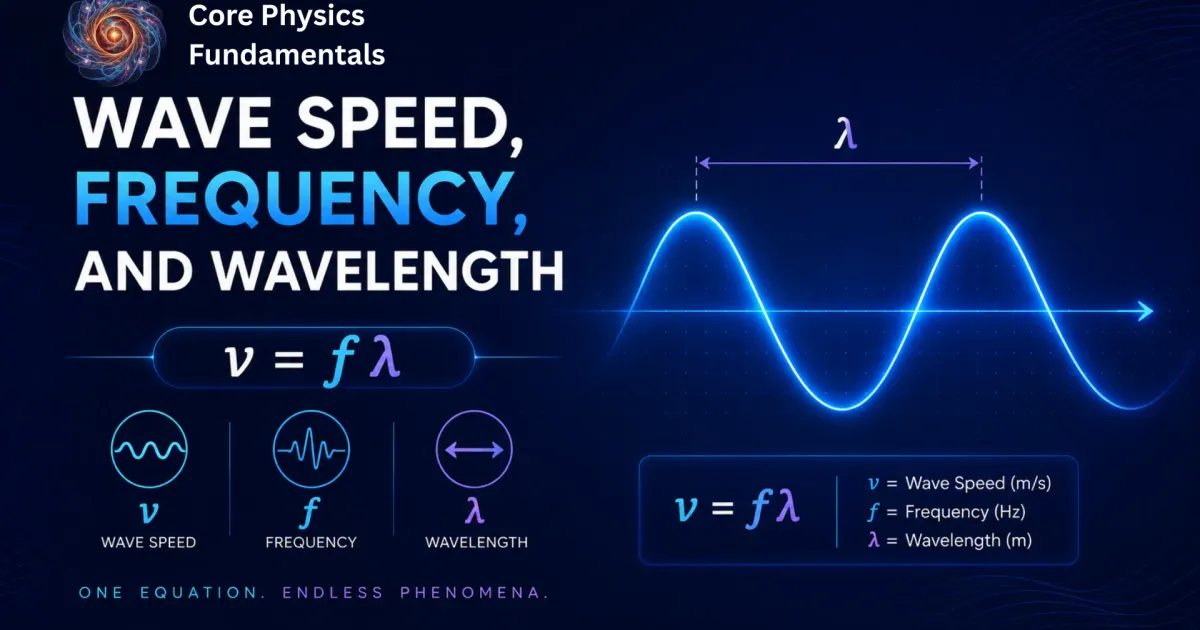
Every wave in the universe follows one simple rule. It connects three things: speed, frequency, and wavelength. This rule is the wave equation: v = fλ.
It works for sound. It works for light. It works for radio signals and ocean waves. If you understand this one formula, you can solve almost any wave problem.
In this guide, we will break it down step by step. We will use simple words, short sentences, and real numbers. Let’s dive in!
What Is the Wave Equation (v = fλ)?
What Does v = fλ Mean?
The wave equation says:
Wave Speed = Frequency × Wavelength
It tells us how fast a wave moves if we know how often it vibrates and how long each wave is. These three values are always connected. Change one, and at least one other must change too.
Understanding Each Variable (v, f, λ)
- v (wave speed) — how fast the wave travels. Measured in meters per second (m/s).
- f (frequency) — how many complete waves pass a point each second. Measured in hertz (Hz).
- λ (wavelength) — the distance from one crest to the next crest. Measured in meters (m). The symbol λ is the Greek letter lambda.
Fact: Light has a speed of about 299,792,458 m/s in a vacuum. That is roughly 300,000 km every single second.
Why the Wave Equation Is Important
This equation is one of the most used formulas in physics. Scientists use it to study electromagnetic waves, sound, earthquakes, and more. Engineers use it to design radios, phones, and fiber optic cables. Doctors use it to build X-ray and MRI machines.
The Wave Equation Formula
Derivation of v = fλ
Think of a wave passing a point. In one second, f waves pass that point. Each wave is λ meters long. So the total distance the wave covers in one second is:
distance = f × λ
Distance per second is speed. So:
v = f × λ
That is the full derivation. It is that simple!
Rearranging the Formula
You can rearrange v = fλ to find any of the three values:
- Speed: v = f × λ
- Frequency: f = v / λ
- Wavelength: λ = v / f
These follow the same algebra rules you use in other equations and formulas like SUVAT equations.
SI Units of Wave Speed, Frequency, and Wavelength
| Variable | SI Unit | Symbol |
|---|---|---|
| Wave speed (v) | Meters per second | m/s |
| Frequency (f) | Hertz | Hz |
| Wavelength (λ) | Meters | m |
Fact: 1 Hz means 1 wave per second. The unit is named after Heinrich Hertz, who proved electromagnetic waves exist in 1887.
Frequency and Period
Relationship Between Frequency and Period
Frequency and period are opposites of each other. Frequency tells you how many waves happen per second. Period tells you how long one wave takes.
Formula: T = 1/f
T = 1 / f
- T is the period in seconds (s).
- f is the frequency in hertz (Hz).
Example: If a wave has a frequency of 50 Hz, the period is T = 1 / 50 = 0.02 seconds. Each wave takes just 0.02 seconds to complete.
Frequency vs. Period
| Frequency (f) | Period (T) | |
|---|---|---|
| Measures | Waves per second | Time for one wave |
| Unit | Hz | Seconds (s) |
| If one is high | The other is low | The other is low |
Fact: Your home electricity supply in most countries runs at 50 Hz or 60 Hz. That means the current changes direction 50 or 60 times every second.
What Determines Wave Speed?
Factors Affecting Wave Speed
What affects wave speed? Two main things:
- The type of medium — solid, liquid, gas, or vacuum.
- The properties of the medium — temperature, density, and elasticity.
The wave itself does not decide its speed. The medium does. A wave cannot choose to go faster. It must follow the rules of the material it travels through.
Effect of the Medium
Waves usually move fastest in solids. They move slowest in gases. This is because particles in a solid are packed tightly. They pass energy to each other quickly.
Fact: Sound travels at about 343 m/s in air. But in steel, sound travels at about 5,960 m/s. That is over 17 times faster!
Mechanical vs. Electromagnetic Waves
- Mechanical waves (sound, water, seismic) need a medium. They cannot travel through space.
- Electromagnetic waves (light, radio, X-rays) do not need a medium. They travel through a vacuum at 299,792,458 m/s.
Transverse waves like light are electromagnetic. Longitudinal waves like sound are mechanical.
Wave Speed in Different Media
Waves in Solids
Waves travel fastest in solids. Particles are close together. Energy passes quickly from one particle to the next.
Fact: Sound moves at about 5,960 m/s in steel and about 3,850 m/s in copper.
Waves in Liquids
Waves move slower in liquids than in solids. Particles are not as tightly packed.
Fact: Sound moves at about 1,480 m/s in water. That is about 4 times faster than in air.
Waves in Gases
Waves travel slowest in gases. Particles are far apart. It takes longer for energy to pass between them.
Fact: Sound moves at about 343 m/s in air at 20°C. If the air is hotter, sound moves a little faster.
Waves in a Vacuum
Only electromagnetic waves can travel in a vacuum. There are no particles at all. These waves move at the speed of light: 299,792,458 m/s.
Fact: Light from the Sun takes about 8 minutes and 20 seconds to reach Earth. The distance is about 150 million kilometers.
Finding Unknown Values Using the Wave Equation
Finding Wave Speed
Problem: A wave has f = 20 Hz and λ = 3 m. Find v.
v = f × λ = 20 × 3 = 60 m/s
Finding Frequency
Problem: A wave has v = 100 m/s and λ = 5 m. Find f.
f = v / λ = 100 / 5 = 20 Hz
Finding Wavelength
Problem: A wave has v = 340 m/s and f = 170 Hz. Find λ.
λ = v / f = 340 / 170 = 2 m
The Electromagnetic Spectrum
All electromagnetic waves travel at the same speed in a vacuum. They differ in frequency and wavelength. Together, they form the electromagnetic spectrum.
Radio Waves
Wavelength: over 1 m. Frequency: up to 300 MHz. Used for radio, TV, and communication. They have the longest wavelengths.
Microwaves
Wavelength: 1 mm to 1 m. Frequency: 300 MHz to 300 GHz. Used in microwave ovens, Wi-Fi, and radar.
Fact: A microwave oven uses waves with a frequency of about 2.45 GHz. That is 2,450,000,000 waves per second!
Infrared Radiation
Wavelength: 700 nm to 1 mm. You feel infrared as heat. Remote controls, thermal cameras, and heaters use infrared.
Visible Light
Wavelength: 400 nm to 700 nm. This is the only part of the spectrum our eyes can see. Red has the longest wavelength (~700 nm). Violet has the shortest (~400 nm).
Ultraviolet Radiation
Wavelength: 10 nm to 400 nm. The Sun gives off UV rays. Too much UV can cause sunburn. UV light also kills germs.
X-Rays
Wavelength: 0.01 nm to 10 nm. Doctors use X-rays to see bones. X-rays pass through soft tissue but not through dense bone.
Fact: Wilhelm Röntgen discovered X-rays in 1895 and won the first-ever Nobel Prize in Physics in 1901.
Gamma Rays
Wavelength: less than 0.01 nm. These have the most energy. They come from radioactive materials and are studied in nuclear physics. They are used to treat cancer.
Properties of Electromagnetic Waves
Common Properties
All electromagnetic waves share these properties:
- They are transverse waves.
- They travel at 299,792,458 m/s in a vacuum.
- They do not need a medium.
- They can be reflected, refracted, and diffracted.
- They carry energy.
The Visible Spectrum
The visible spectrum is a tiny sliver of the full electromagnetic spectrum. It runs from about 400 nm (violet) to 700 nm (red). Remember the order: ROY G. BIV — Red, Orange, Yellow, Green, Blue, Indigo, Violet.
Fact: The human eye can detect about 10 million different colors. But all of them fall within that narrow 400–700 nm range.
Wave Equation and Photon Energy
Light also acts as tiny packets of energy called photons. The energy of a photon is:
E = h × f
Here, h is Planck’s constant (6.63 × 10⁻³⁴ J·s), and f is frequency. Higher frequency means more energy. This is why gamma rays are dangerous, and radio waves are not. This idea connects to quantum physics.
Doppler Effect
What Is the Doppler Effect?
The Doppler Effect is the change in frequency you hear when a source of waves moves toward you or away from you. When it moves toward you, the waves get squeezed. The frequency goes up. When it moves away, the waves get stretched. The frequency goes down.
Real-Life Examples
- Ambulance siren: The pitch sounds higher as it comes toward you and lower as it drives away.
- Race car: A car zooming past makes a “vroom” that drops in pitch as it passes.
Fact: The Doppler Effect works with light too. When a galaxy moves away from Earth, its light shifts to red (redshift). Albert Einstein’s theory of relativity helps explain this.
Applications of the Doppler Effect
- Radar guns — Police use the Doppler Effect to measure car speed.
- Weather radar — Meteorologists track storm movement.
- Medical ultrasound — Doctors measure blood flow speed.
- Astronomy — Scientists measure how fast stars and galaxies move.
Dispersion of Waves
What Is Dispersion?
Dispersion happens when different wavelengths of a wave travel at different speeds in a medium. This causes the wave to spread out into its parts. A prism splitting white light into a rainbow is the most famous example.
Why Wave Speed Changes with Frequency
In some media, wave speed depends on frequency. Short wavelengths (like violet light) slow down more than long wavelengths (like red light) inside glass. This is why violet bends more than red in a prism.
Fact: Isaac Newton first showed in 1666 that white light is made of many colors by using a glass prism.
Wave Energy
Relationship Between Energy and Frequency
Higher frequency means more energy. A gamma ray (frequency ~10²⁰ Hz) carries far more energy than a radio wave (frequency ~10⁶ Hz). The formula is E = h × f.
Fact: A single gamma ray photon can carry over 10 billion times more energy than a single radio wave photon.
Relationship Between Energy and Amplitude
For mechanical waves, bigger amplitude means more energy. If you double the amplitude, the energy goes up by 4 times (2² = 4). This is because energy is proportional to the square of the amplitude. This connects to ideas in simple harmonic motion.
Real-Life Applications
Telecommunications
Radio waves and microwaves carry phone calls, TV, and internet data. Cell towers send signals as electromagnetic waves. Satellites use microwaves to connect people across the globe.
Fact: Over 5.4 billion people use the internet today. All that data travels as electromagnetic waves.
Medical Imaging
X-rays show bones. MRI machines use radio waves and magnets. Ultrasound uses high-frequency sound waves. These tools save millions of lives every year.
Astronomy
Telescopes detect electromagnetic waves from space. Radio telescopes pick up radio waves from distant galaxies. Infrared telescopes see through dust clouds. The Doppler Effect helps scientists measure how fast galaxies are moving.
Fact: The farthest galaxy ever observed is about 13.4 billion light-years away. We see it using electromagnetic waves that traveled for 13.4 billion years.
Radar and SONAR
Radar sends out radio waves and listens for echoes. It is used in aviation, weather tracking, and military defense. SONAR uses sound waves underwater to find objects like submarines and fish.
Fiber Optic Communication
Fiber optic cables carry light signals through glass fibers. They transfer data at nearly the speed of light.
Fact: A single fiber optic cable can carry over 100 terabits of data per second. That equals about 12,500 HD movies downloaded in one second.
Worked Examples
Example 1: Finding Wavelength from Frequency
Problem: An FM radio station broadcasts at 100 MHz. The speed of the wave is 3 × 10⁸ m/s. Find the wavelength.
λ = v / f = (3 × 10⁸) / (100 × 10⁶) = 3 m
Example 2: Finding Frequency from Wavelength
Problem: A wave has a wavelength of 0.5 m and travels at 340 m/s. Find the frequency.
f = v / λ = 340 / 0.5 = 680 Hz
Example 3: Finding Wave Speed
Problem: A wave has f = 50 Hz and λ = 4 m. Find the speed.
v = f × λ = 50 × 4 = 200 m/s
Example 4: Wave on a String
Problem: A string has a tension of 200 N and mass per unit length of 0.05 kg/m. Find the wave speed.
v = √(T / μ) = √(200 / 0.05) = √4000 ≈ 63.2 m/s
Example 5: Doppler Effect Calculation
Problem: A car horn has a frequency of 500 Hz. The car moves toward you at 30 m/s. The speed of sound is 340 m/s. What frequency do you hear?
f’ = f × v / (v − vₛ) = 500 × 340 / (340 − 30) = 500 × 340 / 310 ≈ 548 Hz
The pitch sounds higher because the car is moving toward you.
Example 6: Wavelength of an FM Radio Wave
Problem: An FM radio wave has a frequency of 92.5 MHz. Find its wavelength.
λ = v / f = (3 × 10⁸) / (92.5 × 10⁶) ≈ 3.24 m
Common Mistakes When Using v = fλ
Confusing Frequency and Wave Speed
Frequency is how often a wave vibrates. Wave speed is how fast it moves through a medium. They are not the same thing. What is wave speed measured in? It is measured in meters per second (m/s). Frequency is measured in hertz (Hz).
Using Incorrect Units
Always use SI units. Speed must be in m/s. Frequency must be in Hz. Wavelength must be in meters. Mixing units like km/h or cm will give wrong answers.
Forgetting to Convert Units
MHz means megahertz — that is millions of Hz. You must convert: 100 MHz = 100 × 10⁶ Hz. Nanometers must become meters: 500 nm = 500 × 10⁻⁹ m. Always convert before you plug numbers into the formula.
Conclusion
The wave equation v = fλ is one of the most powerful tools in physics. It connects wave speed, frequency, and wavelength in one simple formula. It works for every wave — from sound in air to light crossing the universe.
We learned that wave speed depends on the medium. Sound travels at 343 m/s in air but 5,960 m/s in steel. Electromagnetic waves travel at 299,792,458 m/s in a vacuum. We explored the electromagnetic spectrum from radio waves to gamma rays. We covered the Doppler Effect, dispersion, and wave energy.
This equation connects to many other topics in physics like forces, Newton’s laws, transverse waves, longitudinal waves, and simple harmonic motion. Master v = fλ, and you have a key that unlocks wave physics.
Frequently Asked Questions (FAQs)
1. What does v = fλ stand for?
v is wave speed (m/s), f is frequency (Hz), and λ is wavelength (m). Together they mean: speed equals frequency times wavelength.
2. What is wave speed measured in?
Wave speed is measured in meters per second (m/s) in the SI system.
3. What affects wave speed?
The medium affects wave speed. Waves move faster in solids than in gases. Temperature and density also play a role.
4. Does changing frequency change wave speed?
No. In a given medium, the wave speed stays the same. If frequency goes up, wavelength goes down to keep v = fλ balanced.
5. What is the speed of electromagnetic waves in a vacuum?
All electromagnetic waves travel at 299,792,458 m/s in a vacuum. This is the speed of light.
6. What is the difference between frequency and period?
Frequency is how many waves pass per second (Hz). Period is the time for one wave (seconds). They are inverses: T = 1/f.
7. Can sound travel through a vacuum?
No. Sound is a mechanical wave. It needs a medium like air, water, or a solid. There is no sound in space.
8. What is the Doppler Effect?
It is the change in frequency when a wave source moves toward or away from you. Moving toward you raises the pitch. Moving away lowers it.
9. Why do gamma rays have more energy than radio waves?
Gamma rays have much higher frequencies. Energy depends on frequency (E = h × f). Higher frequency means more energy.
10. What is dispersion?
Dispersion is when different wavelengths travel at different speeds in a medium. It causes white light to split into a rainbow through a prism.