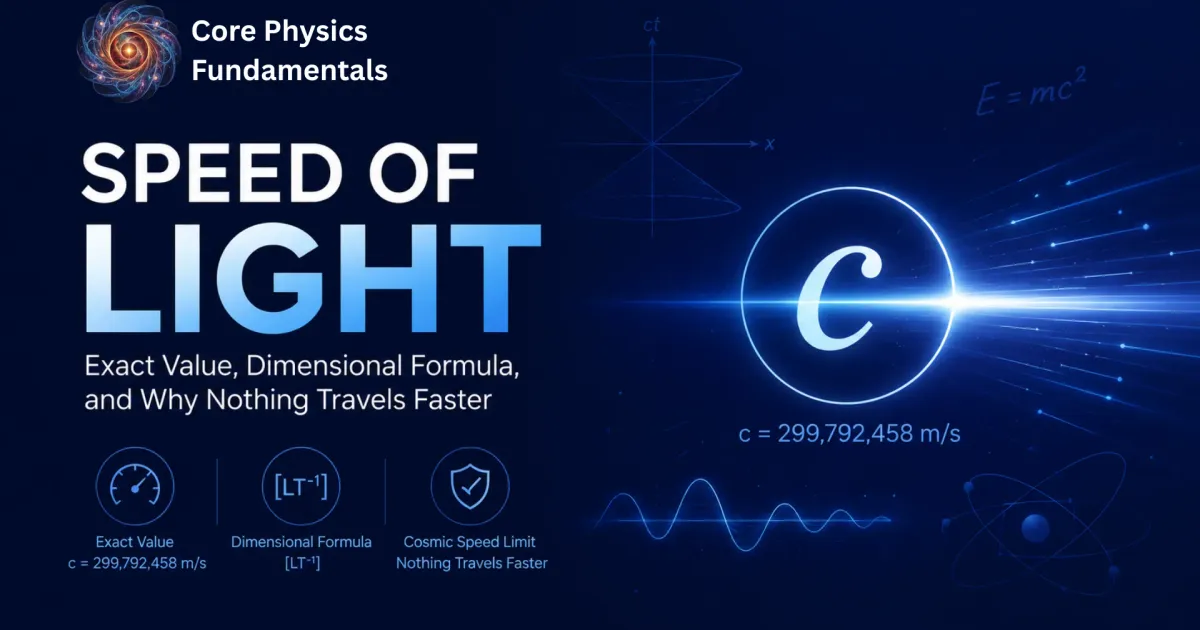
Speed of Light: Exact Value, Dimensional Formula, and Why Nothing Travels Faster
The speed of light in a vacuum is exactly 299,792,458 metres per second. Not approximately — exactly. Since 1983, this number has been locked into the foundations of the metric system itself: one metre is now defined as the distance light covers in precisely 1/299,792,458 of a second.
In practical terms, that works out to roughly 1.08 billion kilometres per hour, or about 670.6 million miles per hour. Light crosses the distance between the Earth and the Moon in around 1.28 seconds, reaches us from the Sun in about 8 minutes and 20 seconds, and travels from Proxima Centauri, the nearest star beyond our solar system, in 4.24 years.
But what makes this constant genuinely remarkable is not its magnitude. It is its universality. Every observer in the universe, regardless of how fast they are moving, measures the same value for c. A spaceship racing toward a laser beam at 90% of light speed does not measure the beam arriving at 1.9c; it still measures exactly c.
This experimental fact, first demonstrated by the Michelson–Morley experiment in 1887 and later embedded into Einstein’s theory of special relativity, forced physicists to abandon the idea that space and time are fixed and absolute. Instead, it is the speed of light that is absolute, and space and time reshape themselves around it.
This article covers the exact value of c in every commonly used unit, its dimensional formula, how light behaves in different materials, the full history of its measurement from the seventeenth century to modern laser techniques, why nothing with mass can reach it, and how c shapes technologies you use every day, from GPS navigation to fibre-optic internet.
What Is the Speed of Light?
Speed of Light (c)
The speed of light, universally denoted by the lowercase letter c (from the Latin word celeritas, meaning “swiftness”), is a fundamental constant of nature. It represents the maximum speed at which energy, matter, or any signal carrying information can travel through the universe.
Critically, c is not merely the speed at which visible light travels. It is the speed of all electromagnetic radiation in a vacuum — radio waves, microwaves, infrared, visible light, ultraviolet, X-rays, and gamma rays all propagate at the same speed. Gravitational waves, too, travel at c, a prediction of general relativity that was spectacularly confirmed in 2017 when the LIGO and Virgo observatories detected a gravitational wave signal from two merging neutron stars (event GW170817). The gravitational wave and an accompanying gamma-ray burst, detected by NASA’s Fermi Gamma-ray Space Telescope, arrived within 1.7 seconds of each other after travelling approximately 1.3 billion light-years. That simultaneity confirmed that the speed of gravitational waves matches the speed of light to better than one part in 10¹⁵ — one of the most precise verifications of general relativity ever achieved, as documented by Abbott et al. in Physical Review Letters.
Within Maxwell’s theory of electromagnetism, c emerges naturally from two properties of space:
c = 1 / √(ε₀μ₀)Speed of light from electromagnetic constantsHere, ε₀ (the electric permittivity of free space) equals 8.854 × 10⁻¹² farads per metre, and μ₀ (the magnetic permeability of free space) equals 4π × 10⁻⁷ henries per metre. When James Clerk Maxwell calculated this expression in 1865, the result matched the experimentally measured speed of light so precisely that he concluded light itself must be an electromagnetic wave. That inference — connecting optics, electricity, and magnetism into a single framework — ranks among the greatest unifications in the history of physics.
A Brief History of Light: From Ancient Debate to Quantum Theory
For over two thousand years, the nature of light was a matter of philosophical debate — from the ancient Greek emission theories of Empedocles (~450 BC) to Ibn al-Haytham’s experimental proof around 1011 AD that light enters the eye rather than leaving it. The seventeenth-century clash between Newton’s corpuscular theory and Huygens’ wave model was settled by Thomas Young’s double-slit experiment (~1801) and Maxwell’s 1865 revelation that light is an electromagnetic wave travelling at exactly c.
The twentieth century then rewrote the picture entirely: Planck’s quantisation of energy (1900), Einstein’s photon theory (1905), and Compton’s X-ray scattering experiments (1923) proved that light also behaves as discrete particles — a wave–particle duality formalised by quantum mechanics and since harnessed in technologies from lasers (1960) to gravitational-wave detectors and quantum entanglement experiments (Aspect, Nobel Prize 2022).
Speed of Light in m/s
The speed of light in a vacuum is exactly c = 299,792,458 m/s.
This is not a measured approximation subject to future refinement. It is an exact, defined value. The 17th General Conference on Weights and Measures (CGPM) fixed this value in 1983. It simultaneously redefined the metre: one metre is the length of the path travelled by light in vacuum during a time interval of 1/299,792,458 of a second. In effect, measuring c with greater precision became meaningless; if you improved your measurement of how far light travels in a given time, you would simply be refining your definition of the metre, not changing the value of c.
c = 2.99792458 × 10⁸ m/sSpeed of light in scientific notationFor most physics problems at school, undergraduate, or even many research-level calculations, the approximation c ≈ 3 × 10⁸ m/s is perfectly adequate. This rounded figure introduces an error of only 0.07%, which is negligible in the vast majority of contexts. However, problems requiring four or more significant figures — or any scenario involving precise timing, such as satellite navigation or interferometry — demand the full value.
Speed of Light in km/h
Converting from metres per second to kilometres per hour involves multiplying by 3,600 (the number of seconds in an hour) and dividing by 1,000 (the number of metres in a kilometre):
c = 299,792,458 m/s × 3,600 / 1,000 = 1,079,252,848.8 km/hSpeed of light in kilometres per hourThat is roughly 1.08 billion kilometres per hour. The number is so large that it defies everyday intuition, so comparisons help give it scale:
- Earth’s circumference at the equator is approximately 40,075 km. Light could circle the planet about 26,940 times in a single hour, or roughly 7.5 times every second.
- A commercial jet flying at around 900 km/h would need more than 137 years of nonstop flight to cover the distance light covers in a single hour.
- The International Space Station orbits Earth at about 27,600 km/h — roughly 39,000 times slower than light.
This conversion is particularly relevant for anyone comparing cosmic speeds with familiar terrestrial velocities. When astronomers say that the Voyager 1 spacecraft, the most distant human-made object in the universe, travels at about 61,000 km/h, it becomes immediately clear why interstellar travel at current speeds is impractical: at that rate, reaching Proxima Centauri (4.24 light-years away) would take roughly 73,000 years.
Speed of Light in km/s, mph, and Miles per Second
The speed of light can be expressed in several other standard units. Each conversion follows straightforwardly from the exact value of 299,792,458 m/s:
| Unit | Value | Commonly Rounded To |
|---|---|---|
| Metres per second (m/s) | 299,792,458 (exact) | 3 × 10⁸ m/s |
| Kilometres per second (km/s) | 299,792.458 | ~300,000 km/s |
| Kilometres per hour (km/h) | 1,079,252,848.8 | ~1.08 billion km/h |
| Miles per second (mi/s) | 186,282.4 | ~186,000 mi/s |
| Miles per hour (mph) | 670,616,629 | ~670.6 million mph |
| Astronomical units per day (AU/day) | 173.1 | ~173 AU/day |
| Parsecs per year (pc/yr) | 0.3066 | ~0.307 pc/yr |
The miles-per-second figure of approximately 186,000 is the one most frequently cited in older English-language textbooks and popular science writing, particularly in the United States. The conversion from the exact SI value is: 299,792,458 ÷ 1,609.344 (metres per mile) = 186,282.397 miles per second, then multiplied by 3,600 for the hourly rate.
For astronomical contexts, the “173 AU per day” figure is a useful intuitive anchor. One astronomical unit (AU) is the mean Earth–Sun distance — about 149.6 million km. Light covers this distance in approximately 499 seconds, or 8 minutes and 19 seconds. Over the course of a full day, light therefore travels about 173 times that distance.
Dimensional Formula of the Speed of Light
The dimensional formula of the speed of light is [M⁰ L¹ T⁻¹].
This follows directly from the definition of speed as distance divided by time. The dimension of distance (length) is L, and the dimension of time is T. Since speed equals length per unit time, its dimensional formula is L/T, or equivalently [L¹ T⁻¹]. There is no dependence on mass, so the mass exponent M is zero. Written in the standard dimensional notation used across physics curricula:
[M⁰ L¹ T⁻¹]Dimensional formula of the speed of lightThis formula applies not just to the speed of light but to all forms of speed and velocity. The distinction between speed and velocity is directional — velocity is a vector quantity that includes direction, while speed is its scalar magnitude — but both share the same dimensional formula because direction is not captured by dimensional analysis.
You can also derive this formula through the wave equation. The speed of any wave, including light, is related to its wavelength (λ) and frequency (f) by:
c = λ × fWave equationThe dimensional formula of wavelength is [M⁰ L¹ T⁰] (it is simply a length), and the dimensional formula of frequency is [M⁰ L⁰ T⁻¹] (it is the inverse of time — cycles per second). Multiplying these:
[M⁰ L¹ T⁰] × [M⁰ L⁰ T⁻¹] = [M⁰ L¹ T⁻¹]Dimensional consistency of the wave equationThis confirms the dimensional consistency of the wave equation and verifies that the speed of light has the dimensions of length per time, as expected. In the SI system, the unit corresponding to this dimensional formula is the metre per second (m·s⁻¹).
Dimensional analysis is especially useful for verifying that physics equations involving c are self-consistent. For instance, in E = mc², the left side has dimensions of energy: [M¹ L² T⁻²]. The right side is mass times velocity squared: [M¹] × [L¹ T⁻¹]² = [M¹ L² T⁻²]. Both sides match, confirming the equation’s dimensional validity.
The Electromagnetic Spectrum: What c = λf Reveals
The equation c = λf does more than confirm dimensional consistency — it maps out the entire electromagnetic spectrum. Because c is fixed, wavelength and frequency are inversely proportional: a longer wavelength means a lower frequency, and vice versa. Every form of electromagnetic radiation, from the longest radio waves to the most energetic gamma rays, travels at the same speed in vacuum; what distinguishes them is where they sit on the wavelength–frequency spectrum.
| Band | Wavelength Range | Frequency Range | Everyday Example |
|---|---|---|---|
| Radio waves | > 1 mm (up to km) | < 300 GHz | FM radio, Wi-Fi, TV broadcasts |
| Microwaves | 1 mm – 1 m | 300 MHz – 300 GHz | Microwave ovens, 5G, radar |
| Infrared (IR) | 700 nm – 1 mm | 300 GHz – 430 THz | TV remotes, thermal cameras, body heat |
| Visible light | 380–750 nm | 400–790 THz | Human vision, photography |
| Ultraviolet (UV) | 10 nm – 380 nm | 790 THz – 30 PHz | Sunburn, black lights, sterilisation |
| X-rays | 0.01 nm – 10 nm | 30 PHz – 30 EHz | Medical imaging, airport scanners |
| Gamma rays | < 0.01 nm | > 30 EHz | Nuclear decay, cancer radiotherapy |
Visible light — the narrow band human eyes can detect — occupies only a tiny slice of this spectrum, roughly 380 nm (violet) to 750 nm (red), corresponding to frequencies between about 400 and 790 terahertz. This range is not arbitrary: the Sun’s peak emission, governed by its surface temperature of roughly 5,800 K, falls near 500 nm, and evolution tuned human vision to match the wavelengths our star emits most abundantly.
The equation c = λf also explains why higher-frequency radiation is more dangerous — a gamma-ray photon carries roughly a million times more energy than a visible-light photon, enough to ionise atoms and damage DNA, while radio-wave photons pass through the body with negligible biological effect.
Speed of Light in Different Materials
Light travels at c only in a perfect vacuum. In every material medium — air, water, glass, diamond — it slows down. The ratio of c to the speed of light in a given material is called the refractive index, denoted n:
v = c / nSpeed of light in a material with refractive index nA higher refractive index means slower light and greater bending (refraction) at the boundary between two materials. This is the principle behind lenses, prisms, optical fibres, and the sparkle of gemstones.
| Medium | Refractive Index (n) | Speed (m/s) | Speed (km/s) | Percentage of c |
|---|---|---|---|---|
| Vacuum | 1.0000 | 299,792,458 | 299,792 | 100% |
| Air (at STP) | 1.0003 | 299,702,547 | 299,703 | 99.97% |
| Water | 1.333 | 224,901,311 | 224,901 | 75.0% |
| Crown glass | 1.523 | 196,843,373 | 196,843 | 65.7% |
| Flint glass | 1.620 | 185,056,455 | 185,056 | 61.7% |
| Diamond | 2.417 | 124,034,845 | 124,035 | 41.4% |
Several things are worth noting about this table.
First, the speed of light in air is so close to c that for most purposes air and vacuum are interchangeable. The difference — roughly 90 km/s — matters only in extremely precise measurements, such as those involving interferometry or the calibration of optical instruments.
Second, light in diamond travels at only about 41% of its vacuum speed. This dramatic slowing is directly responsible for a diamond’s brilliance. When light enters a diamond, the steep change in speed causes it to bend sharply (refract). Combined with the diamond’s high critical angle for total internal reflection, this traps light inside the gem, bouncing it from facet to facet before it exits in a burst of dispersed colour. A stone with a lower refractive index — say, quartz at n = 1.544 — simply cannot produce the same optical fire.
Third, the apparent “slowing” of light in a medium is not the same as individual photons losing speed. Between atoms, photons always travel at c. What happens at the microscopic level is more nuanced: photons are absorbed by atoms in the material and then re-emitted a fraction of a moment later. This cycle of absorption and re-emission creates a delay at each atomic interaction, and the cumulative effect of billions of such delays across the thickness of the material manifests as a lower effective speed. The underlying photons, in the gaps between atoms, never travel at anything other than c.
Cherenkov Radiation: When Particles Outrun Light in a Medium
An extraordinary consequence of light’s reduced speed in a material medium is Cherenkov radiation. When a charged particle — such as an electron or a beta particle from radioactive decay — travels through a medium faster than the speed of light in that medium (but still slower than c in vacuum), it produces a characteristic cone of blue-white light. This is the optical equivalent of a sonic boom: just as an aircraft exceeding the speed of sound in air creates a shockwave of compressed air, a particle exceeding the local speed of light creates a shockwave of electromagnetic radiation.
The eerie blue glow visible in the water pools surrounding nuclear reactor fuel rods is Cherenkov radiation. High-energy particles emitted by fission products move through the cooling water at speeds exceeding 224,901 km/s (the speed of light in water), generating that distinctive radiance. Cherenkov radiation is also used as a detection tool in particle physics; the IceCube Neutrino Observatory at the South Pole, for instance, detects neutrinos by observing the Cherenkov light produced when neutrino-induced particles travel through Antarctic ice faster than the local light speed.
Importantly, Cherenkov radiation does not violate Einstein’s universal speed limit. The particle in question is always travelling slower than c in vacuum. It is only exceeding the local speed of light within a medium where c is effectively reduced.
How the Speed of Light Was Measured: A History from 1676 to 1983
For most of recorded history, light was assumed to travel instantaneously. Aristotle held this view, and it persisted largely unchallenged for nearly two millennia. The idea that light might have a finite, measurable speed was first seriously proposed by Galileo Galilei in the early seventeenth century.
Galileo attempted to measure it by stationing two people with covered lanterns on hilltops a few miles apart, uncovering the lanterns in sequence and timing the delay. The experiment was a conceptual success but a practical failure; light is far too fast for human reaction times to detect any lag over such short distances. It would take astronomical observations, not hilltop lanterns, to crack the problem.
Rømer (1676) — The First Measurement: ~214,000 km/s
The Danish astronomer Ole Rømer made the first successful measurement of the speed of light in 1676, though he did not initially express it in terrestrial units. Rømer was studying the eclipses of Io, one of Jupiter’s four large moons, from the Royal Observatory in Paris. He noticed a systematic pattern: when Earth was moving towards Jupiter in its orbit, the eclipses of Io occurred slightly earlier than predicted. When Earth was moving away from Jupiter, the eclipses were slightly late.
Rømer realised the discrepancy was caused by the finite time light needed to travel the changing distance between Earth and Jupiter. He predicted, before the French Royal Academy of Sciences in September 1676, that the next eclipse of Io would occur exactly ten minutes later than the tables predicted. On 9 November 1676, the eclipse arrived precisely on his revised schedule, an episode analysed in detail by I. Bernard Cohen in Isis (1940), the journal of the History of Science Society.
His estimate, reconstructed from the known size of Earth’s orbit at the time, works out to roughly 214,000 km/s — about 28% lower than the true value, mainly because the diameter of Earth’s orbit was not yet accurately known. Despite its quantitative imprecision, Rømer’s achievement was conceptual: he proved, for the first time in history, that light travels at a finite speed.
Bradley (1728) — Stellar Aberration: ~301,000 km/s
In 1728, the English astronomer James Bradley discovered a subtle annual wobble in the apparent positions of stars, now called stellar aberration. This wobble is caused by the combination of Earth’s orbital velocity and the finite speed of incoming starlight — analogous to how rain appears to fall at an angle when you run through it.
By measuring the aberration angle and knowing Earth’s orbital speed (~30 km/s), Bradley calculated the speed of light as approximately 301,000 km/s — accurate to within about 1% of the modern value and a dramatic improvement over Rømer’s estimate.
Fizeau (1849) — The First Terrestrial Measurement: ~313,000 km/s
Hippolyte Fizeau achieved the first measurement of the speed of light using entirely Earth-based apparatus, without relying on astronomical observations. His setup was elegantly simple: a beam of light was shone through gaps in a rapidly spinning toothed wheel, reflected off a mirror positioned 8,633 metres away on the hill of Montmartre in Paris, and returned through the next gap in the wheel. By adjusting the wheel’s rotation speed until the returning light was blocked by the adjacent tooth rather than passing through the gap, Fizeau could calculate c from the known distance, the number of teeth, and the rotation rate — a method recounted in detail by the American Physical Society.
His result — approximately 313,000 km/s — was about 4.5% too high, mainly because visually estimating the intensity minimum was difficult. But it proved that the speed of light could be measured in a laboratory, not just inferred from the heavens.
Foucault (1862) — Rotating Mirrors: ~298,000 km/s
Léon Foucault improved on Fizeau’s approach by replacing the toothed wheel with a rotating mirror. His method was more sensitive and yielded a value of approximately 298,000 km/s — within 0.6% of the modern figure. Crucially, Foucault also adapted his apparatus to measure the speed of light in water by inserting a water-filled tube into the light path. He demonstrated conclusively that light travels more slowly in water than in air. This was a decisive blow against Newton’s corpuscular theory of light, which had predicted the opposite. The wave theory of light, which correctly predicted that light would slow in denser media, was vindicated.
Michelson (1879–1926) — Precision Over Mountains: ~299,796 km/s
Albert Abraham Michelson dedicated much of his career to refining the measurement of c. His most famous speed-of-light experiment, conducted in 1926, used a rapidly rotating octagonal mirror to bounce a beam of light across a 35-kilometre baseline between Mount Wilson and Mount San Antonio in Southern California. The measurement yielded 299,796 ± 4 km/s, accurate to within 0.001% of the true value.
Michelson was awarded the 1907 Nobel Prize in Physics, primarily for his optical precision instruments and the spectroscopic and metrological investigations carried out with them. He remains the only person to have won a Nobel Prize primarily for measuring the speed of light.
Laser Methods (1972–1983) — The End of Measurement
From the 1950s onward, increasingly precise technologies — microwave cavities, interferometers, and especially lasers — pushed the uncertainty in c down to fractions of a metre per second. In 1972, a team led by Kenneth Evenson at the US National Bureau of Standards (now NIST) used a methane-stabilised helium-neon laser to measure c as 299,792,457.4 ± 1.1 m/s. By 1976, further laser measurements had narrowed the uncertainty to ±0.2 m/s.
At this point, the measurement had become so precise that the limiting factor was no longer the speed of light itself but the definition of the metre (which was then based on the wavelength of krypton-86 radiation, itself limited in precision). The solution, adopted by the 17th CGPM in 1983, was to fix c at exactly 299,792,458 m/s and redefine the metre accordingly. Since that moment, the speed of light has been a defined constant, not a measured quantity.
| Year | Scientist | Method | Result (km/s) | Error vs Modern |
|---|---|---|---|---|
| 1676 | Ole Rømer | Io eclipses (Jupiter) | ~214,000 | ~28% low |
| 1728 | James Bradley | Stellar aberration | ~301,000 | ~0.4% high |
| 1849 | Hippolyte Fizeau | Toothed wheel (8.6 km) | ~313,000 | ~4.5% high |
| 1862 | Léon Foucault | Rotating mirror | ~298,000 | ~0.6% low |
| 1879 | Albert Michelson | Rotating mirror | ~299,910 | ~0.04% high |
| 1926 | Albert Michelson | Rotating octagonal mirror (35 km) | ~299,796 | ~0.001% high |
| 1950 | Louis Essen | Microwave cavity resonator | ~299,792.5 | ~0.0001% |
| 1972 | Evenson et al. | Laser method | ~299,792.457 | ~0.0000003% |
| 1983 | CGPM (international) | Defined constant | 299,792.458 | Exact |
The progression from Rømer’s 28% error to the exact definition in 1983 spans just over three centuries — a remarkably compact arc for one of the most fundamental constants in physics.
Why the Speed of Light Is Constant for All Observers
The constancy of c is not just an empirical observation. It is the cornerstone of special relativity and the foundation on which much of modern physics is built.
The Michelson–Morley Experiment (1887)
In the late nineteenth century, physicists believed that light, like sound, required a medium to propagate through. This hypothetical medium was called the luminiferous aether. If the aether existed, then Earth’s motion through it should cause the speed of light to vary depending on the direction of measurement — just as a swimmer moves faster with a current than against it.
In 1887, Albert Michelson and Edward Morley designed an extraordinarily sensitive interferometer to detect this variation. They split a beam of light into two perpendicular paths, reflected both beams back, and recombined them, looking for an interference pattern shift caused by any difference in light speed along the two directions.
The result was null. No matter when or in what direction they measured, the speed of light was the same. The experiment has been repeated many times since, with ever-greater sensitivity, and the result has always been the same: no variation in c whatsoever.
Einstein’s Resolution (1905)
Einstein took the null result of the Michelson–Morley experiment not as a puzzle to be explained away, but as a fundamental truth about the universe. In his 1905 paper on special relativity, he elevated the constancy of c to a postulate — a foundational assumption from which everything else follows.
If the speed of light is the same for all observers, then something else must be flexible. Einstein showed that the “something else” is space and time themselves. The consequences are profound and have all been experimentally confirmed:
Time dilation — moving clocks run slower. A clock on a spacecraft travelling at 90% of light speed ticks at only about 43.6% of the rate of a stationary clock (the Lorentz factor γ at 0.9c is approximately 2.294). This effect has been measured directly using atomic clocks on aircraft and is corrected for every day in GPS satellites.
Length contraction — objects moving at high speeds are physically shorter in the direction of motion. At 90% of c, an object’s measured length in the direction of travel is about 43.6% of its rest length.
Relativistic velocity addition — speeds do not add linearly at relativistic velocities. If a rocket travels at 0.9c and fires a projectile forward at 0.9c relative to the rocket, the projectile’s speed as seen from a stationary observer is not 1.8c. Instead, the relativistic addition formula gives:
v_total = (v₁ + v₂) / (1 + v₁v₂/c²)Relativistic velocity additionv_total = (0.9c + 0.9c) / (1 + 0.81) = 1.8c / 1.81 ≈ 0.9945cExample: two speeds of 0.9c combinedNo combination of sub-light speeds, however large, produces a total speed that reaches or exceeds c. The formula mathematically guarantees this.
The Lorentz Transformation Equations
The velocity addition formula above is itself derived from a deeper set of equations, the Lorentz transformations, which describe how measurements of space and time in one inertial reference frame (x, t) relate to measurements in another frame (x’, t’) moving at constant velocity v relative to the first:
x’ = γ(x − vt)Lorentz transformation — spacet’ = γ(t − vx/c²)Lorentz transformation — timewhere the Lorentz factor γ is defined as:
γ = 1 / √(1 − v²/c²)Lorentz factorAt everyday speeds, v is negligibly small compared to c, so v²/c² is essentially zero; γ reduces to 1, and the equations collapse back to the familiar Galilean transformations (x’ = x − vt, t’ = t) where space and time are independent. But as v climbs toward c, γ grows without bound, and the equations reveal that space and time are no longer separate quantities — they mix.
A measurement that is purely spatial in one frame acquires a time component in another, and vice versa. This mathematical intertwining is why physicists speak of a unified four-dimensional spacetime rather than treating space and time as separate entities.
The Lorentz transformations encode every relativistic effect in one compact framework. Time dilation, length contraction, and the relativity of simultaneity — the fact that two events simultaneous in one frame may not be simultaneous in another — all follow directly from these two equations. They are the algebraic spine of special relativity, and every prediction the theory has ever made, from the lifetime extension of fast-moving muons to the relativistic corrections applied in GPS satellites, traces back to them.
Why Massive Objects Cannot Reach c
The relativistic kinetic energy of an object is:
KE = (γ − 1) × mc²Relativistic kinetic energywhere γ = 1 / √(1 − v²/c²) is the Lorentz factor. As v approaches c, γ diverges toward infinity, meaning the kinetic energy required to continue accelerating also approaches infinity. You would need infinite energy to accelerate even a single electron to exactly c. Only massless particles — photons, gluons, and (if they exist) gravitons — travel at c, and they must travel at c; they cannot exist at rest.
This is not merely a theoretical limit. Particle accelerators like CERN’s Large Hadron Collider routinely accelerate protons to 99.9999991% of c. At that speed, each proton has a Lorentz factor of about 7,454 — meaning its relativistic energy is over seven thousand times its rest mass energy. Pushing it even closer to c requires more energy for diminishing returns exponentially. The asymptotic barrier at c is real and absolute.
Speed of Light and E = mc²
Einstein’s mass–energy equivalence, published in a short follow-up paper in 1905, is a direct consequence of special relativity. The equation states that mass and energy are interconvertible, with c² acting as the exchange rate:
E = mc²Mass–energy equivalenceThe factor c² = (299,792,458)² ≈ 8.988 × 10¹⁶ joules per kilogram. This is an extraordinarily large number. One kilogram of mass, if converted entirely to energy, would release approximately 89.88 petajoules — roughly equivalent to the energy output of a large nuclear power plant operating continuously for about three years, or about 21.5 megatons of TNT, comparable to the most powerful nuclear weapon ever tested in the United States (Castle Bravo, 15 megatons).
In practice, complete mass-to-energy conversion does not occur in everyday nuclear processes. Nuclear fission, the splitting of heavy atoms like uranium-235, converts only about 0.1% of the fuel’s mass into energy. Nuclear fusion is the process that powers the Sun; fusing hydrogen into helium, it converts about 0.7% of the input mass into energy.
Yet even these tiny fractions, multiplied by c², yield enormous outputs. The Sun converts approximately 4.26 million tonnes of mass into energy every second, producing 3.846 × 10²⁶ watts, and it has been doing so for 4.6 billion years with sufficient fuel reserves to continue for another 5 billion.
The equation has been experimentally verified to remarkable precision. A 2005 study published in Nature by Simon Rainville and colleagues at MIT compared the mass difference in neutron capture reactions with the energy of the emitted gamma rays and confirmed E = mc² to an accuracy of at least 0.00004%.
Speed of Light in Everyday Technology
The speed of light is not an abstract curiosity confined to physics textbooks. It shapes the design constraints and performance limits of technologies that billions of people rely on daily.
GPS Navigation
The Global Positioning System depends on measuring the time it takes for signals travelling at c to reach a receiver from at least four satellites in orbit. Position accuracy demands timing precision in the nanosecond range, which means relativistic effects cannot be ignored.
GPS satellites orbit at an altitude of approximately 20,200 km and a speed of about 14,000 km/h. Two competing relativistic effects act on their onboard atomic clocks:
- Special relativity causes the satellite clocks to run slower by approximately 7 microseconds per day, because moving clocks tick slower.
- General relativity causes the satellite clocks to run faster by approximately 45 microseconds per day, because clocks in weaker gravitational fields (higher altitude) tick faster.
The net effect is that satellite clocks gain about 38 microseconds per day relative to ground-based clocks. Without correction, this timing error would accumulate into a position error of approximately 38 × 10⁻⁶ seconds × 3 × 10⁸ m/s ≈ 11.4 kilometres per day. GPS would become useless for navigation within hours. Every GPS satellite continuously applies relativistic corrections — a direct, practical consequence of c being constant and finite.
Fibre-Optic Communications
The global internet backbone relies on light pulses travelling through glass optical fibres. Standard single-mode fibre has a refractive index of approximately 1.468, so light travels through it at about c / 1.468 ≈ 2.04 × 10⁸ m/s, or roughly 68% of c.
A fibre-optic cable running undersea from London to New York covers approximately 5,500 km. The one-way propagation time is about 5,500,000 / 204,000,000 ≈ 27 milliseconds, giving a round-trip latency of roughly 54 ms. This latency is a hard physical floor; no amount of engineering can make signals travel faster than light through the fibre.
For high-frequency financial trading, where microseconds translate directly into profit or loss, companies have spent hundreds of millions of dollars to lay slightly shorter, straighter cables between financial centres, shaving off milliseconds that represent the speed-of-light limit through glass.
Computer Processor Design
Within a computer processor, electrical signals propagate through copper traces at approximately 50–70% of c. At a clock frequency of 5 GHz, each clock cycle lasts 0.2 nanoseconds. In that time, an electrical signal can travel at most about 4–6 centimetres.
This is the fundamental reason processor clock speeds plateaued in the mid-2000s and have remained broadly between 3 and 5.5 GHz since: the physical size of the chip places an absolute limit on how fast the clock can cycle while still allowing signals to reach all parts of the circuit. Modern processors gain performance through parallelism (multiple cores, wider pipelines) rather than faster clocks — a design reality dictated by the finite speed of light.
The Light-Year: How Far Light Travels in One Year
A light-year is a unit of distance, not time. It is defined by the International Astronomical Union (IAU) as the distance light travels in one Julian year (exactly 365.25 days):
1 light-year = c × 1 Julian year = 299,792,458 m/s × 31,557,600 s = 9,460,730,472,580,800 mDefinition of one light-yearThat is approximately 9.461 trillion kilometres or 5.879 trillion miles.
The light-year exists because the distances between stars and galaxies are so vast that expressing them in kilometres or miles produces unwieldy numbers. Some representative distances in light-years:
| Object | Distance from Earth |
|---|---|
| The Moon | 1.28 light-seconds |
| The Sun | 8 light-minutes 19 seconds |
| Edge of the solar system (Oort Cloud) | ~1.87 light-years |
| Proxima Centauri (nearest star) | 4.24 light-years |
| Centre of the Milky Way | ~26,000 light-years |
| Andromeda Galaxy (nearest large galaxy) | ~2.5 million light-years |
| Most distant observed galaxy (JADES-GS-z14-0, as of 2024) | ~13.5 billion light-years |
| Diameter of observable universe | ~93 billion light-years |
Because light takes time to reach us, observing distant objects is literally looking into the past. The light arriving from Proxima Centauri left the star 4.24 years ago. Light from the Andromeda Galaxy departed 2.5 million years ago, when early Homo species were beginning to use stone tools. The most distant light we can detect, the cosmic microwave background radiation, was emitted roughly 13.8 billion years ago, about 380,000 years after the Big Bang. In this sense, a telescope is a time machine, and the speed of light determines how deep into cosmic history we can see.
Slow Light: When c Drops to Walking Speed
While the refractive-index table above shows light slowing to 41% of c in diamond, researchers have achieved far more dramatic slowdowns under laboratory conditions.
In 1999, a team led by Lene Vestergaard Hau at Harvard University slowed a pulse of light to just 17 metres per second — about 61 km/h, roughly the speed of a bicycle — by passing it through a Bose–Einstein condensate (BEC) of sodium atoms cooled to within a few billionths of a degree above absolute zero.
In 2001, two independent teams at Harvard and the Harvard-Smithsonian Center for Astrophysics went further, effectively “stopping” light entirely within a rubidium BEC by converting the light pulse into an atomic excitation and then re-emitting it later on command.
It is important to note that in these “stopped light” experiments, the photons themselves are not frozen in place at zero velocity. Rather, the light’s energy and information are stored in the quantum state of the atomic cloud and then released as new photons. During the interval when the light is “stopped,” no photons exist — the information is encoded in atomic spin states. When the light is re-emitted, the new photons travel at c between the atoms, as always.
These experiments are not mere curiosities. They have direct applications in quantum computing and quantum memory, where the ability to store and retrieve photonic quantum states is essential for building quantum networks.
Common Misconceptions About the Speed of Light
“A light-year is a unit of time”
This is perhaps the most widespread confusion. A light-year is a unit of distance — specifically, the distance light travels in one Julian year (about 9.46 trillion km). It is not a duration. When an astronomer says a star is “100 light-years away,” they mean the distance is 100 × 9.46 trillion km. It is also true that the light currently arriving from that star left 100 years ago, so we see the star as it was a century in the past — but the “100 light-years” refers to the spatial separation, not the temporal one.
“Nothing can travel faster than light — ever, period”
This is an oversimplification. Einstein’s actual constraint is more nuanced: no information or causal signal can travel faster than c. Several phenomena appear to exceed c without violating relativity:
Spacetime expansion. Distant galaxies are receding from us at effective speeds exceeding c because the fabric of space itself is expanding. A galaxy at the edge of the observable universe is receding at roughly 3.3 times the speed of light. This does not violate relativity because no object is moving through space faster than c — the space between us is simply accumulating.
Phase velocity. In certain media and wave configurations, the phase velocity of a wave (the speed at which a wave crest moves) can exceed c. However, phase velocity does not carry information; the group velocity (which does carry information) remains at or below c.
Quantum entanglement. When two entangled particles are measured, the outcomes are correlated instantaneously, regardless of separation distance. This “spooky action at a distance,” as Einstein called it, has been experimentally confirmed. However, no usable information can be transmitted through entanglement alone — the outcomes appear random to each observer, and comparing them requires classical communication at or below c.
“Everything travels at c”
Only massless particles travel at c. Everything with mass — electrons, protons, atoms, tennis balls, spacecraft — travels at less than c. Even the drift velocity of electrons in a copper wire is astonishingly slow: typically on the order of millimetres per second. What propagates at close to c in a circuit is the electromagnetic field, not the electrons themselves. The distinction between signal propagation speed and particle drift speed is crucial and frequently misunderstood.
“Light always travels at 300,000 km/s”
Only in a vacuum. As detailed earlier, light slows substantially in materials. In water it drops to about 225,000 km/s, in glass to about 197,000 km/s, and in diamond to about 124,000 km/s. Under extreme laboratory conditions, light has been slowed to 17 m/s and even “stopped” entirely within atomic clouds.
The Speed of Light Compared to Other Speeds
Placing c alongside other velocities in nature and engineering helps convey its scale:
| Speed | Value (km/h) | Fraction of c |
|---|---|---|
| Walking speed | ~5 | 0.0000000046 |
| Cheetah (fastest land animal) | ~112 | 0.000000104 |
| Commercial jet aircraft | ~900 | 0.00000083 |
| Speed of sound in air (Mach 1) | ~1,235 | 0.0000011 |
| Bullet from a high-powered rifle | ~4,000 | 0.0000037 |
| Earth’s orbital speed around the Sun | ~107,000 | 0.0001 |
| International Space Station | ~27,600 | 0.0000256 |
| Parker Solar Probe (fastest spacecraft, 2024) | ~692,000 | 0.00064 |
| Speed of light in vacuum | 1,079,252,849 | 1.0 |
The speed of sound in air (approximately 343 m/s or 1,235 km/h) is roughly 874,030 times slower than the speed of light. This ratio explains why you see lightning before you hear thunder, why you see a distant firework burst before its sound arrives, and why electromagnetic communication is functionally instantaneous at terrestrial scales while acoustic signals are noticeably delayed.
Even the fastest human-made object — NASA’s Parker Solar Probe, which reached a peak speed of about 692,000 km/h in late 2024 during a close approach to the Sun — travels at only 0.064% of c. At that speed, reaching Proxima Centauri would still take about 6,300 years.
Conclusion
The speed of light is far more than a large number in a physics table. It is the structural constant of the universe — the value that ties together space, time, energy, and matter in a single coherent framework. Its exact magnitude, 299,792,458 metres per second, now underpins the very definition of the metre. Its constancy for all observers forced a fundamental rethinking of space and time that produced special and general relativity. Its appearance in E = mc² revealed the enormous energy latent in ordinary mass, unlocking both nuclear power and nuclear weapons. And its finite, fixed speed imposes hard limits on technologies from GPS satellites to computer processors to intercontinental internet cables.
What began with Rømer watching the eclipses of a tiny moon orbiting Jupiter has, over three and a half centuries, grown into one of the most precisely known and deeply consequential quantities in all of science. The speed of light is not just how fast a photon moves. It is the speed limit of causality itself — the pace at which the universe allows cause to produce effect, the boundary that separates the possible from the physically forbidden. Every time you use a GPS-enabled device, send a message across an ocean, or look at a star, you are interacting with the consequences of that boundary.
Understanding c is understanding the architecture of reality.
Frequently Asked Questions
What is the speed of light in m/s?
The speed of light in a vacuum is exactly 299,792,458 m/s. This value was fixed by international agreement in 1983, and the metre is now defined in terms of c. For everyday physics calculations, c ≈ 3 × 10⁸ m/s is accurate to within 0.07%.
What is the speed of light in km/h?
The speed of light is 1,079,252,848.8 km/h, or roughly 1.08 billion km/h. At this speed, light circles the Earth approximately 26,940 times in one hour and crosses the Earth–Moon distance in about 1.28 seconds.
What is the dimensional formula of the speed of light?
The dimensional formula of the speed of light is [M⁰ L¹ T⁻¹], the same as any velocity — length per unit time, with no dependence on mass. It can be derived from the wave equation c = λf, where the dimensions of wavelength [L] and frequency [T⁻¹] multiply to give [L T⁻¹].
Why is the speed of light constant for all observers?
This is an experimental fact established by the Michelson–Morley experiment in 1887 and incorporated as a postulate of Einstein’s special relativity in 1905. Rather than light adjusting to the observer’s motion, space and time adjust — dilating and contracting — so that every observer, regardless of their own velocity, measures c as exactly 299,792,458 m/s.
Does light slow down in water or glass?
Yes. Light travels at c only in a vacuum. In a material with refractive index n, the effective speed is v = c/n. In water (n ≈ 1.33), light travels at about 225,000 km/s, or 75% of c. In diamond (n ≈ 2.42), light travels at about 124,000 km/s, or 41% of c. The slowing is caused by repeated absorption and re-emission by atoms in the medium; between atoms, photons still travel at c.
What is a light-year?
A light-year is the distance light travels in one Julian year (365.25 days): approximately 9.461 × 10¹⁵ metres, or about 9.46 trillion kilometres. It is a unit of distance, not time. Proxima Centauri, the nearest star, is 4.24 light-years away; the Milky Way galaxy is about 100,000 light-years across; and the observable universe has a diameter of approximately 93 billion light-years.
Why can’t anything travel faster than light?
As an object with mass approaches c, its relativistic kinetic energy rises toward infinity, requiring infinite energy to reach c. Only massless particles (photons, gluons) travel at c — and they must do so; they cannot exist at rest. The relativistic velocity addition formula also mathematically prevents any combination of sub-light speeds from producing a total speed at or above c. This has been confirmed experimentally in particle accelerators, where protons are routinely accelerated to 99.9999991% of c but can never reach 100%.
Who first measured the speed of light?
Ole Rømer, a Danish astronomer, made the first successful measurement in 1676 by observing timing discrepancies in the eclipses of Jupiter’s moon Io. His estimate was about 28% too low due to imprecise knowledge of planetary distances, but he demonstrated conclusively that light has a finite speed. The first terrestrial measurement was made by Hippolyte Fizeau in 1849 using a rotating toothed wheel.
The Scientists Behind the Science

Who Made c Absolute
Albert Einstein (1879–1955)
Einstein’s 1905 theory of special relativity elevated the constancy of c to a fundamental postulate, reshaping our understanding of space, time, and energy with E = mc².
Read his full biography →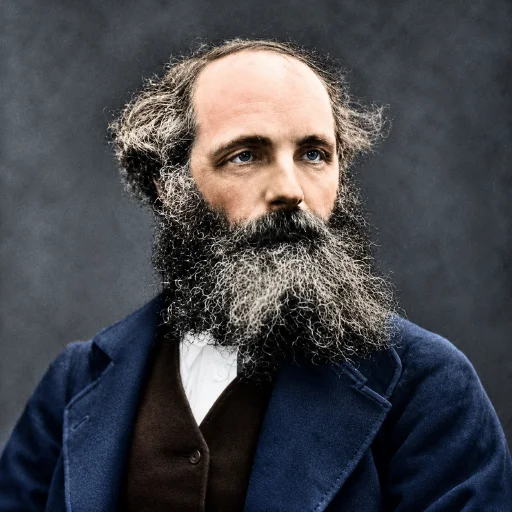
Who Proved Light Is Electromagnetic
James Clerk Maxwell (1831–1879)
Maxwell’s 1865 equations unified electricity, magnetism, and optics, deriving c = 1/√(ε₀μ₀) and proving that light is an electromagnetic wave.
Read his full biography →