
Introduction
Waves are all around us. We hear sound every day. We feel vibrations in the ground. These are all types of waves.
There are two main kinds of waves. One is the transverse wave. The other is the longitudinal wave.
In this article, we will learn all about longitudinal waves. We will look at what they are, how they work, their parts, their speed, and their uses.
By the end, you will understand longitudinal waves clearly and simply.
What Is a Longitudinal Wave?
Definition of a Longitudinal Wave
Longitudinal Wave
A longitudinal wave is a wave where the particles move back and forth in the same direction as the wave travels. The particles do not move up and down — they move left and right, along the path of the wave.
Sound is the most common example. When you clap your hands, air particles push together and pull apart. This creates a longitudinal wave. In fact, about 99% of the sounds we hear every day travel as longitudinal compressional waves through air.
How Longitudinal Waves Work
Think of a slinky toy. If you push one end forward — applying a force as described by Newton’s first law of motion — a pulse moves through the coils. The coils bunch up in some places. They spread out in other places.
This is exactly how a longitudinal wave works:
- Energy moves from one end to the other
- Each coil only moves a small distance back and forth
- It does not travel with the wave
- Only the energy moves forward
Why They Are Called Longitudinal Waves
The word “longitudinal” means “along the length.” In these waves, the particles move along the same line as the wave itself. That is why they have this name.
If a wave moves to the right, the particles also vibrate to the right and left. They move in the same direction as the wave. This is what makes longitudinal and compressional waves different from transverse waves, where particles move at right angles to the wave.
Labeled Diagram of a Longitudinal Wave
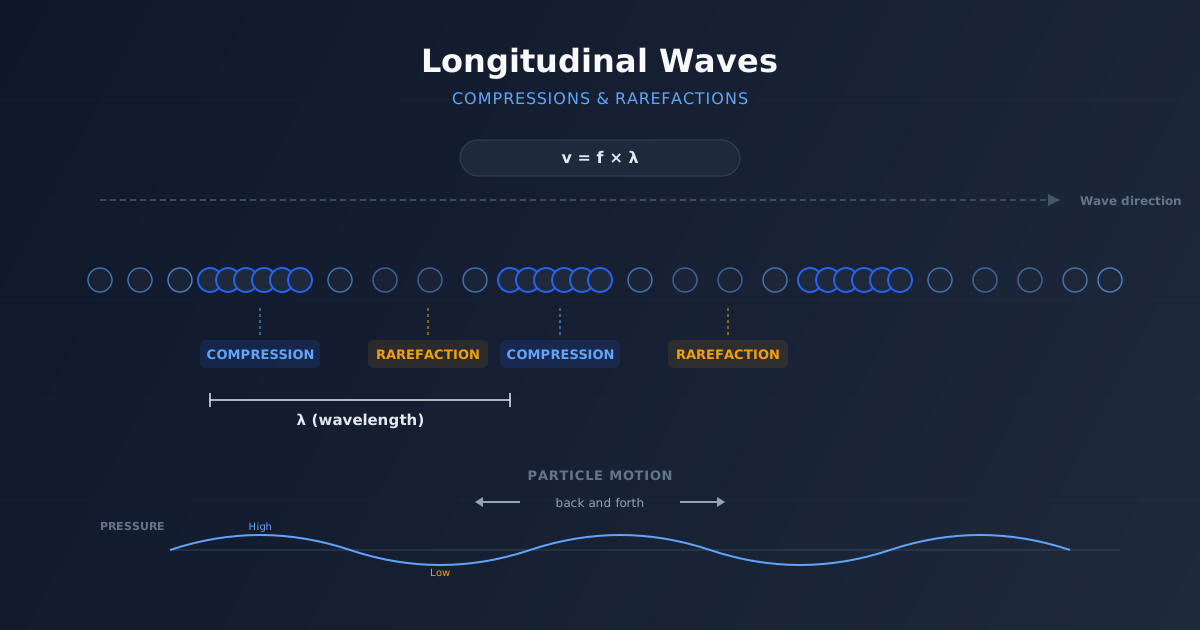
A longitudinal wave diagram helps us see the parts of the wave clearly. In a labeled picture, you can spot two main regions.
Compression
A compression is the part where particles are pushed close together. The particles are packed tightly. The pressure here is high. In a longitudinal wave picture, compressions look like crowded areas.
In sound waves, the air pressure in a compression can be about 0.00002 pascals above normal at the threshold of hearing. Louder sounds create stronger compressions.
Rarefaction
A rarefaction is the opposite. Here, the particles are spread far apart. The pressure is low. In a longitudinal wave labeled diagram, rarefactions look like stretched-out areas.
One full wavelength includes one compression and one rarefaction together.
Direction of Wave Propagation
The wave moves in one direction. This is called the direction of propagation. In a longitudinal wave diagram, an arrow shows this direction. The energy travels this way, from the source outward.
Particle Motion
The particles vibrate back and forth. They move parallel to the wave direction. They do not travel with the wave. They just shake in place. A labeled diagram shows small arrows on the particles going left and right.
Characteristics of Longitudinal Waves
Longitudinal waves have several key features. Let us look at each one.
Particle Motion
Particles in a longitudinal wave move parallel to the wave direction. They vibrate back and forth around a fixed point. This fixed point is called the rest position.
Compressions and Rarefactions
Every longitudinal compressional wave has compressions and rarefactions. Compressions are high-pressure areas. Rarefactions are low-pressure areas. They repeat in a pattern as the wave moves.
Wavelength
The wavelength is the distance between two compressions in a row. Or it is the distance between two rarefactions in a row. It is measured in meters.
For example, a sound with a frequency of 440 Hz (the musical note A) has a wavelength of about 0.78 meters in air at room temperature.
Frequency
Frequency tells us how many waves pass a point in one second. It is measured in Hertz (Hz). A sound of 1000 Hz means 1000 waves pass by every second.
- Humans can hear sounds from about 20 Hz to 20,000 Hz
- Dogs can hear up to about 65,000 Hz
Amplitude
Amplitude is the maximum distance a particle moves from its rest position. A bigger amplitude means a louder sound or a stronger wave. A whisper has a small amplitude. A shout has a large amplitude.
Period
The period is the time for one full wave to pass a point. It is measured in seconds. The period and frequency are related. If the frequency is 500 Hz, the period is 1 ÷ 500 = 0.002 seconds.
Wave Speed
Wave speed tells us how fast the wave moves through a medium. Sound in air at 20°C moves at about 343 meters per second. That is about 1,235 km per hour.
The Wave Equation
Formula (v = fλ)
The wave equation connects speed, frequency, and wavelength:
v = f × λThe Wave EquationWhere:
- v = wave speed (m/s)
- f = frequency (Hz)
- λ (lambda) = wavelength (m)
Rearranging the Formula
You can rearrange this formula to find any value:
- To find frequency: f = v ÷ λ
- To find wavelength: λ = v ÷ f
SI Units
| Quantity | Symbol | SI Unit |
|---|---|---|
| Speed | v | meters per second (m/s) |
| Frequency | f | Hertz (Hz) |
| Wavelength | λ | meters (m) |
Sample Calculation
Problem: A sound wave has a frequency of 250 Hz. Its wavelength is 1.37 meters. What is the speed?
Solution:
v = f × λ
v = 250 × 1.37
v = 342.5 m/s
This is close to the speed of sound in air. That makes sense!
How Energy Travels in Longitudinal Waves
Energy Transfer
A longitudinal wave carries energy from one place to another. The source gives energy to the wave. The wave passes that energy through the medium.
For example, a drum hit sends energy through the air. That energy reaches your ear. You hear the sound. A loud rock concert can produce sound energy of about 1 to 100 watts.
Motion of Particles
The particles in the medium do not travel with the wave. They only vibrate back and forth — each particle has inertia and resists being moved from its rest position. Think of a row of dominoes. Each one pushes the next. But no single domino travels the full distance.
Medium vs Energy Movement
The medium stays in place. Only the energy moves forward. Air does not blow from a speaker to your ear. The air particles just push and pull their neighbors. The energy passes along, like a chain reaction.
Speed of Longitudinal Waves
Factors Affecting Wave Speed
The speed of a longitudinal wave depends on two things:
- Elasticity of the medium — how quickly it bounces back
- Density of the medium — how heavy the particles are
A stiffer material lets waves move faster. A denser material slows them down.
Speed in Different Media
| Medium | Speed of Sound | Comparison |
|---|---|---|
| Steel | ~5,960 m/s | 17× faster than air |
| Water | ~1,480 m/s | 4× faster than air |
| Air (20°C) | ~343 m/s | Baseline |
| Helium | ~1,007 m/s | 3× faster than air |
Why Sound Travels Fastest in Solids
Solid particles are very close together. They can pass vibrations quickly. They are also more elastic — they return to shape fast. So the wave moves through them at high speed.
Remember: Waves move fastest in solids and slowest in gases. Gas particles are far apart, so they take longer to bump into each other.
Measuring the Speed of Sound
Experimental Methods
There are simple ways to measure the speed of sound:
Method 1: Echo Method. Stand about 50 meters from a wall. Clap your hands. Measure the time for the echo to come back. Use the formula: speed = 2 × distance ÷ time.
Method 2: Two Microphones. Place two microphones a known distance apart. Make a sharp sound. A computer records the time difference. Then calculate the speed.
In 1986, scientists measured the speed of sound in dry air at 0°C as exactly 331.3 m/s. This value is used as a standard today.
Factors Affecting Accuracy
Several things can affect your results:
- Temperature — sound moves about 0.6 m/s faster for every 1°C rise in temperature
- Wind — wind can carry sound faster or slow it down
- Human reaction time — using a stopwatch adds error; electronic timers are better
Sound as a Longitudinal Wave
How Sound Is Produced
Sound is made when something vibrates. A guitar string vibrates. A bell shakes. Your vocal cords move back and forth. These vibrations push and pull the air around them. This is what makes a sound wave, which is a longitudinal wave.
A human voice box vibrates at about 85–255 Hz during normal speech.
How Sound Travels
Sound travels as a longitudinal compressional wave through a medium. It needs matter to travel. The vibrating source pushes air particles. Those particles push the next ones. A pattern of compressions and rarefactions moves through the air.
A sound wave is longitudinal because the air particles vibrate in the same direction as the wave moves.
Can Sound Travel in a Vacuum?
No. Sound cannot travel in a vacuum. A vacuum has no particles. With no particles, there is nothing to compress or stretch. That is why there is no sound in outer space.
In 1660, scientist Robert Boyle showed this with a famous experiment. He placed a ringing bell inside a glass jar. When he pumped out the air, the sound disappeared.
Pressure Waves
What Are Pressure Waves?
A pressure wave is a wave where the pressure changes from high to low in a pattern. Longitudinal waves create pressure waves. The compressions have high pressure. The rarefactions have low pressure.
Relationship Between Pressure Waves and Sound
Sound is a pressure wave. When you speak, you create tiny changes in air pressure. These changes move outward from your mouth. Your ear detects these pressure changes. Your brain reads them as sound.
Normal conversation creates pressure changes of about 0.02 pascals. This is very tiny compared to normal air pressure, which is about 101,325 pascals.
Examples of Longitudinal Waves
Here are the most common examples of longitudinal waves in real life.
Sound Waves
Sound is the best-known longitudinal wave. It moves through air, water, and solids. The particles vibrate back and forth. This creates compressions and rarefactions. We hear sound every day, from talking to music to thunder.
Seismic P-Waves
P-waves are longitudinal waves inside the Earth. The “P” stands for “primary.” They are the fastest seismic waves. They arrive first during an earthquake. P-waves can travel at about 5–8 km/s through the Earth’s crust.
Ultrasound
Ultrasound waves have frequencies above 20,000 Hz. Humans cannot hear them. Doctors use ultrasound to see babies inside the womb. The waves bounce off tissues and create an image. Medical ultrasound uses frequencies between 2 and 18 MHz.
Infrasound
Infrasound waves have frequencies below 20 Hz. They are too low for humans to hear. Elephants use infrasound to talk to each other over distances of up to 10 km. Volcanoes and earthquakes also produce infrasound.
Compression Waves in a Spring (Slinky)
A slinky is a great tool to show longitudinal waves. Push one end of the slinky. The coils bunch up and spread out. You can see the compressions and rarefactions clearly. This is why teachers use slinkies to explain longitudinal and compressional waves in science class.
Seismic Waves
Earthquakes produce waves that travel through the Earth. These are called seismic waves. There are two main types.
P-Waves
P-waves are longitudinal waves. The particles move back and forth in the same direction as the wave. P-waves are the fastest seismic waves. They travel about 6 km/s through rock. They can move through solids, liquids, and gases. They arrive first at seismograph stations.
S-Waves
S-waves are transverse waves. The particles move up and down or side to side. S-waves are slower. They travel about 3.5 km/s through rock. They can only move through solids. They cannot pass through liquid. This is how scientists know that the Earth’s outer core is liquid.
Key Differences
| Feature | P-Waves | S-Waves |
|---|---|---|
| Type | Longitudinal | Transverse |
| Speed | ~6 km/s | ~3.5 km/s |
| Arrives | First | Second |
| Travels through | Solids, liquids, gases | Solids only |
Longitudinal vs Transverse Waves
Differences in Particle Motion
- In a longitudinal wave, particles move parallel to the wave direction — they go back and forth
- In a transverse wave, particles move perpendicular to the wave direction — they go up and down
Comparison Table
| Feature | Longitudinal Wave | Transverse Wave |
|---|---|---|
| Particle motion | Parallel (back and forth) | Perpendicular (up and down) |
| Parts | Compressions and rarefactions | Crests and troughs |
| Example | Sound waves | Light waves |
| Medium needed | Yes (usually) | Not always |
| Can be polarized? | No | Yes |
| Speed in air (sound) | 343 m/s | N/A for sound |
Which Waves Can Be Polarized?
Only transverse waves can be polarized. Polarization means the wave vibrates in just one direction. Since longitudinal waves vibrate back and forth along the wave direction, they cannot be polarized.
Key difference: Sunglasses work because they polarize transverse light waves. You cannot polarize sound because it is a longitudinal wave.
Real-Life Applications of Longitudinal Waves
Medical Ultrasound
Doctors use ultrasound to see inside the body. Ultrasound waves bounce off organs and tissues. A computer turns the echoes into a picture. This is safe and painless. Over 25 million ultrasound scans are done each year in the United States alone.
SONAR
SONAR stands for Sound Navigation and Ranging. Ships send sound waves into the water. The waves bounce off the ocean floor or objects. The time for the echo helps find the distance. Submarines use SONAR to detect objects up to 100 km away in deep water.
Earthquake Detection
Seismographs detect P-waves from earthquakes. P-waves are longitudinal waves that travel through the Earth. By measuring how long P-waves take to arrive at different stations, scientists can locate where an earthquake started. There are over 4,000 seismograph stations around the world.
Industrial Testing
Engineers use ultrasound to check for cracks in metal and pipes. This is called non-destructive testing (NDT). The sound waves travel through the material. If there is a crack, the wave bounces back differently. This keeps bridges, planes, and buildings safe.
Underwater Communication
Sound travels well in water. Whales and dolphins use longitudinal sound waves to communicate underwater. Blue whales can send sounds across the ocean over distances of more than 1,600 km. The military also uses low-frequency sound to send messages between submarines.
Solved Examples
Finding Wave Speed
Problem: A longitudinal wave has a frequency of 200 Hz and a wavelength of 1.7 m. Find the wave speed.
Solution:
v = f × λ = 200 × 1.7 = 340 m/s
Finding Frequency
Problem: A sound wave travels at 340 m/s. Its wavelength is 0.85 m. What is the frequency?
Solution:
f = v ÷ λ = 340 ÷ 0.85 = 400 Hz
Finding Wavelength
Problem: A wave has a speed of 1,500 m/s and a frequency of 500 Hz. What is its wavelength?
Solution:
λ = v ÷ f = 1500 ÷ 500 = 3 m
This could be a sound wave in water. Sound in water moves at about 1,480–1,500 m/s.
Speed of Sound Problem
Problem: Thunder is heard 4 seconds after lightning is seen. The speed of sound is 343 m/s. How far away is the lightning?
Solution:
Distance = speed × time = 343 × 4 = 1,372 m (about 1.37 km)
A simple rule: every 3 seconds of delay means the storm is about 1 km away.
Common Mistakes and Misconceptions
Longitudinal vs Transverse Waves
Many students mix up these two types. Remember: longitudinal = parallel motion. Transverse = perpendicular motion. Sound is longitudinal. Light is transverse.
Compression vs Rarefaction
Some students confuse these parts of a longitudinal wave:
- Compression = particles close together (high pressure)
- Rarefaction = particles far apart (low pressure)
Think of it this way: compression = crowd, rarefaction = space.
Particle Motion vs Wave Motion
Common mistake: Thinking that particles travel with the wave. They do not. The particles only vibrate in place. The energy moves forward, not the particles. If air particles traveled with sound, you would feel a strong wind every time someone talked!
Key Takeaways
Key Takeaways
- Definition: A longitudinal wave is a wave where particles move back and forth in the same direction as the wave travels.
- Parts: Every longitudinal wave has compressions (high pressure) and rarefactions (low pressure).
- Wave Equation: v = f × λ connects speed, frequency, and wavelength.
- Speed: Sound travels fastest in solids (~5,960 m/s in steel) and slowest in gases (~343 m/s in air).
- Examples: Sound waves, seismic P-waves, ultrasound, infrasound, and slinky compression waves.
- Applications: Medical ultrasound, SONAR, earthquake detection, industrial testing, and underwater communication.
Conclusion
Longitudinal waves are an important part of science. They are waves where particles move back and forth in the same direction as the wave. Sound is the most common example of a longitudinal wave.
We learned that every longitudinal wave has compressions and rarefactions. The wave equation v = f × λ connects speed, frequency, and wavelength. We also saw that sound travels fastest in solids (about 5,960 m/s in steel) and slowest in gases (about 343 m/s in air).
Examples of longitudinal waves include sound waves, seismic P-waves, ultrasound, and infrasound. These waves have many real-life uses. Doctors use them to see inside the body. Ships use them to find objects in the ocean. Scientists use them to study earthquakes.
Understanding longitudinal waves helps us make sense of the world around us. From the music we enjoy to the earthquakes we study, these waves play a big role in our daily lives.
The Scientists Behind Wave Theory
Pioneer of Wave Theory
Christiaan Huygens (1629–1695)
Huygens proposed the wave theory of light and formulated Huygens’ principle — that every point on a wavefront acts as a source of new wavelets. His work laid the foundation for understanding all wave phenomena, including longitudinal waves.
Full biography coming soonProved Electromagnetic Waves Exist
Heinrich Hertz (1857–1894)
Hertz experimentally confirmed Maxwell’s prediction of electromagnetic waves and demonstrated that waves can be reflected, refracted, and polarized — key properties that distinguish transverse from longitudinal waves.
Full biography coming soonFrequently Asked Questions
What is a longitudinal wave in simple words?
A longitudinal wave is a wave where particles move back and forth in the same direction as the wave travels. Sound is the best example.
What are 5 examples of longitudinal waves?
Five examples of longitudinal waves are: sound waves in air, seismic P-waves in the Earth, ultrasound used by doctors, infrasound from volcanoes, and compression waves in a slinky spring.
Is sound a longitudinal wave?
Yes, sound is a longitudinal wave. When something vibrates, it pushes and pulls the air particles. These particles move back and forth in the same direction as the sound travels.
What is the difference between longitudinal and transverse waves?
In longitudinal waves, particles move parallel to the wave direction (back and forth). In transverse waves, particles move perpendicular to the wave direction (up and down).
Can longitudinal waves travel through a vacuum?
No. Longitudinal waves need a medium (solid, liquid, or gas) to travel. They cannot move through a vacuum. This is why there is no sound in outer space.
What are the parts of a longitudinal wave?
The main parts of a longitudinal wave are compressions and rarefactions. A compression is where particles are close together. A rarefaction is where particles are spread apart.
How fast does sound travel?
Sound travels at about 343 meters per second in air at 20°C. It moves faster in water (about 1,480 m/s) and even faster in steel (about 5,960 m/s).
Why can’t longitudinal waves be polarized?
Longitudinal waves cannot be polarized because the particles vibrate along the same direction as the wave moves.
What are P-waves?
P-waves are primary seismic waves. They are longitudinal waves that travel through the Earth during an earthquake. P-waves are the fastest seismic waves.
What is the wave equation for longitudinal waves?
The wave equation is v = f × λ. Here, v is the wave speed in m/s, f is the frequency in Hz, and λ (lambda) is the wavelength in meters. You can rearrange this formula to find any of the three values.